Did LIV Golf Fail? What I Make of Its Collapse
LIV had Jon Rahm, major champions, and billions behind it. The relaunch is off and the league is preparing to wind down. Here's what I make of its collapse.
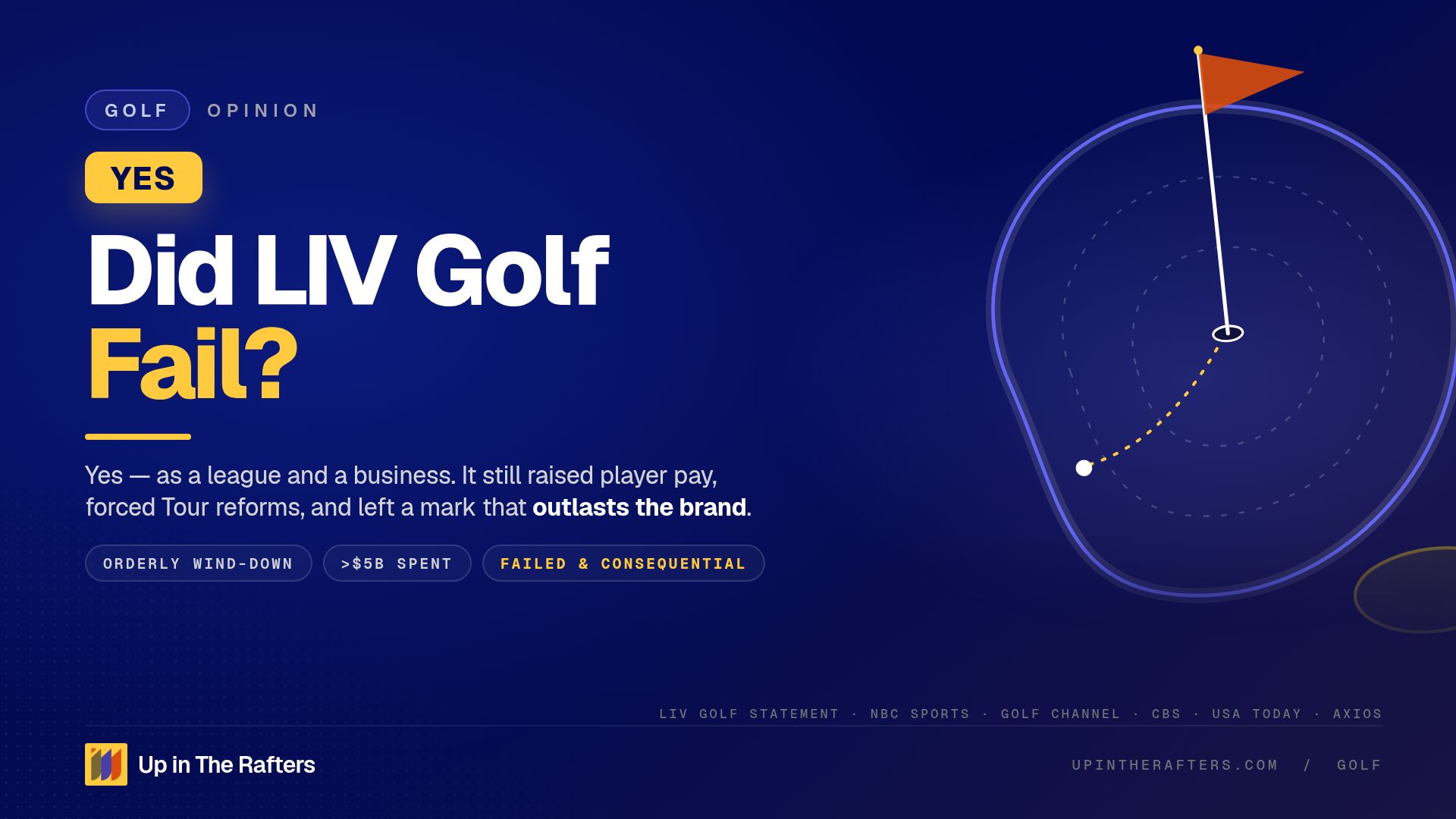
LIV had Jon Rahm, major champions throughout its field, and billions of dollars behind it. That should have given it a chance to become a regular part of watching golf. Instead, its lawyers told a New Jersey bankruptcy court on Nov. 5, 2026, that the proposed relaunch wasn't going ahead. The league is now preparing to wind down.
I think that's a failure. LIV paid to bring some of the best players in the world together, but it couldn't build a league that could last without continuing Saudi funding. The collapse of the BC Partners rescue deal leaves it without the plan that was supposed to keep it playing.
That doesn't mean the PGA Tour can dismiss everything LIV did. Players had another place to go and considerably more leverage because of it. The established tours had to respond on money and how they treated their players. Those changes matter, even if LIV itself hasn't worked out.
How it got here
LIV began playing outside London in June 2022. Rahm joined in December 2023, adding another major champion to a field that already had plenty. The league wasn't short of recognizable names.
The funding situation changed in April 2026, when Saudi Arabia's Public Investment Fund said it would stop supporting LIV at the end of the year. LIV Golf Incorporated and its affiliates filed for Chapter 11 protection in New Jersey on Sept. 8, 2026. A restructuring agreement announced on Oct. 5 offered a way forward through a roughly $300 million deal with BC Partners Credit.
By the Nov. 5 hearing, that deal had fallen apart. NBC Sports and CBS Sports reported that the proposed relaunch hadn't secured the player commitments it needed for 2027.
In its official statement, LIV said the BC Partners agreement had been terminated and that it intended to move to an orderly wind-down. It also said it remained open to alternatives that could preserve value. That isn't the same as a completed liquidation, and the court process is still ongoing.
USA Today and Front Office Sports reported that attorneys intended to file a wind-down plan by Monday, Nov. 9, 2026. That's a planned filing, not one that had already happened. A further hearing reported for Nov. 24, 2026, shouldn't be taken as confirmation that liquidation has been approved either.
Signing good players wasn't enough
The amount spent makes this difficult to excuse as a league that simply needed more time. NBC Sports and Golf Channel put PIF's spending at more than $5 billion since LIV launched. That figure is reported spending, not a measure of debt or an audited loss. But it does show how much financial support LIV had while trying to establish itself.
The players were good enough to attract attention. Getting Rahm to leave was a significant signing, and nobody needed an introduction to the major champions already there. What LIV didn't manage was turning those names into enough regular support from fans and sponsors to keep going without PIF. Golf Channel's Brentley Romine described a league whose initial novelty faded and whose appeal never developed as its backers had hoped.
LIV gave viewers something different with shotgun starts, team competition, shorter events and music. But having a different format doesn't, by itself, give people a reason to keep watching. Whatever someone thought of those changes, LIV still needed its tournaments to become events that enough people cared about regularly. The money spent on the field didn't guarantee that.
The rescue also depended on players wanting to stay. NBC Sports named Rahm, Sergio Garcia, Tyrrell Hatton, Ian Poulter and Louis Oosthuizen among those moving away from LIV 2.0. Brooks Koepka and Patrick Reed had already left. It's hard to see how a reorganized league could persuade people to follow it when so many of its best-known players weren't committing to it.
There were consequences to staying, too. NBC reported that the DP World Tour said players signing with LIV 2.0 wouldn't be allowed to compete on its tour in 2027 and would be ineligible for Ryder Cup captaincy. Those restrictions made the decision more complicated than whether a player liked LIV's format or wanted another contract.
The players did gain something
The strongest argument in LIV's favour is what happened to player pay. The PGA Tour had to compete for golfers it could previously expect to keep. LIV's contracts and purses gave those players a choice, and that changed the negotiations even for players who never left.
I don't think the increased purses and discussion of player equity on the established tours can be separated from that pressure. LIV made it much harder to tell players that the existing arrangement was the best they could expect. Its commercial failure doesn't undo that benefit for them.
The format deserves a more limited assessment. Teams, shorter tournaments and a different atmosphere offered an alternative to the usual tour event. LIV's difficulties don't prove that every one of those ideas was bad, just as trying them doesn't prove they were successful. There's no need to make a judgment on all of them to recognize that the league didn't become financially sustainable.
That's where I disagree with calling LIV a success because it changed golf. It changed the choices available to players and forced a response from the other tours. But the golfers who joined also needed a competition they could continue playing in. The announced wind-down is a failure to provide that, regardless of what they earned along the way.
Returning won't be the same for everyone
For the players, the immediate question is where they can compete next. Leaving LIV doesn't automatically restore their previous tour status.
According to NBC Sports, Koepka returned to the PGA Tour through a one-time Returning Member Program that included a $5 million charitable donation and giving up participation in the Player Equity Program until 2030. Reed didn't meet that program's criteria and was looking toward a 2027 return through the DP World Tour route. PGA Tour CEO Brian Rolapp said the offer wouldn't be repeated.
NBC also reported that Rahm and others would become eligible beginning Aug. 24, 2027, under the one-year suspension measured from their last LIV appearance. They would need to be free of their LIV contracts before engaging with the PGA Tour. Bryson DeChambeau, Cameron Smith and Dustin Johnson hadn't announced clear next steps in the immediate reporting after the hearing. Their individual situations shouldn't be treated as settled.
The next stage of this story will involve those decisions as well as the bankruptcy proceedings. For now, I don't see a reason to soften the assessment of the league just because it made the PGA Tour pay more. LIV couldn't secure its own future. The players' increased bargaining power is the part of its impact that shouldn't be forgotten.
Sources
Sources
Matt's first sports memories are Kobe dropping 81, LaDainian Tomlinson making defenders look silly, and Derek Jeter somehow always coming through in October. He's been hooked ever since.
Think a number is off? Tell us, or check the Corrections page.