Up in The Rafters
How Often Is the Olympics?
The Olympics are held every 4 years — but Summer and Winter alternate so there's one every 2. Full schedule, history, and upcoming host cities explained.
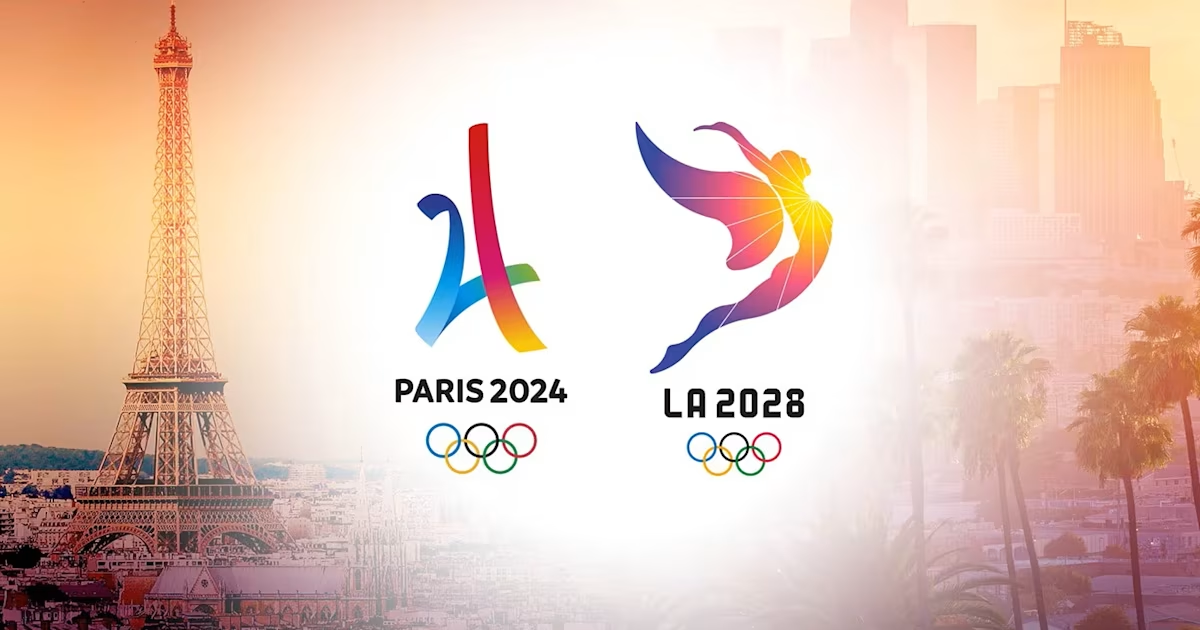
The Olympics are held every four years. But because the Summer and Winter Games alternate on separate cycles, there's actually an Olympic event every two years. Simple as that.
Summer vs. Winter: The Schedule Breakdown
Each Games runs on its own four-year cycle, staggered so they never land in the same year. The Summer Olympics fall in years divisible by four — 2024, 2028, 2032 — while the Winter Olympics land two years after each Summer edition.
Games | Frequency | Recent Example | Next Edition |
Summer Olympics | Every 4 years | Paris 2024 | Los Angeles 2028 |
Winter Olympics | Every 4 years | Milan-Cortina 2026 | French Alps 2030 |
Combined (Summer + Winter) | Every 2 years | — | — |
Why Aren't They Held in the Same Year Anymore?
They used to be. From 1924 to 1992, the Summer and Winter Games were each held in the same year, every four years. The last Summer and Winter Games held in the same year were in Barcelona (Summer) and Albertville (Winter) in 1992.
In 1994, things changed when the Winter and Summer games split and were then held every two years instead. The IOC made the call primarily to ease the financial and logistical strain on host cities, broadcasters, and sponsors — two massive global events in a single calendar year was unsustainable at the scale the modern Games demand.
What Is an "Olympiad"?
An Olympiad is the official four-year window between each set of Games. The Summer Games open each new Olympiad, with the Winter Games arriving in the third year of that same cycle. This is why the Tokyo Games — delayed to 2021 because of COVID-19 — were still officially called the "2020 Olympics." The Olympiad number is preserved regardless of scheduling disruptions.
When Have the Olympics Been Canceled?
Three times in history: 1916 (World War I), and both 1940 and 1944 (World War II). The 2020 Tokyo Games were postponed rather than canceled outright — the first time that had ever happened.
Upcoming Olympics Schedule
Here's the confirmed lineup through 2034, per the International Olympic Committee:
Year | Games | Host City | Dates |
2026 | Winter | Milan & Cortina d'Ampezzo, Italy | Feb 6–22, 2026 |
2028 | Summer | Los Angeles, USA | Jul 14–30, 2028 |
2030 | Winter | French Alps, France | Feb 1–17, 2030 |
2032 | Summer | Brisbane, Australia | Jul 23–Aug 8, 2032 |
2034 | Winter | Salt Lake City, USA | TBD |
The 2026 Winter Games in Italy are worth noting — it's the first time the Games have been officially shared between two host cities, and the NHL is allowing its players to compete for the first time since 2018, making it a must-watch for hockey fans.
How Long Does Each Games Last?
Roughly two to three weeks. Summer Games run slightly longer than Winter Games given the larger number of sports and athletes. The 2024 Paris Summer Games ran 17 days; the 2026 Milan-Cortina Winter Games span 16 days.
A Quick History of Olympic Frequency
The modern Games started in Athens in 1896, and the four-year rhythm has held ever since. Since 1896, there have been 30 Summer Olympic Games and 24 Winter Olympic Games, each marking a celebration of athletic excellence and international cooperation. The Winter Olympics weren't added until 1924 in Chamonix, France — running parallel to the Summer edition but now offset by two years.
The Bottom Line
Summer Olympics: every four years. Winter Olympics: every four years. Together: every two years. It's one of the most predictable schedules in sports — and with LA 2028 on the horizon after the current Milan-Cortina Winter Games, the calendar is packed.
For more sports coverage, browse the rest of Up in the Rafters, and subscribe here for sharp takes delivered straight to you.