Should the NFL Change Playoff Seeding? Yes. Seed All Seven Teams by Record
The 4-5 Panthers lead the NFC South, and the NFL is talking about seeding by record again. I think it should. In the last six seasons, 11 wild cards with better records had to play a playoff game on the road.
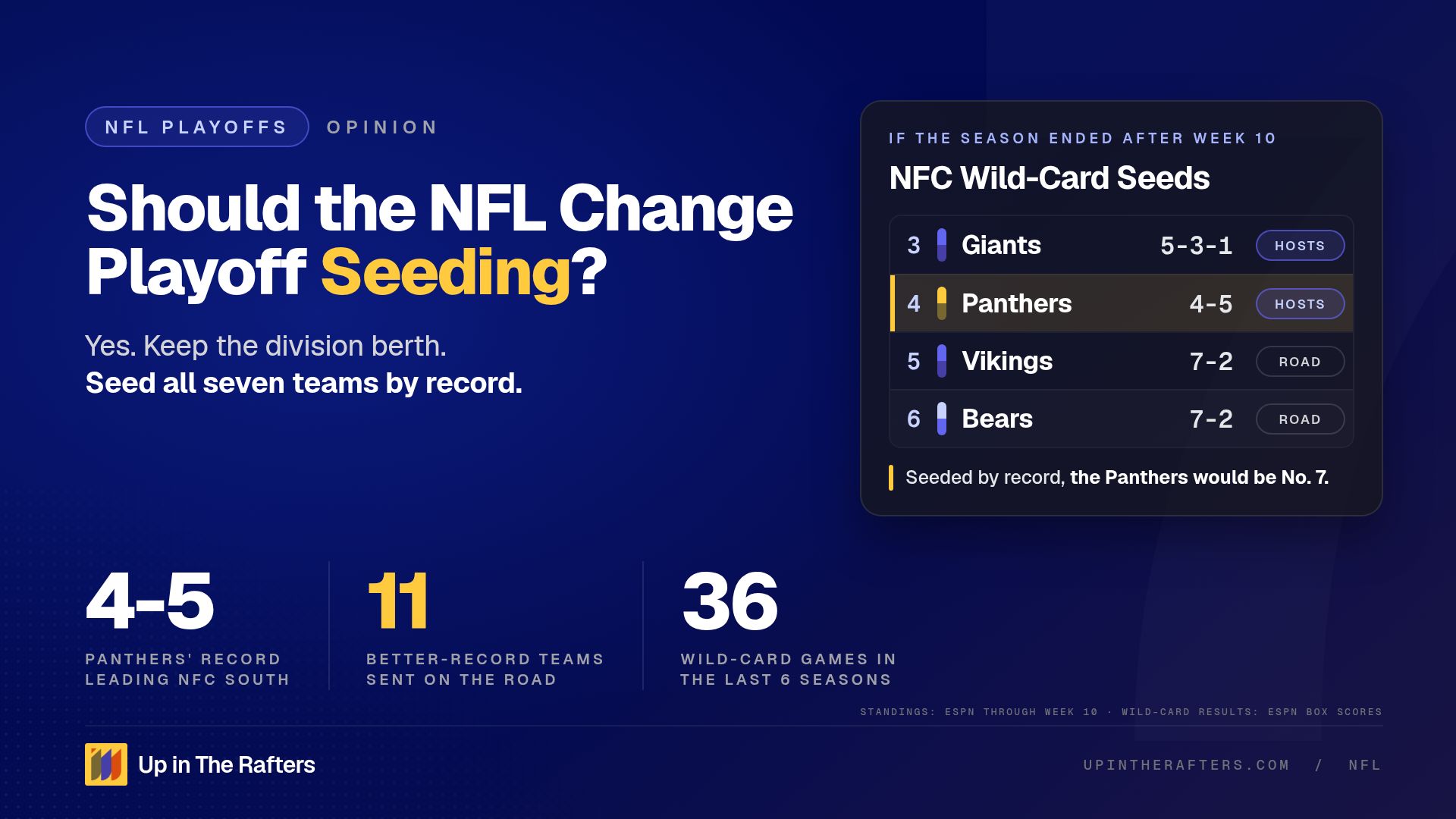
The Carolina Panthers are 4-5 and in first place in the NFC South. The other three teams in that division have three wins each. Meanwhile, the Lions, Vikings and Bears are all 7-2 in the NFC North, and if the season ended after Week 10, two of them would be playing road playoff games at teams with worse records (ESPN standings).
That's why the seeding debate is back. On Nov. 18, 2026, ESPN's Dan Graziano reported "rumblings from the league office" about reviving the 2025 discussion over whether division winners with losing records should be guaranteed home playoff games and top-four seeds (Yahoo Sports/The Spun). The same day, Mike Florio wrote at Pro Football Talk that reseeding will likely follow when the NFL expands to 18 games (PFT).
Should the NFL change playoff seeding? Yes. Keep the four division winners in the playoffs, but seed all seven teams in each conference by record, with the No. 1 seed and its bye going to the best division winner. That's the plan the Lions proposed in 2025. A division title should get you in. It shouldn't get you a home game over a team that won more games than you.
How NFL Playoff Seeding Works Right Now
Seven teams make it from each conference: four division winners and three wild cards. The division winners get seeds 1 through 4, ranked by record. The wild cards get seeds 5 through 7, no matter how many games they won. Only the No. 1 seed gets a bye, and in the wild-card round it's 2 vs. 7, 3 vs. 6 and 4 vs. 5, with the higher seed at home (NBC Sports). I go through the whole bracket in how the NFL playoffs work.
So a 14-3 wild card can be seeded below an 8-9 division winner. That's not hypothetical. In the 2024 season, the 14-3 Vikings were the NFC's No. 5 seed, behind the 10-7 Buccaneers and 10-7 Rams.
Here's what the NFC would look like if the season ended after Week 10 (games through Nov. 16, 2026), under the current rules and under the Lions' plan. Ties are listed the way ESPN breaks them today (the Seahawks and Rams are also 6-4).
| Seed | Current rules | Seeded by record |
|---|---|---|
| 1 | 49ers, 8-1 (West) | 49ers, 8-1 (West) |
| 2 | Lions, 7-2 (North) | Lions, Vikings or Bears, 7-2 |
| 3 | Giants, 5-3-1 (East) | Lions, Vikings or Bears, 7-2 |
| 4 | Panthers, 4-5 (South) | Lions, Vikings or Bears, 7-2 |
| 5 | Vikings, 7-2 (wild card) | Packers, 6-4 |
| 6 | Bears, 7-2 (wild card) | Giants, 5-3-1 |
| 7 | Packers, 6-4 (wild card) | Panthers, 4-5 |
Under the current rules, the 7-2 Vikings would go to Charlotte to play a 4-5 team, and the 7-2 Bears would have to play at the 5-3-1 Giants. Seeded by record, the Panthers and Giants still make the playoffs. They just go on the road, where the worse team usually goes.
There's a lot of season left. The AFC doesn't have this problem right now, since every division leader there is at least 7-2. But the NFC South had an 8-9 champion last year too, so this isn't a one-year thing.
The Bracket Keeps Getting This Wrong
Since the playoffs went to 14 teams in 2020, there have been 36 wild-card games. In 11 of them, the road team had the better regular-season record. I pulled every one from ESPN's box scores.
| Season | Road team | Home team | Score | Winner |
|---|---|---|---|---|
| 2020 | Buccaneers, 11-5 | Washington, 7-9 | 31-23 | Road |
| 2022 | Chargers, 10-7 | Jaguars, 9-8 | 31-30 | Home |
| 2022 | Cowboys, 12-5 | Buccaneers, 8-9 | 31-14 | Road |
| 2023 | Browns, 11-6 | Texans, 10-7 | 45-14 | Home |
| 2023 | Eagles, 11-6 | Buccaneers, 9-8 | 32-9 | Home |
| 2024 | Chargers, 11-6 | Texans, 10-7 | 32-12 | Home |
| 2024 | Commanders, 12-5 | Buccaneers, 10-7 | 23-20 | Road |
| 2024 | Vikings, 14-3 | Rams, 10-7 | 27-9 | Home |
| 2025 | Rams, 12-5 | Panthers, 8-9 | 34-31 | Road |
| 2025 | 49ers, 12-5 | Eagles, 11-6 | 23-19 | Road |
| 2025 | Texans, 12-5 | Steelers, 10-7 | 30-6 | Road |
That's almost one in three wild-card games played in the wrong building. It happened in every season but one (2021), and three times in each of the last two.
I'm a Chargers fan, so two of those rows hurt. In January 2023, the Chargers led the 9-8 Jaguars 27-0 in Jacksonville and lost 31-30 on a field goal as time expired (ESPN box score). Two years later, an 11-6 Chargers team lost 32-12 at the 10-7 Texans. I can't tell you the Chargers win either game at home. Blowing a 27-point lead is on them. But they had the better record both times and still had to travel. (This season is a different story, and I wrote about whether the Chargers should fire Jim Harbaugh.)
The Vikings row is the one that started all this. They went 14-3 in 2024, lost the NFC North to the 15-2 Lions in Week 18, dropped to the No. 5 seed and had to play the 10-7 Rams. That game got moved to Glendale, Arizona, because of the Los Angeles wildfires, and the Rams won 27-9 (ESPN). Detroit's seeding proposal came out of that season (SI).
My dad, Steve, is a Rams fan, and his team has now been on both sides of this. In the 2024 season, the 10-7 Rams got the home game against 14-3 Minnesota, even if it was played in Arizona. Last season, the 12-5 Rams had to go to 8-9 Carolina and needed a Matthew Stafford touchdown pass to Colby Parkinson with 38 seconds left to win 34-31 (ESPN). One rule, two very different Januaries.
Every Division Winner With a Losing Record
It's happened five times, and three of the five came in the last six seasons (Sporting News). All five hosted a playoff game.
| Season | Team | Record | Home wild-card game |
|---|---|---|---|
| 2010 | Seahawks | 7-9 | W 41-36 vs. Saints (11-5) |
| 2014 | Panthers | 7-8-1 | W 27-16 vs. Cardinals (11-5) |
| 2020 | Washington | 7-9 | L 31-23 vs. Buccaneers (11-5) |
| 2022 | Buccaneers | 8-9 | L 31-14 vs. Cowboys (12-5) |
| 2025 | Panthers | 8-9 | L 34-31 vs. Rams (12-5) |
Scores and records are from ESPN's game data. The 2010 Seahawks game is the famous one: Marshawn Lynch's 67-yard touchdown run, and the defending champion Saints went home.
The Best Case for Leaving It Alone
I want to be fair to the other side, because some of these points are good.
Winning the division should mean something. This is the big one. When owners tabled the Lions' plan in April 2025, Roger Goodell said there was support for "some version" of it, but also a strong point of view from many teams about the value of winning the division (Larry Brown Sports, citing NFL Network's Mike Garafolo). Detroit withdrew the proposal at the May 2025 league meeting (NFL.com), and Florio later wrote that it never made it to a vote because it would have failed (PFT).
Schedules aren't equal. Teams play six division games. An 11-6 team from a soft division might not be better than a 10-7 team that had to play three NFC North teams twice each. Record isn't a perfect measure.
Home field isn't automatic. Look back at that table of 11 games. The better team on the road still won six of them. The sub-.500 division winners went 2-3 at home. If home field were a free pass, those numbers would look different.
Re-drawing old brackets is a trap. CBS Sports' Jonathan Jones, who supports the change, still makes this point: teams would have played Week 18 differently if a home game had been on the line, so "this team would have played that team" is hindsight (CBS Sports).
Why I Still Think the NFL Should Seed by Record
The league already trusts record everywhere else. Division winners are ranked against each other by record. Wild cards are ranked against each other by record. The draft order is set by record. The only place the NFL refuses to compare records is between those two groups. That's the part that doesn't hold up.
Division winners still get the real prize. Under the Lions' plan, winning your division still guarantees a playoff spot, and the No. 1 seed still has to be a division winner. Jones made the point that the odds have already shifted: before 2020 a division winner had a 1-in-2 shot at a bye, and now it's 1-in-4. Divisions already matter less than they used to, and the league made that call itself when it expanded the field.
Home field matters enough to get right. Home teams won 23 of those 36 wild-card games since 2020, or 64%, by my count from ESPN's results. It's a one-game playoff. "The better team won 6 of 11 anyway" also means the better team lost five times in a building it shouldn't have been in.
It makes December better. This is the argument I find the most convincing. Right now, a division winner that's locked into its seed can coast. Under record seeding, a division winner at 10-5 still has to keep winning to host. Jones argued the same thing: more games with something on the line late in the year.
The schedule argument is the only one that really gives me pause. But it cuts both ways. A weak division can pad a record, too, and the Panthers still can't get over .500 in one.
If owners won't go all the way, there's a smaller version Goodell floated in April 2025: no home playoff game for a division winner with a losing record. I'd take that as a first step. It would've fixed three of the 11 games above. It just wouldn't have helped the 14-3 Vikings.
My Take
Seed all seven by record. Keep the division-winner berth, keep the bye for the best division winner and let everyone else line up by wins and losses.
I don't think this is radical. It's the same rule that already sorts the top four and the bottom three. It just stops pretending those two groups can't be compared. And based on the reporting from Graziano and Florio, I think it's coming once the season goes to 18 games. I'd rather the league do it before another 7-2 team has to fly to Charlotte in January.
If you want the college version of this argument, I wrote about why I think the 24-team College Football Playoff is a good idea.
Frequently Asked Questions
Is the NFL changing playoff seeding?
Not yet. No change has been approved as of Nov. 19, 2026. On Nov. 18, 2026, ESPN's Dan Graziano reported that the league office wants to revive the idea, and Pro Football Talk's Mike Florio reported that reseeding is expected to come when the season expands to 18 games.
How does NFL playoff seeding work?
Each conference sends four division winners and three wild cards. Division winners get seeds 1-4 by record, wild cards get seeds 5-7 by record, and only the No. 1 seed gets a bye. In the wild-card round, 2 hosts 7, 3 hosts 6 and 4 hosts 5.
What was the Lions' playoff seeding proposal?
Submitted in 2025, it kept the same 14 playoff teams but gave the No. 1 seed to the best division winner and seeded the other six strictly by record. A wild card with a better record could be seeded, and host, above a division winner. The Lions withdrew it in May 2025.
Has a team with a losing record ever hosted an NFL playoff game?
Yes, five times: the 2010 Seahawks (7-9), 2014 Panthers (7-8-1), 2020 Washington Football Team (7-9), 2022 Buccaneers (8-9) and 2025 Panthers (8-9). The Seahawks and 2014 Panthers won their home games. The other three lost.
Who would host a playoff game if the season ended now?
After Week 10 (games through Nov. 16, 2026), the NFC hosts would be the 49ers (bye), Lions, Giants and 4-5 Panthers. Seeded by record, the Giants and Panthers would go on the road, and the Vikings and Bears (both 7-2) would host.
Why do NFL division winners get a home playoff game?
Because the rule rewards the division title itself. Division winners take the top four seeds, and the higher seed hosts in the wild-card round, so every division winner except the No. 1 seed plays at home that weekend.
Sources
Matt's first sports memories are Kobe dropping 81, LaDainian Tomlinson making defenders look silly, and Derek Jeter somehow always coming through in October. He's been hooked ever since.
Think a number is off? Tell us, or check the Corrections page.
More in NFL
View all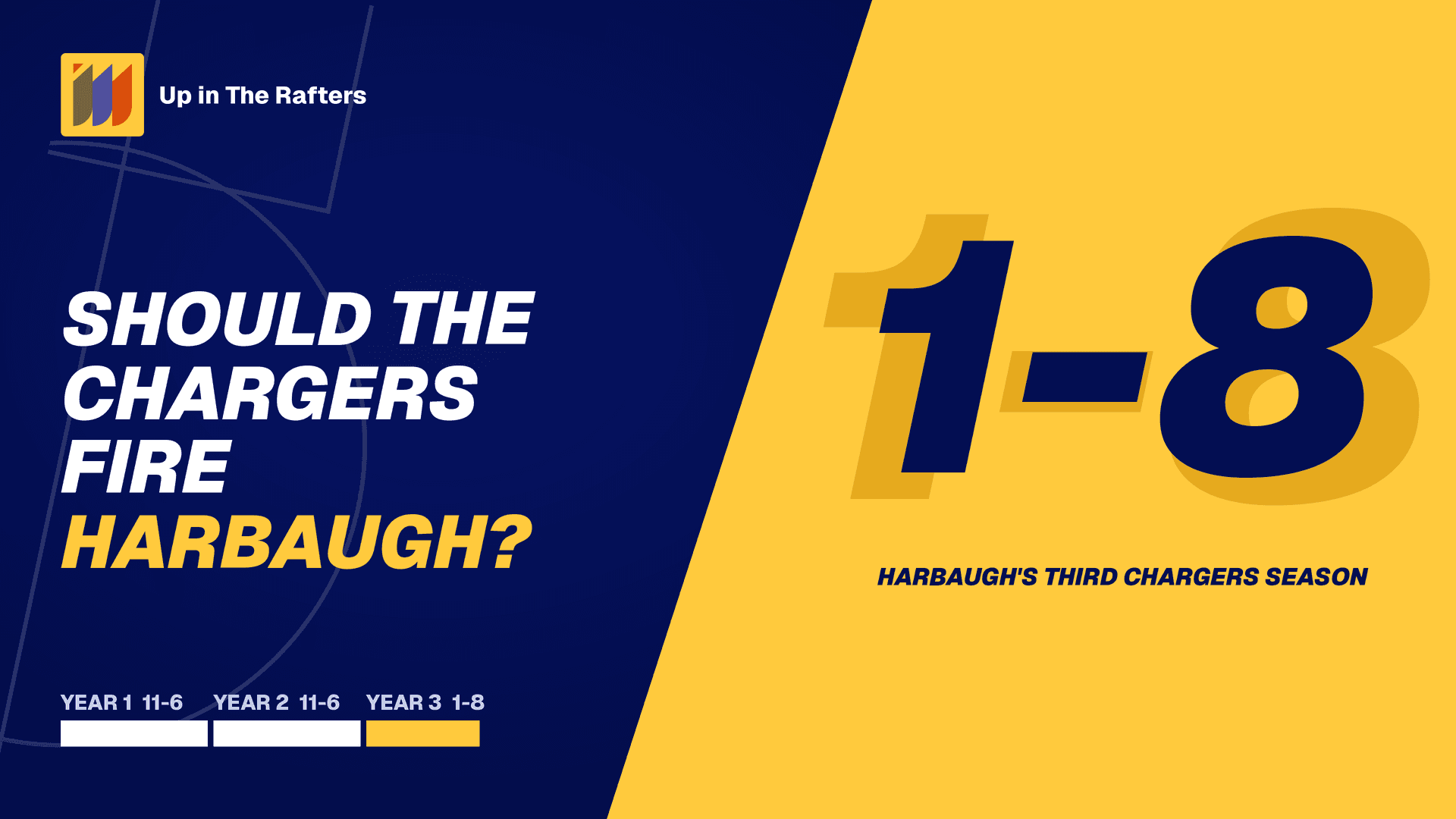
Should the Chargers Fire Jim Harbaugh? No, but Mike McDaniel Shouldn't Be Back

Did the Vikings Win the Kirk Cousins Trade? For a Third-Round Pick, Yes
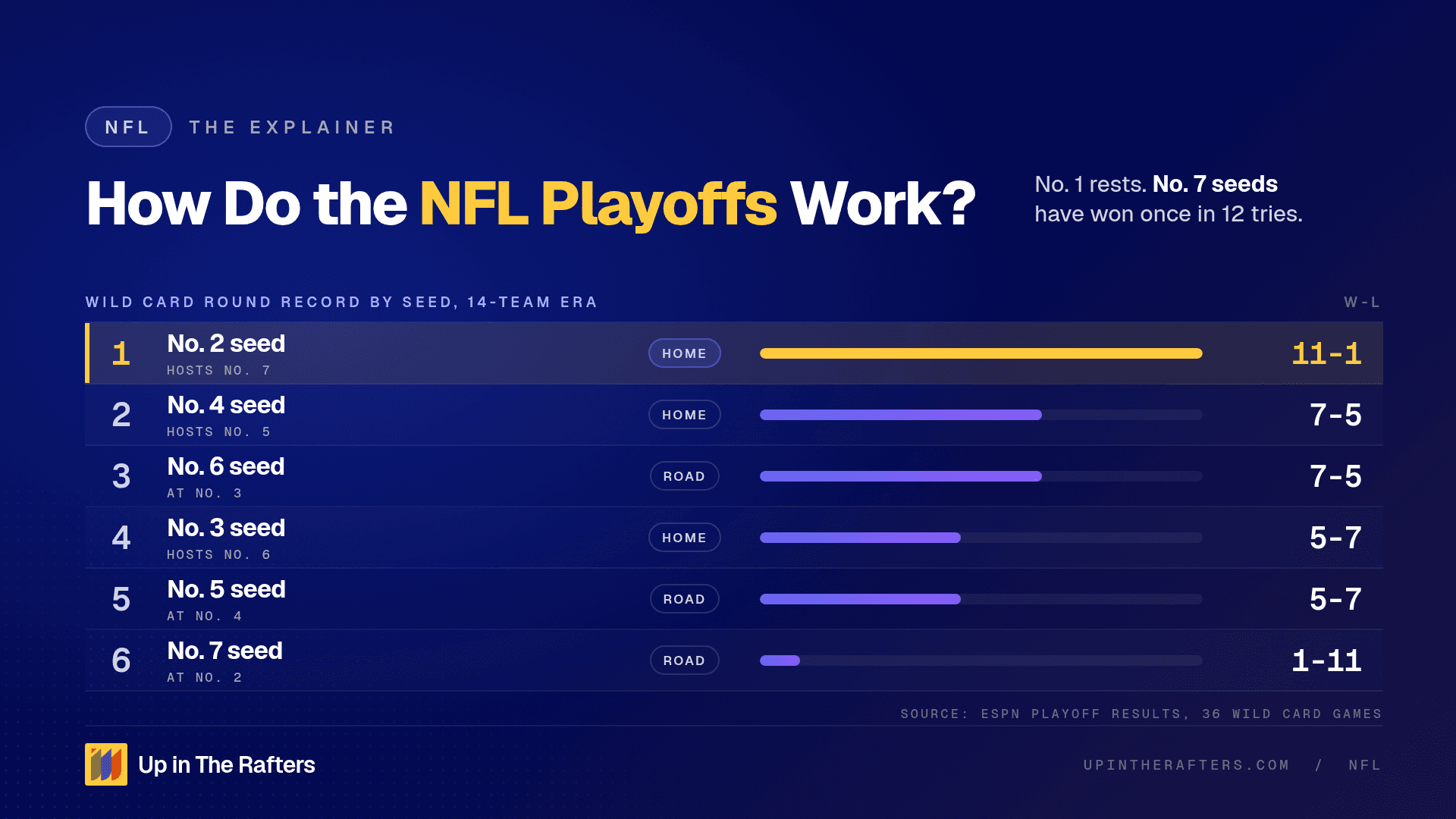
How Do the NFL Playoffs Work? I Went Through All 78 Games of the 14-Team Era