How Do the NFL Playoffs Work? I Went Through All 78 Games of the 14-Team Era
Fourteen teams make the NFL playoffs, and only one per conference gets a bye. I explain seeding, reseeding and tiebreakers, plus what 78 playoff games show.
Fourteen teams make the NFL playoffs, seven from the AFC and seven from the NFC. In each conference, the four division winners get seeds 1 through 4, ranked by record, and the three best teams that didn't win their division get seeds 5 through 7 as wild cards. Only the No. 1 seed gets a bye. Everyone else plays on Wild Card Weekend: No. 2 hosts No. 7, No. 3 hosts No. 6 and No. 4 hosts No. 5. It's single elimination from there, and the higher seed hosts every game until the Super Bowl, which is at a site picked years in advance.
That rule about division winners is why the NFC standings look so strange right now. Through the games of Nov. 9, 2026, the Carolina Panthers are 3-5 and lead the NFC South. The Detroit Lions are 6-2. If the season ended on Nov. 10, Carolina would be the No. 4 seed and Detroit would have to play the wild card game in Charlotte (ESPN standings). Posts on X mentioning the playoff picture, playoff seeding or the NFC South jumped from 170 to 280 a day between Nov. 3 and Nov. 7, 2026, to more than 2,100 on Nov. 9, and Detroit's own failed seeding proposal is getting passed around again (Yahoo Sports).
The format is simple once you see it. How it plays out is less obvious, so I pulled the seeds, records and scores for every playoff game since the league went to 14 teams in the 2020 season. That's six postseasons and 78 games, from ESPN's standings and scoreboard data.
How do the NFL playoffs work? Seven teams per conference qualify: four division winners (seeds 1-4, by record) and three wild cards (seeds 5-7). The No. 1 seed gets a bye. In the Wild Card round, 2 hosts 7, 3 hosts 6 and 4 hosts 5. The bracket reseeds after that, so the No. 1 seed always plays the lowest seed left. The higher seed hosts every game except the Super Bowl.
Who Makes the NFL Playoffs
There are 32 teams, split into two conferences of 16. Each conference has four divisions of four teams. Here's how the seven spots get handed out in each conference:
| Seed | Who gets it | Wild Card round |
|---|---|---|
| 1 | Division winner with the best record | Bye |
| 2 | Second-best division winner | Hosts No. 7 |
| 3 | Third-best division winner | Hosts No. 6 |
| 4 | Fourth-best division winner | Hosts No. 5 |
| 5 | Best record among non-division winners | At No. 4 |
| 6 | Second-best non-division winner | At No. 3 |
| 7 | Third-best non-division winner | At No. 2 |
The part that trips people up: a wild card can't be seeded above a division winner, no matter the records. A 12-5 wild card is still a No. 5 seed if a 9-8 team won its division. The NFL ranks teams by winning percentage, and a tie game counts as half a win and half a loss (NFL.com). It's also why the 5-2-1 New York Giants, who lead the NFC East, sit at No. 3 in the current NFC standings while the 6-2 Lions are No. 5.
The league went from 12 teams to 14 when owners approved a seventh team per conference on March 31, 2020 (NFL.com). Under the old format, the top two seeds in each conference got byes. Now only the No. 1 seed does, which is a big reason teams care so much about it.
How the Bracket Works, Round by Round
| Round | Games | Who plays | Dates for this season |
|---|---|---|---|
| Wild Card | 6 | 2 vs. 7, 3 vs. 6, 4 vs. 5 in each conference | Jan. 16-18, 2027 |
| Divisional | 4 | No. 1 hosts the lowest seed left; the other two winners meet | Jan. 23-24, 2027 |
| Conference Championships | 2 | AFC and NFC title games, higher seed hosts | Jan. 31, 2027 |
| Super Bowl LXI | 1 | AFC champion vs. NFC champion | Feb. 14, 2027, SoFi Stadium |
Round dates are from the NFL's schedule as reported by CBS Sports and other outlets. The regular season ends with Week 18 on Jan. 10, 2027.
The reseeding after the Wild Card round is the part most people miss. The bracket isn't fixed. If the No. 7 seed wins its game, it goes to the No. 1 seed's stadium next, even though it "would have" played someone else on a fixed bracket. So nobody knows their Divisional round opponent until all six Wild Card games are over. The one sure thing is that No. 1 gets whoever is lowest.
There are no limits on division rivals meeting. Two teams from the same division can play in any round, including the Wild Card round.
What Happens if a Playoff Game Is Tied
Playoff overtime is different from the regular season. Periods are 15 minutes instead of 10, there are no ties, and both teams are guaranteed a possession even if the first team scores a touchdown. The only exception is a safety on the opening possession, which ends the game (NBC Sports). Owners approved the both-teams-possess rule for the playoffs in March 2022 (NFL.com). Super Bowl LVIII, when the Chiefs beat the 49ers 25-22, was the first game played under the current playoff overtime rules.
What 78 Playoff Games Show
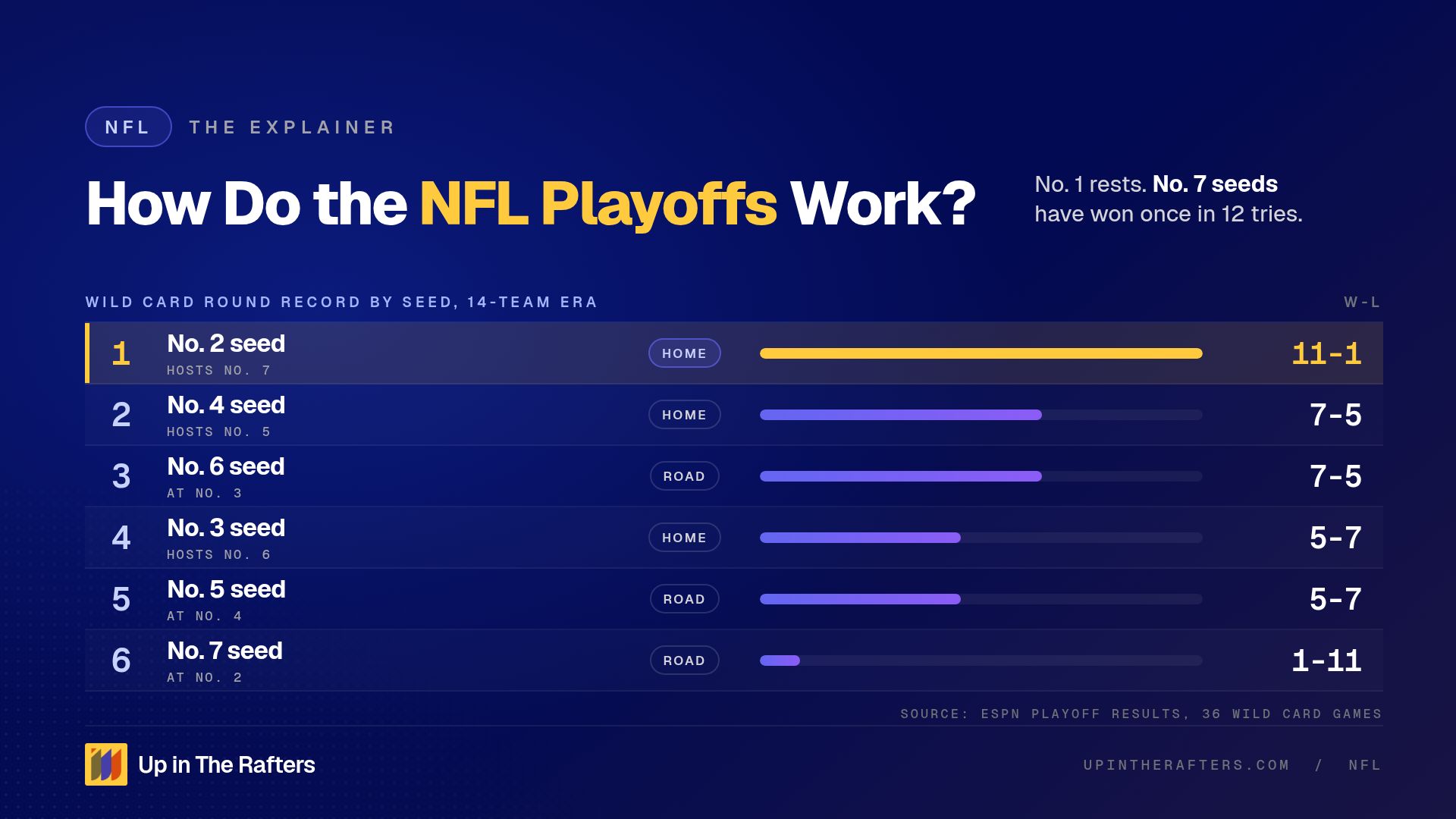
Here's every Wild Card round game from the 2020 through 2025 seasons, sorted by seed. Six postseasons, 36 Wild Card games.
| Seed | Wild Card round record | Win % |
|---|---|---|
| No. 2 (hosts No. 7) | 11-1 | .917 |
| No. 4 (hosts No. 5) | 7-5 | .583 |
| No. 6 (at No. 3) | 7-5 | .583 |
| No. 3 (hosts No. 6) | 5-7 | .417 |
| No. 5 (at No. 4) | 5-7 | .417 |
| No. 7 (at No. 2) | 1-11 | .083 |
Source: ESPN playoff scoreboard and final standings, 2020 through 2025 seasons.
A few things stand out.
The No. 7 seed is almost a formality. Seventh seeds are 1-11. The only win was the 2023 Packers, who went into Dallas and beat the No. 2 Cowboys 48-32. Every other No. 2 seed won.
The 3 vs. 6 game has gone to the road team more often. No. 6 seeds are 7-5 against No. 3 seeds. In the 2025 season, both No. 6 seeds won on the road: the Bills 27-24 at Jacksonville and the 49ers 23-19 at Philadelphia. The 4 vs. 5 game is close to even too, at 7-5 for the home team.
Home field still helps. Home teams went 23-13 in the Wild Card round, 16-8 in the Divisional round and 8-4 in conference title games. That's 47-25 overall, a .653 win rate, before the neutral-site Super Bowl.
How the No. 1 Seed Has Done
The bye is worth a lot, but it isn't a free trip to the Super Bowl.
| What I checked | Result |
|---|---|
| No. 1 seeds | 12 (two per season) |
| Record in the Divisional round | 9-3 |
| Reached the Super Bowl | 6 of 12 |
| Won the Super Bowl | 2 (2022 Chiefs, 2025 Seahawks) |
The three No. 1 seeds that lost their first game were the 2021 Titans and Packers, who both lost in the same postseason, and the 15-2 Lions in the 2024 season, who lost 45-31 at home to Washington.
Super Bowl Winners by Seed
| Season | Champion | Seed | Super Bowl |
|---|---|---|---|
| 2020 | Tampa Bay Buccaneers | NFC No. 5 | LV, beat Chiefs 31-9 |
| 2021 | Los Angeles Rams | NFC No. 4 | LVI, beat Bengals 23-20 |
| 2022 | Kansas City Chiefs | AFC No. 1 | LVII, beat Eagles 38-35 |
| 2023 | Kansas City Chiefs | AFC No. 3 | LVIII, beat 49ers 25-22 (OT) |
| 2024 | Philadelphia Eagles | NFC No. 2 | LIX, beat Chiefs 40-22 |
| 2025 | Seattle Seahawks | NFC No. 1 | LX, beat Patriots 29-13 |
Six champions, five different seeds. The 2020 Buccaneers won three road games as a No. 5 seed and then won the Super Bowl in their own stadium. The 2021 Rams won it in their home stadium, SoFi, a year later. Super Bowl LXI is at SoFi again on Feb. 14, 2027, and SoFi is home to both the Rams and the Chargers.
Can a Team With a Losing Record Make the Playoffs?
Yes, if it wins its division. And it gets a home playoff game, too. It has happened five times outside the strike-shortened 1982 season, according to CBS Sports. I checked each one against ESPN's records and scores.
| Season | Team | Record | Playoff result |
|---|---|---|---|
| 2010 | Seattle Seahawks | 7-9 | Beat Saints 41-36, lost at Bears 35-24 |
| 2014 | Carolina Panthers | 7-8-1 | Beat Cardinals 27-16, lost at Seahawks 31-17 |
| 2020 | Washington Football Team | 7-9 | Lost to Buccaneers 31-23 |
| 2022 | Tampa Bay Buccaneers | 8-9 | Lost to Cowboys 31-14 |
| 2025 | Carolina Panthers | 8-9 | Lost to Rams 34-31 |
Those five teams are 2-5 in the playoffs, and the three from the 14-team era all lost at home in the Wild Card round. In each of those three seasons, at least one NFC team with a better record than the division winner missed the playoffs. In 2025, the 9-8 Vikings and 9-8 Lions stayed home while the 8-9 Panthers hosted.
The bigger question is whether hosting even helps a weaker team. In the 14-team era, a road team with a better record than its host has played 11 Wild Card games. The road team went 6-5. So the home game hasn't saved many weak division winners.
Why the NFL Hasn't Changed It
In 2025, the Lions proposed seeding the six teams after the No. 1 seed purely by record, so a better wild card could host a worse division winner. They withdrew it at the May 2025 league meeting without a vote because there wasn't enough support (NFL.com). CBS Sports reported that owners like the guaranteed chance at a home playoff game for every division, and Mike Tomlin called himself one of the "football purists" who think a division title should come with one. Pro Football Talk reported the idea won't come back until the regular season expands to 18 games (NBC Sports).
That's the strongest case for the current rule. Your six division games are worth something, and the 2025 Rams-Panthers game came down to three points in Charlotte. The case against it is sitting in the NFC standings right now.
How NFL Playoff Tiebreakers Work
When two teams finish with the same record, the NFL uses a step-by-step list until one of them wins a step. There are two different lists, and which one applies depends on whether the teams are in the same division (NFL.com).
| Step | Two teams, same division | Two teams, different divisions (wild card) |
|---|---|---|
| 1 | Head-to-head | Head-to-head, if they played |
| 2 | Division record | Conference record |
| 3 | Record in common games | Record in common games (minimum of four) |
| 4 | Conference record | Strength of victory |
| 5 | Strength of victory | Strength of schedule |
| 6 | Strength of schedule | Combined ranking in points scored and allowed |
Both lists keep going after that, through point rankings, net points and net touchdowns, and both end in a coin toss. A few rules are worth knowing:
Division ties get settled first. If two wild card contenders are from the same division, the league uses the division tiebreakers between them.
Seeding among division winners uses the wild card list. So if two division winners tie for the No. 1 seed, head-to-head comes first, then conference record.
Three-way ties restart. Once one team is eliminated or advances at any step, the remaining teams go back to step 1.
Strength of victory is the combined winning percentage of the teams you beat. Strength of schedule is the combined winning percentage of every team you played.
The NFL Playoff Picture Right Now
Here's how the seeds would look if the season ended on Nov. 10, 2026, after every team has played eight or nine games. Records are from ESPN.
| Seed | AFC | Record | NFC | Record |
|---|---|---|---|---|
| 1 | Buffalo Bills | 7-1 | San Francisco 49ers | 7-1 |
| 2 | Denver Broncos | 7-2 | Chicago Bears | 7-2 |
| 3 | Jacksonville Jaguars | 6-2 | New York Giants | 5-2-1 |
| 4 | Pittsburgh Steelers | 6-2 | Carolina Panthers | 3-5 |
| 5 | Kansas City Chiefs | 6-2 | Detroit Lions | 6-2 |
| 6 | Cincinnati Bengals | 6-2 | Minnesota Vikings | 6-2 |
| 7 | New England Patriots | 5-4 | Green Bay Packers | 6-3 |
| First out | Cleveland Browns | 5-4 | Seattle Seahawks | 5-4 |
The whole NFC North is in. The four teams are a combined 25-9. The NFC South is 12-22. It isn't a coincidence that one looks so good and the other so bad: the 2026 schedule rotation has every NFC North team playing every NFC South team. So far the North is 8-2 in those games.
That leaves the NFC with a real chance of a 7-2 or 6-2 team traveling to play a division winner with a losing record, or a winning NFC North team missing the playoffs entirely. My dad Steve's Rams are 5-4 and ninth in the NFC, the second team out behind Seattle. My Chargers are 0-8, so I'm reading this table for everyone else's teams this year.
There's still a lot of football left. Every team has eight or nine games to go, and the trade deadline is Nov. 10, 2026, at 4 p.m. ET. We covered how that works in our NFL trade deadline explainer.
Questions People Are Asking
How many teams make the NFL playoffs? 14. Seven from the AFC and seven from the NFC: four division winners and three wild cards in each conference.
Who gets a bye in the NFL playoffs? Only the No. 1 seed in each conference. Before the 2020 season, the top two seeds in each conference got byes.
How does NFL playoff seeding work? Division winners are seeded 1 through 4 by record, and wild cards are seeded 5 through 7 by record. A wild card can't be seeded above a division winner.
Can a team with a losing record make the NFL playoffs? Yes, by winning its division. It has happened five times outside the 1982 strike season, most recently the 8-9 Carolina Panthers in the 2025 season.
Do the NFL playoffs reseed? Yes. After the Wild Card round, the No. 1 seed hosts the lowest remaining seed, and the other two winners play each other at the higher seed's stadium.
How does overtime work in the NFL playoffs? Overtime periods are 15 minutes, games can't end in a tie, and both teams get at least one possession unless the defense scores a safety on the first one.
When are the NFL playoffs this season? Wild Card Weekend is Jan. 16-18, 2027. The Super Bowl is Feb. 14, 2027, at SoFi Stadium in Inglewood, California.
Final Thoughts
The NFL playoff format comes down to two rules. Win your division and you're guaranteed a home game, and be the best team in your conference and you skip a round. The 78 games since the 2020 season say the top seeds have a real edge, but a division title on its own doesn't buy much. No. 2 seeds are 11-1 against No. 7 seeds. Losing-record division winners are 0-3 at home, and road teams with the better record are 6-5.
If you want to compare, our explainers on the College Football Playoff and the MLB playoffs show how other leagues handle byes and seeding. And for how long one of these games actually takes, see how long a football game lasts.
How I put this together: the format and tiebreaker rules are from NFL.com. The 78 games, seeds and final records for the 2020 through 2025 seasons, plus the current standings through Nov. 9, 2026, are from ESPN's standings and scoreboard data, pulled on Nov. 10, 2026. The list of losing-record division winners is from CBS Sports, and I checked each team's record and playoff scores against ESPN.
Sources
Matt's first sports memories are Kobe dropping 81, LaDainian Tomlinson making defenders look silly, and Derek Jeter somehow always coming through in October. He's been hooked ever since.
Think a number is off? Tell us, or check the Corrections page.