Up in The Rafters
How Does Overtime Work in Hockey Playoffs?
What exactly happens when the horn sounds after 60 minutes of deadlocked hockey in the playoffs? Let me break down the beautiful chaos that is playoff overtime.

How Does Overtime Work in the NHL Playoffs? The Complete Guide
A defenseman jumps up into the rush. A forward threads a pass through two sticks. The one-timer beats the goalie glove side, and 18,000 people lose their minds simultaneously. That's the electric, gut-wrenching reality of playoff overtime hockey, where one shot can alter legacies, swing entire series, and keep fans awake until the small hours of the morning.
The 2025 Stanley Cup Playoffs delivered a masterclass in exactly this kind of drama. Leon Draisaitl set a new NHL record with four overtime goals in a single postseason. Cole Perfetti scored with just three seconds remaining in regulation to force overtime in a do-or-die Game 7 between Winnipeg and St. Louis. Brad Marchand willed the Panthers' repeat into existence with a double-overtime backhand in the Cup Final. These are the moments that make playoff overtime the most compelling spectacle in professional sports.
But how does it all actually work? Whether you're a die-hard or brand new to the game, here's your complete breakdown of how overtime functions once the NHL's postseason begins.
Playoff Overtime Rules: The Basics
When the final buzzer sounds after 60 minutes of regulation and the score is knotted, the NHL doesn't resort to any of the regular season's crowd-pleasing shortcuts. No 3-on-3 periods. No shootouts. Instead, the league turns to something far more grueling and authentic.
Here's what playoff overtime looks like:
Full 5-on-5 hockey, identical to regulation play
20-minute sudden-death periods, where the next goal wins
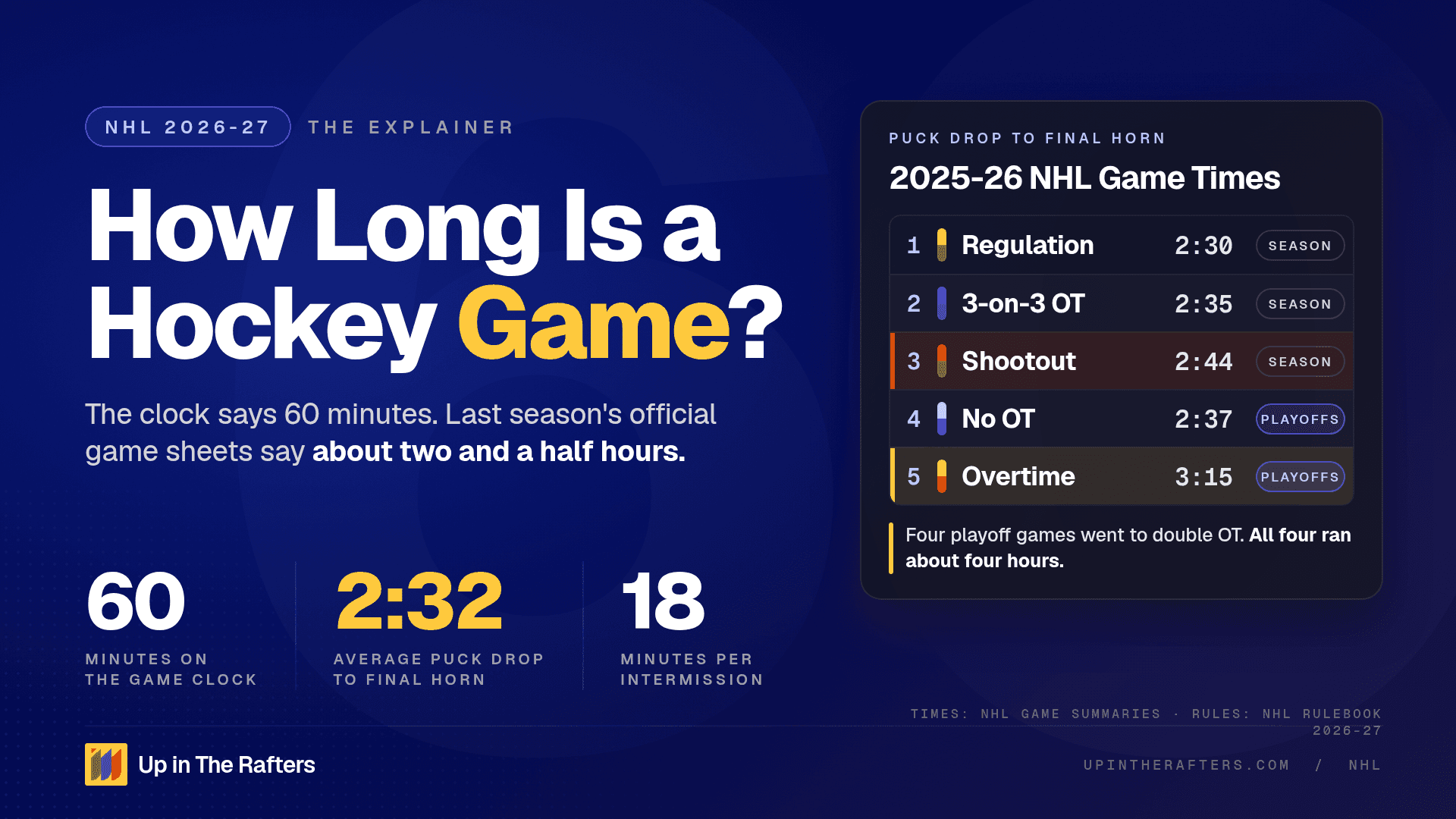
Full intermissions (roughly 15 to 18 minutes) between each overtime period, complete with ice resurfacing
Unlimited overtime periods, meaning teams play as many as it takes to produce a goal
Zero shootouts, under any circumstances
As ESPN's NHL rules explainer puts it, overtime in the postseason reverts to the sport's most fundamental form: five skaters, a goalie, and sudden death. The purity of the format is exactly what separates the Stanley Cup Playoffs from every other championship in professional sports.
Why Playoff Overtime Is Nothing Like the Regular Season
If you've only watched regular season hockey, you've experienced a very different version of extra time. During the 82-game grind, overtime is designed for quick resolution: three skaters per side, five minutes of wide-open ice, followed by a skills-competition shootout if nobody scores. It's fun. It's fast. It exists partly for TV scheduling and partly because nobody wants a Tuesday night game against Columbus stretching past midnight.
Playoff overtime throws all of that out the window. Here's a side-by-side comparison:
Regular Season OT | Playoff OT | |
Format | 3-on-3 | 5-on-5 |
Period Length | 5 minutes | 20 minutes |
Periods Played | 1 | Unlimited |
Shootout | Yes, if still tied | Never |
Intermission | Brief break at benches | Full intermission with ice resurface |
Loser Gets a Point | Yes (1 point) | No |
Penalty Format | 4-on-3 power play | 5-on-4 power play |
The stakes transform everything. Regular season overtime gives the losing team a consolation point in the standings. In the playoffs, there are no consolation prizes. Just a win or a loss, with seasons hanging in the balance on every shift.
A Brief History of NHL Overtime
The NHL hasn't always handled extra time this way. Overtime was first introduced in 1921 as a full 20-minute sudden-death period. The rules have shifted quite a bit since then:
Year | Change |
1921 | Overtime introduced as a 20-minute sudden-death period |
1927 | Reduced to 10-minute overtime periods |
1942 | Regular season overtime eliminated (wartime train schedules) |
1983 | Five-minute regular season overtime introduced |
2005 | Shootout added to end regular season ties |
2015 | Regular season overtime switches to 3-on-3 format |
Through all of these changes, playoff overtime has stayed remarkably consistent. Full periods, sudden death, 5-on-5 hockey, no gimmicks. It's one of the oldest traditions in the sport, and the format has produced some of the most unforgettable moments in hockey history.
For fans of unbreakable records in sports, the longest game in NHL history still belongs to the 1936 Detroit Red Wings and Montreal Maroons. Mud Bruneteau finally ended it at the 176:30 mark, the equivalent of nearly three full games, in what remains a testament to the sheer endurance that playoff overtime can demand.
What Happens Inside the Arena During Overtime
When regulation ends tied, the shift inside an arena is palpable. The energy doesn't dissipate. It condenses.
Teams head to the dressing room for a full intermission. Trainers scramble to patch up battered players, tape broken sticks, and rehydrate anyone dealing with cramps after 60 exhausting minutes. Coaches draw up plays on whiteboards, trying to find matchups they can exploit. The ice crew resurfaces the sheet to give both teams a clean playing surface.
When teams return, they switch ends, just like they do between regulation periods, ensuring that neither team is disadvantaged by any ice conditions. Then the puck drops, and from that moment forward, every whistle, every shot, every line change carries the weight of a potential season-ending moment.
In the stands, nobody moves. Superstitions multiply. The tension becomes something you can physically feel, a collective held breath that only releases when the puck finally crosses the goal line.
The Marathon Games That Made History
The unlimited nature of playoff overtime is what produces legends.
Keith Primeau's fifth-overtime goal for Philadelphia against Pittsburgh in 2000 remains one of the great endurance tests in playoff history. More recently, Matthew Tkachuk scored with 12.7 seconds left in quadruple overtime to open the 2023 Eastern Conference Finals for Florida against Carolina, a game where Sergei Bobrovsky stopped 63 of 65 shots in the sixth-longest game in NHL history.
Here are some of the longest and most memorable overtime games in NHL playoff history:
Year | Teams | OT Periods | Game Time | Winning Goal |
1936 | Detroit vs. Montreal Maroons | 6 OT | 176:30 | Mud Bruneteau |
2000 | Philadelphia vs. Pittsburgh | 5 OT | 152:01 | Keith Primeau |
2020 | Tampa Bay vs. Columbus | 5 OT | 150:27 | Brayden Point |
2023 | Florida vs. Carolina | 4 OT | 139:47 | Matthew Tkachuk |
2025 | Winnipeg vs. St. Louis (Gm 7) | 2 OT | ~136:10 | Adam Lowry |
The 2025 playoffs took overtime drama to yet another level. Three of the six Stanley Cup Final games between Florida and Edmonton required extra time, including one double-overtime thriller. Draisaitl's record-setting four overtime goals in a single postseason put him in rare historical company, and Sam Bennett's 15 playoff goals, including an NHL-record 13 on the road, earned him the Conn Smythe Trophy as the Panthers repeated as champions.
Meanwhile, the first round served up its own classics. The Hurricanes erased a three-goal deficit against New Jersey and won in double overtime on a Sebastian Aho goal in Game 5. And Winnipeg's Game 7 comeback against St. Louis, featuring Perfetti's goal with three seconds left in regulation, has already entered the conversation as one of the most dramatic Game 7s ever played.
Overtime Strategy: How Coaches Navigate the Chaos
Coaching in playoff overtime is a balancing act with no margin for error.
The conventional wisdom says coaches should roll all four forward lines evenly to keep legs fresh. But in practice, it's far more nuanced. Watch the ice-time distribution closely and you'll notice top-pair defensemen getting slightly shorter shifts while third-liners might sit for extended stretches during critical moments.
The competing philosophies are straightforward: some coaches tighten up defensively, prioritizing structure and limiting odd-man rushes, believing that the team that makes the first mistake loses. Others push the pace, flooding the offensive zone with shots and bodies, betting that relentless pressure will eventually create a breakthrough.
What nearly every coach agrees on is simplicity. Playoff overtime goals rarely come from elaborate passing plays or highlight-reel dekes. They come from greasy rebounds, deflections through traffic, and seeing-eye wrist shots from the point. Get pucks to the net, crash hard, and let the chaos work in your favor.
The 2025 Final illustrated this perfectly. Draisaitl's Game 4 overtime winner deflected off a defender's stick. Marchand's Game 2 double-overtime goal was a backhand shoved through the five-hole while battling a backchecking forward. These aren't pretty goals. They're winning goals.
The Fan Experience: Nothing Else Compares
There is nothing in sports that replicates the experience of watching playoff overtime hockey, whether in the arena or at home.
Networks go commercial-free. Broadcasters lower their voices, as if speaking too loudly might jinx something. Every shot on goal produces an audible gasp from thousands of people simultaneously. Every save extends the agony for one fan base and the relief for another.
In the building, strangers become allies (or enemies) united by the shared torture of not knowing when the next goal will come or who will score it. The superstitions compound. If you stood up before the tying goal, you're standing until the final whistle, whether that's five minutes from now or two hours.
For those who follow the broader world of playoff drama across sports, NHL overtime holds a unique place. Unlike basketball, where the clock dictates the final possessions, or football, where coin tosses and rule quirks shape outcomes, hockey's sudden-death format is beautifully simple. One goal. Game over. No qualifiers.
Frequently Asked Questions
Can a playoff game ever end in a tie?
Never. Teams will play indefinitely until someone scores. The 1936 Red Wings-Maroons marathon didn't end until 2:25 a.m. local time. In more recent memory, the 2020 Tampa Bay/Columbus game stretched into the fifth overtime before Brayden Point ended it just after midnight.
How do penalties work in overtime?
Exactly like regulation. Minor penalties result in standard 5-on-4 power plays, and majors carry the full five-minute consequence. This differs from the regular season's 3-on-3 overtime, where penalties create 4-on-3 situations. In the 2025 Cup Final, Draisaitl scored his Game 1 overtime winner on a power play after a delay-of-game penalty, proving that discipline matters just as much in extra time.
Do teams get rest between overtime periods?
Yes. Full intermissions of approximately 15 to 18 minutes occur between each overtime period, with ice resurfacing and all the usual intermission routines. It's a crucial recovery window for exhausted players.
Can a goalie be pulled for an extra attacker in overtime?
Technically, yes. Strategically, it would be borderline reckless. Since any goal immediately ends the game, an empty net against a sudden-death format is an enormous risk. That said, with under a minute left in the third period of Game 4 of the 2025 Final, the Panthers pulled Bobrovsky and Sam Reinhart scored to send the game to overtime, so the strategy has its place in regulation, at least.
Has anyone ever scored on their own net in playoff overtime?
Unfortunately, yes. The most infamous example is Steve Smith of the Edmonton Oilers, who in 1986 accidentally banked a clearing attempt off goalie Grant Fuhr and into his own net during Game 7 against Calgary. It remains one of the cruelest moments in playoff history.
Why Playoff Overtime Is Hockey's Ultimate Proving Ground
At its core, playoff overtime strips hockey down to its most fundamental elements. No gimmicks, no artificial time constraints, no skills competitions. Just two teams, a sheet of ice, and the knowledge that the next goal decides everything.
When a Game 7 goes to overtime, as Winnipeg and St. Louis experienced in 2025 with Perfetti's miracle goal forcing extra time and Adam Lowry ending it in double overtime, there is nothing more dramatic in all of sports. Two teams that couldn't be separated through seven games and 60 minutes of regulation, needing one more goal to decide who survives and who goes home.
That's what makes playoff overtime sacred. It's why players talk about it with a reverence reserved for almost nothing else in their careers. It's why fans plan their lives around it, calling in sick to work after a triple-overtime Game 5 that ended at 1 a.m. And it's why, year after year, the Stanley Cup Playoffs remain the gold standard for postseason drama.
So as the next playoff season approaches, brace yourself for the sleepless nights, the heart palpitations, and the raw, unfiltered emotion that only playoff overtime can deliver. After all, somewhere out there, an unlikely hero is waiting for his moment, and the lamp is about to light up one more time.