 Up in The Rafters
How Old Do You Have to Be to Be in the Olympics?
How old do you have to be to be in the Olympics? There's no single answer. It depends on the sport. From age 11 to 72, here's the full breakdown.
It's one of those questions that sounds simple until you actually try to answer it. You'd think the International Olympic Committee would have a clean, clear rule pinned somewhere on their website. And technically, they do. It's just not the answer most people expect.
The IOC's official position is that there is no specific age limit to compete in the Olympic Games. That's not a typo. According to the IOC's own FAQ, age requirements are left entirely up to each sport's governing International Federation. Which means the answer to "how old do you have to be?" depends almost entirely on which sport you're asking about.
Let's break it all down.
The Default: 16 Years Old
While there's no universal minimum written into the Olympic Charter, 16 is widely considered the baseline. Most National Olympic Committees and International Federations hover around this number as their floor. So if you're a 15-year-old prodigy wondering if your Olympic dreams are on hold, the answer is: it depends on your sport.
For Team USA, the youngest an athlete can be is 13, as long as the sport's governing body agrees. Canada sits at the same threshold. Russia, on the other hand, requires athletes to be 18. China sets its minimum at 14 for most sports.
Age Requirements by Sport
This is where it gets genuinely interesting. Each sport has its own rules, and some of them will surprise you.
Artistic Gymnastics: 16 Gymnastics has one of the strictest age minimums in the Olympics, and it has a complicated history behind it. The FIG raised the minimum from 14 to 15 in 1981 and then to 16 in 1997, largely in response to widespread age fraud by countries trying to gain a competitive edge. Athletes must turn 16 in the calendar year of the Games to be eligible. For the 2024 Paris Olympics, gymnasts had to be born on or before December 31, 2008.
Diving: 14 Younger than gymnastics, but still regulated. Divers must be at least 14 to compete at the Olympic level.
Boxing: 18 One of the oldest minimum ages in the Games. Boxing has maintained an 18-and-up rule as a safety measure, recognizing the physical toll the sport takes on developing bodies.
Soccer (Men's): Under 23 Olympic men's football is a bit of an outlier in that it has both a minimum AND a maximum age structure. It's essentially an under-23 tournament, with teams allowed to bring up to three overage players. For Paris 2024, players had to be born on or after January 1, 2001, unless they were one of those coveted overage exceptions. Women's football has no age restriction at all.
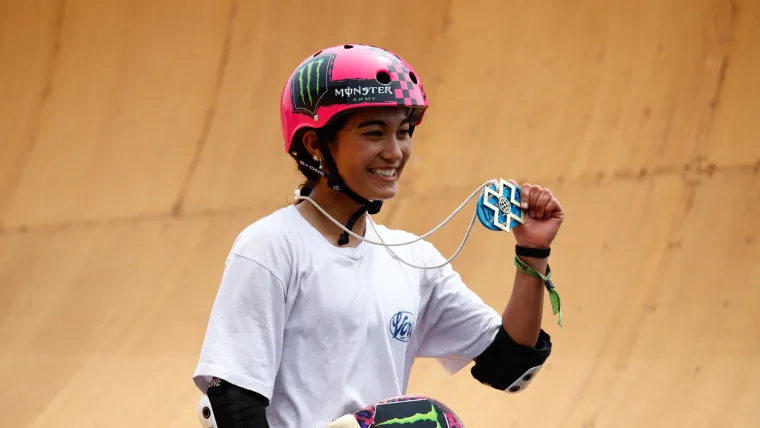
Skateboarding: No minimum Yes, you read that right. Skateboarding, which made its Olympic debut at the Tokyo 2020 Games, has zero age floor. The result? At the Paris 2024 Olympics, 11-year-old Zheng Haohao of China became the youngest competitor in the entire Games. She wasn't even 12 yet. Thailand's Vareeraya Sukasem was 12, and Finland's Heili Sirvio was 13.
Wrestling: 18 Like boxing, wrestling sets a firm 18-year-old minimum.
Shooting: No minimum Shooting events also have no age limit, which is why you occasionally see remarkably young shooters and remarkably old ones in the same competition.
Equestrian: No minimum Another ageless sport. Lorna Johnstone of Great Britain competed in equestrian at the 1972 Munich Olympics at age 70, which tells you everything you need to know about how far a horse can take you.
The Youngest Olympians in History
Since there's been so much variation over the decades, the Olympics have produced some genuinely jaw-dropping youth stories.
The youngest athlete in modern Olympic history is Dimitrios Loundras of Greece, who competed in gymnastics at the very first modern Games in Athens in 1896. He was 10 years old and won a bronze medal. That record has stood for over a century and probably won't be touched given how much stricter age rules have become in gymnastics.
On the gold medal side, South Korean speed skater Kim Yun-mi won gold in the women's 3,000-meter relay at the 1994 Lillehammer Winter Olympics at just 13 years and 86 days old. Shortly after, the International Skating Union raised its minimum qualifying age to 15.
Perhaps the most famous young Olympian ever is Romanian gymnast Nadia Comaneci, who was just 14 when she received the first perfect 10.0 score in Olympic gymnastics history at the 1976 Montreal Games. That kind of performance is what raises the bar (pun intended) and eventually leads to stricter age rules.
More recently, at the 2026 Milan-Cortina Winter Olympics, American freeskier Abby Winterberger represented Team USA at just 15 years old, having started skiing at age two and competing by age six.
Is There a Maximum Age?
No. There is genuinely no maximum age written into Olympic rules, and athletes have proven that at remarkable levels.
Swedish shooter Oscar Swahn won a silver medal at the 1920 Antwerp Olympics at the age of 72, making him the oldest medalist in Olympic history. He had won gold at 64 in the 1912 Stockholm Games, which makes him the oldest Olympic gold medalist ever. The man peaked in his 60s.
In gymnastics, Uzbekistan's Oksana Chusovitina competed at the Tokyo 2020 Olympics at 46 years old. She had been competing in major gymnastics events since the early 1990s. Her career spans more than three decades.
The Youth Olympics: A Separate Stage
If you're a young athlete who doesn't quite meet the age or qualification bar for the main Olympics, there's another option worth knowing about. The Youth Olympic Games, established by the IOC in 2007 and first held in 2010, is exclusively for athletes between the ages of 15 and 18. It runs on a four-year cycle, staggered from the main Games, and covers most of the same sports.
It's a legitimate proving ground and a genuine international competition in its own right, not just a consolation bracket.
The Bottom Line
There's no single answer to how old you have to be to compete in the Olympics, and that's kind of the point. The Games are designed to be as inclusive as possible across a massive range of sports, each with different physical demands and different ideas about when athletes are ready to compete at the elite level.
If you're a gymnast, you need to be 16. If you're a skateboarder, you can be 11 and still make the podium. If you're a shooter or an equestrian, your age is genuinely irrelevant as long as you can hit the target or stay in the saddle.
What matters most isn't the birth certificate. It's whether you're good enough. The rest is paperwork.
For more Olympics coverage and sports content, check out our Olympics section and our piece on how often the Olympics is held. And if you want to stay up with everything we're publishing, subscribe here.