How Long Will the MLB Lockout Last? Longer Than the Last One, I Think
No MLB lockout has started. Owners want a salary cap and players oppose it. If a lockout happens, I think it could outlast the last one's 99 days. Here's why.
No MLB lockout has started as of Nov. 12, 2026. The current collective bargaining agreement expires at 8:59 p.m. Pacific on Dec. 1, 2026. Expiration alone doesn't shut baseball down. Owners would have to decide to lock players out, and Commissioner Rob Manfred has already said MLB will do that if there's no deal, per FanSided. On Nov. 3, 2026, the owners made what was supposed to be a softer offer: they pushed their proposed salary cap back a year, to 2028, and raised the numbers to a $258.2 million cap and a $180.2 million floor (MLB.com). The players' union turned it down the same day. Its statement said the owners "continue to propose blowing up the current system." No new proposal from either side has been reported since then.
A lockout is widely expected. On Nov. 12, MLB Trade Rumors wrote there's "essentially no chance" of a new deal before Dec. 1. It still isn't official until the owners do it. If owners impose one, the question I care about is how long it goes.
My prediction, if a lockout happens: longer than the 99 days of the last one. My guess is that it runs through most of spring training and delays the regular season by at least a week or two. That wouldn't necessarily mean permanently lost games. I don't think it costs the whole season. Here's why I land there.
How long will the MLB lockout last? No lockout has begun, so there is no known duration. Anyone who gives you an exact end date is guessing. The last lockout ran 99 days, from Dec. 2, 2021, to March 10, 2022. The current talks are over whether baseball should have a salary cap at all, the same fight that caused the 232-day strike in 1994 and 1995. I expect it to last longer than 99 days.
Every MLB Work Stoppage, and What Each One Cost
Baseball has had nine work stoppages, five strikes and four lockouts. Here's the full list, from CNN's timeline, CBS Sports and Wikipedia's pages on the 1994-95 strike and the 2021-22 lockout.
| Years | Type | Dates | Calendar days* | Regular-season games permanently lost | Main fight |
|---|---|---|---|---|---|
| 1972 | Strike | April 1-13, 1972 | 13 | 86 | Pensions |
| 1973 | Lockout | Feb. 8-25, 1973 | 18 | 0 | Salary arbitration |
| 1976 | Lockout | March 1-17, 1976 | 17 | 0 | Free agency |
| 1980 | Strike | April 1-8, 1980 | 8 | 0 | Free-agent compensation |
| 1981 | Strike | June 12-July 31, 1981 | 50 | 712 | Free-agent compensation |
| 1985 | Strike | Aug. 6-7, 1985 | 2 | 0 (made up) | Pensions, arbitration |
| 1990 | Lockout | Feb. 15-March 18, 1990 | 32 | 0 (Opening Day moved a week) | Arbitration, revenue sharing, a proposed cap |
| 1994-95 | Strike | Aug. 12, 1994-March 31, 1995 | 232 | 938 (CBS count), plus the entire postseason | Salary cap |
| 2021-22 | Lockout | Dec. 2, 2021-March 10, 2022 | 99 | 0 (Opening Day moved a week) | Luxury tax, minimum salary, pre-arbitration pay |
*Days count both dates shown, including the settlement date; they are not a count of full 24-hour periods. That makes Feb. 8-25, 1973, 18 calendar days, although CNN reports 17. For 1994-95, the table uses CBS's March 31 injunction endpoint and its 938-game figure. CNN instead lists April 2 as the end date while still reporting 232 days. Wikipedia lists 948 games lost in 1994-95 and 713 in 1981, against CBS's 938 and 712. Those disputed game totals are source-reported figures, not a settled recount. The 1985 and 2022 games were rescheduled, not permanently lost; 1990's delayed opener also left the full schedule intact. The 2022 row is confirmed by MLB's agreement report and revised schedule.
Six of the nine stoppages didn't cost a single regular-season game for good. That's the optimist's case, and I'll get to it. But look at the two rows where a cap was on the table. In 1990, when CNN lists the cap as one of the issues, the lockout ended in 32 days and baseball still has no cap. In 1994, the owners insisted on one, and baseball lost the World Series. Right now, the owners are acting a lot more like 1994 than 1990.
The Last Lockout Was a Fight Over Numbers. These Talks Go Further
Here's the part that convinces me this one runs long. By the end of the 2021-22 talks, the two sides were mostly arguing about how big the numbers in the existing system should be, and on some of them they were close. On March 9, 2022, the union's proposed league minimum was $710,000 and the league's was $700,000, a $10,000 gap, according to the Wikipedia account of the talks. The final deal included a $50 million pre-arbitration bonus pool. The minimum-salary gap wasn't the whole dispute: the international draft remained a major disagreement even that late in the talks.
Even with the sides that close on some of the numbers, it took 99 days, and MLB initially announced the first two series were canceled on March 1. The eventual agreement restored a full 162-game schedule. Opening Day moved from March 31 to April 7, and those games were rescheduled rather than permanently lost.
This time, the sides aren't arguing over how much. They're arguing over whether. MLB has tied almost everything it's offering (earlier free agency, a $1 million minimum salary for players with at least two years of service, a bigger pre-arbitration pool) to the union accepting a cap and floor. The union keeps saying a cap is a non-starter. Sports Illustrated put it plainly after the Nov. 3 offer: the 2021-22 dispute "was over the terms of baseball's existing economic system, while this time owners want to replace it entirely."
You can split the difference on a minimum salary. You can't split the difference on whether a hard cap exists.
| 2021-22 lockout | Now | |
|---|---|---|
| CBA expiration | Dec. 1, 2021 | Dec. 1, 2026 |
| What the owners wanted | First offer: a $100 million payroll minimum and a luxury tax starting at $180 million | A hard cap of $258.2 million and a floor of $180.2 million, starting in 2028 |
| What the players wanted | Better pay for young players, limits on tanking | Keep the luxury tax, raise the threshold from $244 million to $300 million |
| Core question | How big the numbers should be (the minimum salary gap got down to $10,000) | Whether a cap exists at all |
| Scheduled Opening Day | March 31, 2022 | Opening Night on March 24, 2027, traditional Opening Day March 25 |
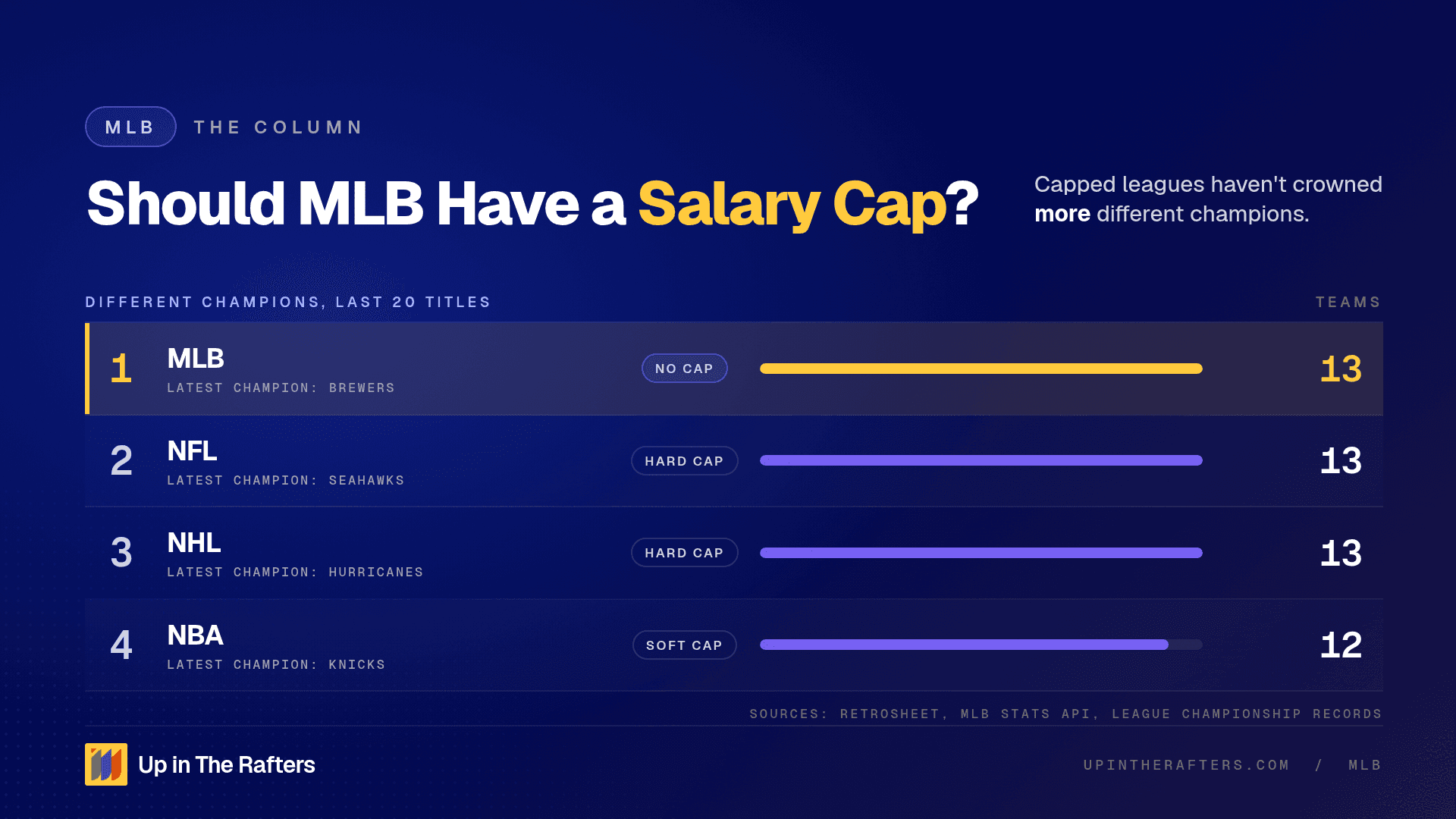
The MLB proposal and the union's threshold numbers are from MLB.com, NBC Sports Philadelphia's tracker and Sports Illustrated. I wrote about why I don't think baseball needs a cap in the first place in Should MLB Have a Salary Cap?, so I won't repeat that argument here. This piece is about the calendar.
The Calendar Is Tighter This Time
The 2027 schedule makes a long lockout hurt sooner. MLB announced that the 2027 season opens with a Netflix game on Wednesday, March 24, followed by 14 games on Thursday, March 25. MLB says that's the earliest traditional Opening Day in league history, not counting special and international openers. Spring training games start Friday, Feb. 19, 2027.
Here's some quick math. If a lockout starts right after the deal expires and lasts exactly as long as the last one, 99 days, it ends on March 10, 2027. That would leave 14 days before Opening Night. In 2022, the lockout ended on March 10 too, but Opening Day was originally March 31, three weeks later, and it still had to move back a week. I think a repeat of 2021-22 on this calendar would push Opening Day back. A longer lockout could leave games to reschedule, or eventually cancel. The timing alone doesn't tell us which.
Our history of MLB Opening Day looks at why that date means so much to people. The 1995 season is the cautionary one here. Because of the strike, teams played 144 games that year instead of 162, per Wikipedia.
Both Sides Have Saved Up for This
Both sides have been preparing financially for a stoppage. In February 2026, MLB Trade Rumors, citing the New York Post, reported that the owners had set aside a war chest of about $2 billion, roughly $75 million per team, from a central fund. The union made similar preparations. MLB Trade Rumors also noted that this is standard when a deal is expiring, which is fair. Those reserves could make it easier to hold out in December or January. They don't tell us when either side would feel pressure to settle.
Commissioner Rob Manfred has admitted concern that a long work stoppage could be coming, CBC Sports reported on Nov. 7, 2026. And the people around the game aren't sounding confident either. In an anonymous ESPN survey of players, as relayed by ClutchPoints, one National League starting pitcher said, "I don't think we're playing until June." Asked how many games players might miss, another NL starter said, "As many as it takes, but the lockout's not up to us." When FanSided asked executives and agents for predictions, the answers ran from "a similar timeframe as 2021-22" to "we won't play meaningful baseball until June, if not July."
Those are guesses, same as mine. The range is wide, which tells you nobody inside the game is sure either. The betting market isn't much more hopeful. The Los Angeles Times reported on Nov. 10 that only 39% of Kalshi bettors expect the full 162-game schedule to be played next year.
This Week Pointed the Same Way
The general managers met in Las Vegas from Nov. 10 to 12, and the public line from front offices was "business as usual." Mets president of baseball operations David Stearns told FOX Sports, "We're here preparing for a business-as-usual offseason, a business-as-usual season." The calendar won't be normal, though. The Winter Meetings, set for Dec. 7 to 9 in San Diego, are expected to be canceled if there's a lockout, and the major-league Rule 5 Draft may not happen on time, per Sportsnet. Agent Scott Boras used his annual news conference at the meetings to say players are "emboldened with truth" and won't break no matter how long it lasts, according to USA Today's report as relayed by RG.
The bigger news was about what happens if the talks go nowhere. On Nov. 10, the Los Angeles Times laid out how the owners could eventually declare an impasse and impose their last offer, cap included. Owners tried that during the 1994-95 strike, and the National Labor Relations Board and Judge Sonia Sotomayor ruled against them, which put the old agreement back in place. On Nov. 12, MLB Trade Rumors, citing Jared Diamond of The Wall Street Journal, reported that MLB is preparing for the chance that the union files a disclaimer of interest, which means it would stop acting as a union so players could sue the league under antitrust law. MLB Trade Rumors said that likely wouldn't happen until deep into a lockout, if at all. The Times noted that impasse, decertification and any involvement from President Trump could all take longer to resolve than the roughly four months before games are at risk. None of those are fast ways out.
The Best Case for a Quick Deal
There's a real argument that I'm wrong, and it's a good one.
Manfred's contract runs through January 2029, and he has said he doesn't plan to seek another term, per MLB Trade Rumors. A long stoppage would be a rough way to leave. MLB also wants a big payday when a large number of its broadcast deals expire after the 2028 season, and canceled games would hurt the sport's popularity right before that. One executive told FanSided there's "too much at stake to risk an extended or perceived duel over billions," pointing to the Padres' sale for almost $4 billion.
History is on that side, too. Six of the nine stoppages in the table above didn't cost a regular-season game for good, and the last one saved a full 162-game season. The owners have also already moved once. Pushing the cap back to 2028 and raising its number by almost $13 million isn't nothing.
I take all of that seriously. It's why I don't think the whole 2027 season is in danger. But every one of those points is about the cost of a long lockout, and both sides knew that cost in 1994 too. What actually decides the length is whether either side gives on the cap, and on Nov. 3, 2026, neither did.
What It Could Mean for the Yankees
The Yankees are one of the eight teams MLB says would have to cut payroll to meet its proposed cap, based on end-of-season 2026 payrolls. The others are the Dodgers, Mets, Phillies, Blue Jays, Padres, Red Sox and Cubs (MLB.com). That is a comparison with the proposal, not a rule the Yankees already have to follow. The union has not accepted it.
Questions People Are Asking
Is MLB in a lockout right now? No, not as of Nov. 12, 2026. The current CBA is still in force. Its expiration would not automatically trigger a lockout.
Will there be an MLB lockout? It's widely expected. Commissioner Rob Manfred has said MLB will lock players out if there's no deal. NBC Sports Philadelphia reports that owners are expected to impose a lockout if there's no deal when the CBA expires, and Sports Illustrated called it "all but assured" after the Nov. 3 proposal.
When does the MLB CBA expire? At 8:59 p.m. Pacific on Dec. 1, 2026.
How long was the last MLB lockout? 99 days. The usual league-date range is Dec. 2, 2021, through March 10, 2022. Opening Day moved from March 31 to April 7, and all 162 games were played.
What happens during an MLB lockout? Major-league signings and trades stop, and so does communication between teams and players, per NBC Sports Philadelphia. A lockout doesn't automatically cancel games. A delay can lead to postponements that are made up later; a long enough disruption could also shorten the season.
Will the MLB season start on time? Opening Night is scheduled for March 24, 2027. If a lockout runs as long as the last one, it would end about two weeks before that, which in 2022 wasn't enough time to keep the original Opening Day.
What would a lockout mean for the Yankees? Under MLB's Nov. 3 proposal, the current luxury-tax system would remain in 2027 and a $258.2 million cap would start in 2028. That would require union agreement; it isn't an adopted rule.
Final Thoughts
I'd love to be wrong about this. The Brewers just won their first World Series title and the sport has momentum. But the last lockout took 99 days, and near the end the two sides were $10,000 apart on the minimum salary. These talks start with the owners asking for a cap and the players saying no to any cap. If owners impose a lockout and neither side moves on that, I'm expecting it to run past 99 days and delay the start of the season. That's my prediction, not a timetable.
How I put this together: the stoppage history comes from CNN, CBS Sports and Wikipedia, with conflicting counts noted below the table. The 2027 dates come from MLB's schedule and spring training announcements. The current status is cross-checked against CBS's Nov. 3 report. The current proposals come from MLB.com, the MLBPA's Nov. 3, 2026 statement, NBC Sports Philadelphia and Sports Illustrated. This week's updates come from the Los Angeles Times, MLB Trade Rumors (citing The Wall Street Journal), FOX Sports, FanSided, Sportsnet and USA Today's report on Boras. The 2026-27 lockout hasn't started as of Nov. 12, 2026, and the prediction in this post is my opinion.
Sources
Matt's first sports memories are Kobe dropping 81, LaDainian Tomlinson making defenders look silly, and Derek Jeter somehow always coming through in October. He's been hooked ever since.
Think a number is off? Tell us, or check the Corrections page.