Up in The Rafters
Should MLB Have a Salary Cap? No. Baseball Needs a Floor
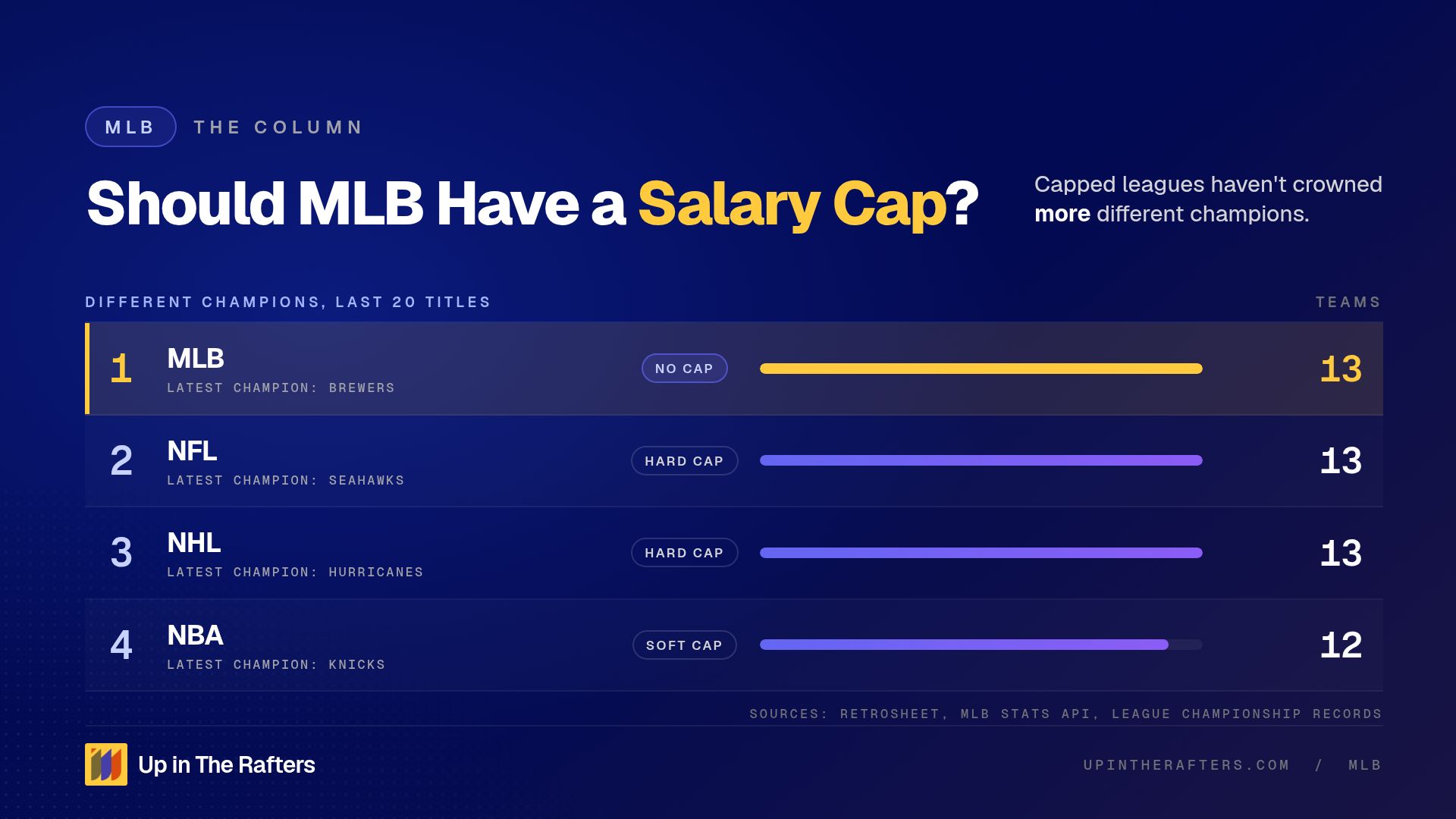
Should MLB have a salary cap? No. Over the last 20 titles, the NFL, NBA and NHL haven't crowned more different champions than baseball, and both World Series teams spent less than the owners' own proposed floor. The fix is a floor, not a cap.
MLB's collective bargaining agreement expires at 11:59 p.m. ET on Dec. 1, 2026, and almost nobody expects a new deal by then. The owners want a hard salary cap for the first time since 1994. The players' union chief, Bruce Meyer, called that proposal a "nuclear bomb," according to the Associated Press. MLB Trade Rumors expects the league to lock the players out as soon as the deal runs out, and the Sports Business Journal reported that both sides called an extension to avoid one unlikely.
So, should MLB have a salary cap? My answer is no. I went back through the last 20 champions in all four major North American leagues, and the three leagues with caps haven't spread titles around any better than baseball has. What I saw in the 2026 postseason points to a different problem. Big payrolls buy a ticket to October. Low payrolls rarely get one, and that's because too many teams at the bottom don't spend. That's a floor problem, not a cap problem.
Does MLB have a salary cap? No. MLB is the only one of the four major North American leagues without a salary cap. It uses a competitive balance tax, often called the luxury tax, instead. Teams can spend past the threshold, which was $244 million in 2026, but they pay a tax on the overage. The owners have proposed a hard cap of $245.3 million and a floor of $171.2 million starting in 2027.
What's Actually on the Table
Both sides made their opening economic offers in late May 2026, and they're still far apart. Here's what each side wants (a dash means that side's published summary didn't address it), based on MLB.com, the MLBPA, MLB Trade Rumors and Sportsnet:
Issue | Owners' proposal | Players' proposal |
Top of the payroll | Hard cap of $245.3 million in 2027. No team can go over | Luxury tax threshold rises from $244 million to $300 million in 2027, then $15 million a year |
Bottom of the payroll | Hard floor of $171.2 million | "Competitive integrity tax" on teams that spend under $150 million |
Revenue | Players guaranteed 50% of "baseball revenue" | Bigger revenue sharing, with every small-market club guaranteed at least $240 million a year |
Local TV money | Pooled and shared equally by all 30 teams | — |
Minimum salary | — | $1.5 million, up from $780,000 |
MLB's own numbers show how big the change would be. Based on 2026 Opening Day payrolls, eight teams would have to cut a combined $578 million to get under the cap: the Dodgers, Mets, Yankees, Blue Jays, Phillies, Red Sox, Padres and Braves. Twelve teams would have to add a combined $617 million to reach the floor: the Marlins, Guardians, Rays, White Sox, Cardinals, Nationals, Pirates, Twins, Brewers, Athletics, Rockies and Reds. That's from the league's Level the Playing Field page.
Look at that second list again. It includes the Brewers, who won the World Series on Oct. 28, 2026. It also includes the Rays, the team they beat. Both World Series teams spent less than the floor MLB wants to require.
Capped Leagues Don't Crown More Champions
The case for a cap is competitive balance. Commissioner Rob Manfred said in July 2026 that fans "at the beginning of the season" need "a realistic belief that their team has a chance to win," as quoted by NBC New York. If caps deliver that, the NFL, NBA and NHL should have a wider spread of champions than MLB does.
They don't. I counted the last 20 champions in each league, from 2007 through 2026. For the NFL, that's Super Bowl XLI in February 2007 through Super Bowl LX in February 2026.
League | Pay system | Different champions, last 20 titles | Different champions, last 10 titles | Most titles by one team, last 20 |
MLB | No cap (luxury tax) | 13 | 7 | 3 (Red Sox, Giants, Dodgers) |
NFL | Hard cap | 13 | 6 | 3 (Patriots, Chiefs) |
NHL | Hard cap | 13 | 8 | 3 (Penguins, Blackhawks) |
NBA | Soft cap with luxury tax | 12 | 8 | 4 (Warriors) |
Baseball, with no cap at all, ties the NFL and NHL over 20 years and beats the NBA. Over the last 10, MLB has had more different champions than the NFL. The Dodgers have won three of the last seven World Series (2020, 2024 and 2025), and that run is a big part of why owners say the system is broken. The Chiefs won three Super Bowls in five years, and the Warriors won four NBA titles in eight, both under a cap.
Recent champions look the same. The NBA's 2026 champion was the Knicks, who beat the Spurs 4-1 for their first title since 1973 (NBA.com). The Hurricanes won the 2026 Stanley Cup in six games over Vegas (NHL.com). The Seahawks beat the Patriots 29-13 in Super Bowl LX (AP). And baseball's champion came out of the smallest market in the sport, which I wrote about in the Brewers' first World Series title.
Parity in the other leagues comes from more than the cap anyway. The NBA's cap is a soft one (I broke down where that league's money comes from in the economics of the NBA). CBS Sports cited Sportico figures showing the NFL gets 66% of its revenue from national sources and MLB only 26%. That gap explains more about money in baseball than the lack of a cap does.
What the 2026 Postseason Says About the Cap and the Floor
Here's where I split the 30 teams into MLB's own three groups and checked how each did in October 2026, using MLB's Stats API.
2026 Opening Day payroll (MLB's groups) | Teams | Made playoffs | Reached LCS | Reached World Series | Won it all |
Over the proposed cap ($245.3M) | 8 | 6 | 1 (Dodgers) | 0 | 0 |
In between | 10 | 2 (Astros, Cubs) | 0 | 0 | 0 |
Under the proposed floor ($171.2M) | 12 | 4 (Guardians, Rays, White Sox, Brewers) | 3 | 2 | 1 (Brewers) |
Two things are true at once. Six of the eight biggest spenders made the playoffs. Only four of the 12 lowest spenders did. Money gets you in. But once the field was set, three of the four LCS teams were from the bottom group, and the most expensive teams didn't win a pennant. The Yankees were swept in the ALDS, and the Brewers swept the Dodgers in the NLCS.
A cap goes after the top of that table, but the top isn't where the problem is. The real problem is the eight low-payroll teams that missed October, and the cap doesn't make any of them spend a dollar. Only the floor does that.
The Floor Is the Part That Fixes Something
The owners deserve credit for one thing here. Their proposal includes a real floor. Twelve teams would have to add $617 million in payroll, and MLB says equal sharing of local media money would help pay for it. That would do more for a fan in Pittsburgh or Miami than cutting $578 million from the eight biggest spenders.
The union wants a floor too, just a softer one. Its "competitive integrity tax" would kick in under $150 million, and 11 teams were projected to be under that in 2026, according to The Athletic, citing Cot's Contracts. The players also want teams penalized if they don't spend revenue-sharing money on payroll, per Sportsnet, which reported the details obtained by the AP.
So both sides already agree that teams at the bottom should have to spend. The fight is over the cap, and that's the piece the evidence supports least. If I were negotiating, I'd take the floor, the local TV pooling and spending rules on revenue-sharing money, and I'd drop the cap.
The Best Argument Against Me
The best case for a cap isn't parity. It's the Dodgers. The AP put their 2026 Opening Day payroll at $415.2 million, about $170 million over the proposed cap. They won back-to-back titles in 2024 and 2025 and were going for a third straight in 2026, something no team has done since the 1998-2000 Yankees, as CBS Sports noted. Even Brewers owner Mark Attanasio, whose team just won it all, supports a cap. Manfred told the Sports Business Journal that the Brewers have been well run "forever," but that getting to the World Series "once every 40 years is not enough." MLB also points out that the NFL, NBA and NHL, which all split revenue close to 50-50 with their players, haven't had a work stoppage in a decade (MLB.com).
That's a fair argument, and the 6-of-8 playoff number above backs part of it. Spending gives a team more chances at October. But the Dodgers lost to the Brewers in 2026, and nothing in the 20-year table suggests a cap would stop one great organization from stacking titles. The Patriots and Chiefs did it under a hard cap. A cap also comes with a cost the owners don't put in their ads. The last time owners proposed one, in 1994, it led to a 7 1/2-month strike and the first canceled World Series in 90 years, according to the AP. The last lockout, in 2021-22, lasted 99 days (NBC New York).
Why This Hits Home for Me
My dad Steve and I both root for the Yankees, so you could argue I'm protecting my own team here. The Yankees are one of the eight teams that would have to cut payroll under the owners' plan. But Yankees owner Hal Steinbrenner is one of the owners backing the cap, per the Sports Business Journal. The Yankees also spent more than almost anyone in 2026 and were swept in the Division Series. My objection isn't that the Yankees would lose an edge. A cap aims at a problem the evidence doesn't show, and it risks real games in 2027 while it does.
When does the MLB CBA expire? At 11:59 p.m. ET on Dec. 1, 2026. The 2027 regular season is scheduled to start March 24, 2027.
Will there be an MLB lockout? It's widely expected. MLB Trade Rumors, citing Manfred and Meyer, reported there's no real chance of a temporary extension, and the league sent teams a memo with lockout procedures.
What is the proposed MLB salary cap? $245.3 million for 2027, with a $171.2 million floor, both measured with luxury-tax payrolls, which MLB projects will include about $23 million per team in benefits.
What's the difference between a salary cap and a luxury tax? A hard cap is a limit no team can go over. A luxury tax lets teams spend past a threshold as long as they pay a penalty on the overage.
Which MLB teams would have to cut payroll under a cap? Based on 2026 Opening Day payrolls, the Dodgers, Mets, Yankees, Blue Jays, Phillies, Red Sox, Padres and Braves.
Final Thoughts
MLB doesn't need a salary cap. Twenty years of champions show baseball spreads titles around about as well as leagues that have one. MLB's own numbers show the real gap is at the bottom, where 12 teams opened 2026 below the floor the league itself is proposing. A floor fixes that. A cap mostly fixes the Dodgers, and it could cost everybody a season. If the owners want the floor, they should take it and leave the cap out.
How I got the numbers: the champions come from Wikipedia's championship lists for the Super Bowl, NBA Finals and Stanley Cup, plus Retrosheet's World Series game logs for 2007 through 2025, and I checked each 2026 champion against league or AP reports. The 2026 playoff results come from MLB's Stats API. The cap and floor groups are MLB's own, built from 2026 Opening Day luxury-tax payrolls. (The information used here was obtained free of charge from and is copyrighted by Retrosheet. Interested parties may contact Retrosheet at www.retrosheet.org.)
If you want to know how the October bracket works, here's how the MLB playoffs work. For the last time baseball's rules changed in a big way, read about how the pitch clock and rule changes changed baseball.
Sources: