Up in The Rafters
What Is a Walk-Off in Baseball? I Counted 2,149 MLB Walk-Offs
A walk-off ends a baseball game the moment the home team takes the lead in its last at-bat. Here's how the rule works, every way a game can walk off, and what 2,149 MLB walk-offs show, including how the extra-inning runner made the walk-off home run rarer.

A walk-off is the play that ends a baseball game the moment the home team takes the lead in its last turn at bat. It happens in the bottom of the ninth inning or an extra inning. The visiting team has already batted, so there's nothing left to play. The home team wins on the spot, and the other team walks off the field.
It's more common than it feels. I went through every MLB regular-season game from the 2016 season through the 2026 season, 25,193 of them, and 2,149 ended in a walk-off. That's 8.5%, or about 1 in every 12 games.
Here's how the rule works, all the ways a game can walk off, and what those 2,149 endings show, including how the extra-inning runner made the walk-off home run a lot rarer.
The Walk-Off Rule in Plain English
The rulebook never uses the word "walk-off." It just says what happens when the home team gets the winning run across in its final at-bat. Rule 7.01(e)(3) of the 2026 Official Baseball Rules says that if the home team scores the winning run in its half of the ninth inning, or its half of an extra inning after a tie, "the game ends immediately when the winning run is scored."
Three details matter:
Home runs are the exception. If the last batter hits the ball out of the park, he and everyone on base get to score, and the game ends when he touches home plate (Rule 7.01(e)(3), Exception). That's the only way a walk-off wins by more than one run.
Any other hit only counts what was needed. On a walk-off single, double or triple, the game ends as soon as the winning run scores. Under Rule 9.06(f), the batter gets credit only for as many bases as the runner who scored the winning run advanced, and only if he runs them out.
A bases-loaded walk or hit batter isn't over yet. Under Rule 5.08(b), the umpire can't end the game until the runner from third touches home and the batter touches first base.
That last rule is the one I'd make sure any young player knows. I played baseball growing up, and Steve coached baseball as an adult, including some of my teams. A bases-loaded walk in the last inning feels like the game is over, but under 5.08(b) it isn't until the batter touches first.
What counts as a walk-off
MLB's glossary lists a hit, an error, a bases-loaded walk or hit batter, a sacrifice fly, an out with fewer than two outs, a wild pitch, a passed ball and a balk. If the play scores the winning run and ends the game, it's a walk-off. Only the home team can get one, because the visitors never bat in the bottom of an inning.
Where the word came from
Hall of Fame reliever Dennis Eckersley gets credit for the term. According to MLB.com, the first printed reference came in a Gannett News Service story on July 30, 1988: "In Dennis Eckersley's colorful vocabulary, a walkoff piece is a home run that wins the game and the pitcher walks off the mound." He meant it about the pitcher who gave it up, not the hitter who got mobbed at home plate.
All the Ways a Game Walks Off
Here's how all 2,149 walk-offs from 2016 through 2026 ended, based on the final play of each game.
How the game ended | Walk-offs | Share |
Single | 920 | 42.8% |
Home run | 690 | 32.1% |
Double | 154 | 7.2% |
Sacrifice fly | 117 | 5.4% |
Fielder's choice, groundout or forceout | 74 | 3.4% |
Walk | 72 | 3.4% |
Wild pitch | 45 | 2.1% |
Error | 25 | 1.2% |
Triple | 16 | 0.7% |
Hit by pitch | 14 | 0.7% |
Sacrifice bunt | 7 | 0.3% |
Balk | 5 | 0.2% |
Passed ball | 4 | 0.2% |
Other | 6 | 0.3% |
Regular season only. "Other" is two strikeouts where the winning run scored anyway (one on a passed ball and throwing error, one on a throw to first), three stolen-base plays where the winning run scored on an error or wild pitch, and one catcher's interference with the bases loaded.
The single is the most common way to walk off, not the home run. And because every non-homer ends the game as soon as the winning run scores, 1,865 of the 2,149 walk-offs (86.8%) were won by exactly one run. All 284 that were won by two or more were home runs, 54 of them grand slams.
How Often Walk-Offs Happen
Season | Games | Walk-offs | Share of games | In extra innings | Home team was trailing |
2016 | 2,428 | 191 | 7.9% | 93 | 48 |
2017 | 2,430 | 204 | 8.4% | 96 | 52 |
2018 | 2,431 | 214 | 8.8% | 117 | 49 |
2019 | 2,429 | 202 | 8.3% | 99 | 58 |
2020 | 898 | 80 | 8.9% | 35 | 34 |
2021 | 2,429 | 225 | 9.3% | 110 | 67 |
2022 | 2,430 | 209 | 8.6% | 113 | 81 |
2023 | 2,430 | 192 | 7.9% | 96 | 70 |
2024 | 2,429 | 208 | 8.6% | 107 | 65 |
2025 | 2,430 | 222 | 9.1% | 110 | 70 |
2026 | 2,429 | 202 | 8.3% | 102 | 79 |
Total | 25,193 | 2,149 | 8.5% | 1,078 | 673 |
"Home team was trailing" means it was behind when it came up for its last at-bat, not tied. The 2020 season was cut to 898 games, and in 2020 and 2021 doubleheader games were scheduled for seven innings, so 27 of these walk-offs came in the seventh inning.
The rate barely moves. Every season from 2016 through 2026 landed between 7.9% and 9.3%. Walk-offs also made up 16.0% of all home wins in that span, about one of every six.
Walk-offs over the long run
The rate hasn't changed much in more than a century, either. Using Retrosheet's game logs, here's the share of MLB regular-season games that ended in a walk-off by decade.
Decade | Games | Walk-offs | Share of games |
1901-1909 | 10,752 | 864 | 8.0% |
1910s | 13,319 | 1,222 | 9.2% |
1920s | 12,318 | 1,170 | 9.5% |
1930s | 12,307 | 1,148 | 9.3% |
1940s | 12,372 | 1,180 | 9.5% |
1950s | 12,373 | 1,168 | 9.4% |
1960s | 15,961 | 1,595 | 10.0% |
1970s | 19,802 | 1,916 | 9.7% |
1980s | 20,337 | 1,957 | 9.6% |
1990s | 21,593 | 1,936 | 9.0% |
2000s | 24,291 | 2,115 | 8.7% |
2010s | 24,297 | 2,150 | 8.8% |
2020-2025 | 13,046 | 1,140 | 8.7% |
From 1901 through 2025, 19,561 of 212,768 games ended in a walk-off, 9.2%. The 1960s had the highest rate, and every decade since the 1990s has been a little under 9%. I don't know why, and I'm not going to guess.
The Extra-Inning Runner Changed the Walk-Off
This is the part that surprised me. Starting in 2020, every extra half-inning in the regular season begins with a runner on second base. MLB added the rule in 2020 and made it permanent before the 2023 season. It's Rule 7.01(b)(2) in the current rulebook, and it doesn't apply in the postseason.
The share of games that end in a walk-off didn't change. How they end did.
2016-2019 | 2020-2026 | |
Extra-inning walk-offs won with a home run | 37.3% (151 of 405) | 17.4% (117 of 673) |
Extra-inning walk-offs won with a single | 36.8% (149 of 405) | 54.4% (366 of 673) |
Extra-inning walk-offs won with a sacrifice fly | 4.2% (17 of 405) | 8.0% (54 of 673) |
Extra-inning walk-offs that ended in the first extra inning | 43.7% (177 of 405) | 72.8% (490 of 673) |
Extra-inning walk-offs where the home team was trailing | 11.1% (45 of 405) | 29.7% (200 of 673) |
All walk-offs won with a home run | 39.5% (320 of 811) | 27.7% (370 of 1,338) |
With a runner already on second, a single or a deep fly ball can win it, so the home team doesn't need a homer. The visitors also start their half with that runner, so the home team comes up trailing far more often. Most extra-inning walk-offs now end in the first extra inning.
One thing that didn't change much: the home team's record in extra innings. It won 51.2% of extra-inning games from 2016 through 2019 (405 of 791) and 49.5% from 2020 through 2026 (673 of 1,360). Every one of those home wins was a walk-off, since an extra-inning game can only end with a home win in the bottom half.
The Biggest Walk-Off Comebacks
Most walk-offs start from a tie.
Home team entering its last at-bat | Walk-offs | Share |
Tied | 1,476 | 68.7% |
Down 1 | 463 | 21.5% |
Down 2 | 146 | 6.8% |
Down 3 | 36 | 1.7% |
Down 4 or more | 28 | 1.3% |
The biggest deficit any team came back from in its final at-bat in this stretch was six runs, and it happened five times, all in the ninth inning:
May 28, 2016: The Royals trailed the White Sox 7-1 and won 8-7 on a Brett Eibner single.
April 9, 2017: The Angels trailed the Mariners 9-3 and won 10-9 on a Cliff Pennington single.
July 30, 2017: The Blue Jays trailed the Angels 10-4 and won 11-10 on a Steve Pearce grand slam.
September 20, 2018: The Blue Jays trailed the Rays 8-2 and won 9-8 on a Justin Smoak home run.
September 3, 2019: The Nationals trailed the Mets 10-4 and won 11-10 on a Kurt Suzuki three-run homer.
That Pearce slam was his second walk-off grand slam in four days. He also hit one in the 10th inning against Oakland on July 27, 2017.
Who Hits the Most Walk-Off Home Runs
These are regular-season walk-off home runs from 2016 through 2026.
Hitter | Walk-off home runs (2016-2026) |
Manny Machado | 6 |
Paul Goldschmidt | 5 |
Carlos Santana | 5 |
Nolan Arenado | 5 |
Charlie Blackmon | 5 |
Will Smith | 5 |
Mike Yastrzemski | 5 |
Pete Alonso | 5 |
Kyle Schwarber | 5 |
Same caveat as any stretch like this: careers that started before 2016 have earlier walk-offs that aren't counted here.
By team, the Athletics had the most walk-off wins from 2016 through 2026 with 93, followed by the Mariners (91) and Giants (85). Steve and I are both Yankees fans, so here's the one I like best: the 2022 Yankees had 16 walk-off wins, the most by any team in a single season in this data. The next most was 13, by the 2022 Mariners and the 2026 Cubs. The Yankees had 74 walk-off wins over the full stretch.
The World Series Walk-Off Home Run
The walk-offs people remember most are in October. Through the 2025 World Series, there had been 19 walk-off home runs in World Series history, according to FOX Sports. A few that stand out:
Bill Mazeroski, 1960, Game 7. His homer for the Pirates beat the Yankees 10-9, and MLB.com calls it the only walk-off home run in a winner-take-all World Series game.
Joe Carter, 1993, Game 6. His homer won the World Series for Toronto over the Phillies.
Freddie Freeman, 2024 and 2025. His grand slam in Game 1 of the 2024 World Series against the Yankees is the only walk-off grand slam in World Series history, and his 18th-inning homer in Game 3 in 2025 against Toronto made him the first player with two World Series walk-off homers, per FOX Sports.
As a Yankees fan, I have to note that the Yankees are on both sides of that list. They hit four of the 19 (Tommy Henrich in 1949, Mickey Mantle in 1964, Chad Curtis in 1999 and Derek Jeter in 2001) and gave up four (Eddie Mathews in 1957, Mazeroski in 1960, Alex Gonzalez in 2003 and Freeman in 2024).
Postseason games don't use the extra-inning runner, so a long playoff game can still end the old way.
Quick Answers
What is a walk-off in baseball? A play that gives the home team the lead in the bottom of the ninth or an extra inning and ends the game right away.
Why is it called a walk-off? Dennis Eckersley coined it. The first printed use, in 1988, described a home run that wins the game while the pitcher walks off the mound.
Can the visiting team get a walk-off? No. The visitors always bat in the top of the inning, so the game can't end on their play.
Can a walk-off win by more than one run? Only on a home run. On any other play, the game ends as soon as the winning run scores.
How common are walk-offs? From 2016 through 2026, 2,149 of 25,193 MLB regular-season games ended in one, 8.5%, or about 1 in 12.
What's the most common walk-off? A single. It ended 42.8% of walk-offs from 2016 through 2026, ahead of the home run at 32.1%.
Who has the most walk-off home runs since 2016? Manny Machado, with six in the regular season from 2016 through 2026.
Final Thoughts
The walk-off home run is the one everybody pictures, but it's not the usual ending. Singles end more walk-offs than homers do, and since the runner-on-second rule came in, a single wins more than half of the extra-inning ones. What hasn't changed is how often it happens: about 1 in 12 games, season after season.
How I got the numbers: the 2016-2026 counts come from MLB's Stats API linescores and play-by-play for every final regular-season game. A walk-off here is a home win where the home team wasn't ahead going into its last at-bat, in a game that went at least its scheduled length. The type of walk-off is the official result of the game's final play. I checked it against Retrosheet. Its game logs give the same walk-off count in every season from 2016 through 2025 except 2020, along with the same deficits and the Yankees' 16 in 2022. Its event files give the same number of walk-off home runs, singles and grand slams in each of those seasons, again except 2020. The 2020 gap (MLB 80, Retrosheet 84) comes from a handful of rescheduled games where the designated home team wasn't the team whose ballpark it was. I used MLB's count because its play-by-play shows which team actually batted last. Retrosheet doesn't cover 2026 yet, so the 2026 numbers are MLB's alone. The decade table uses Retrosheet's game logs, 1901 through 2025. Playoffs aren't included. (The information used here was obtained free of charge from and is copyrighted by Retrosheet. Interested parties may contact Retrosheet at www.retrosheet.org.)
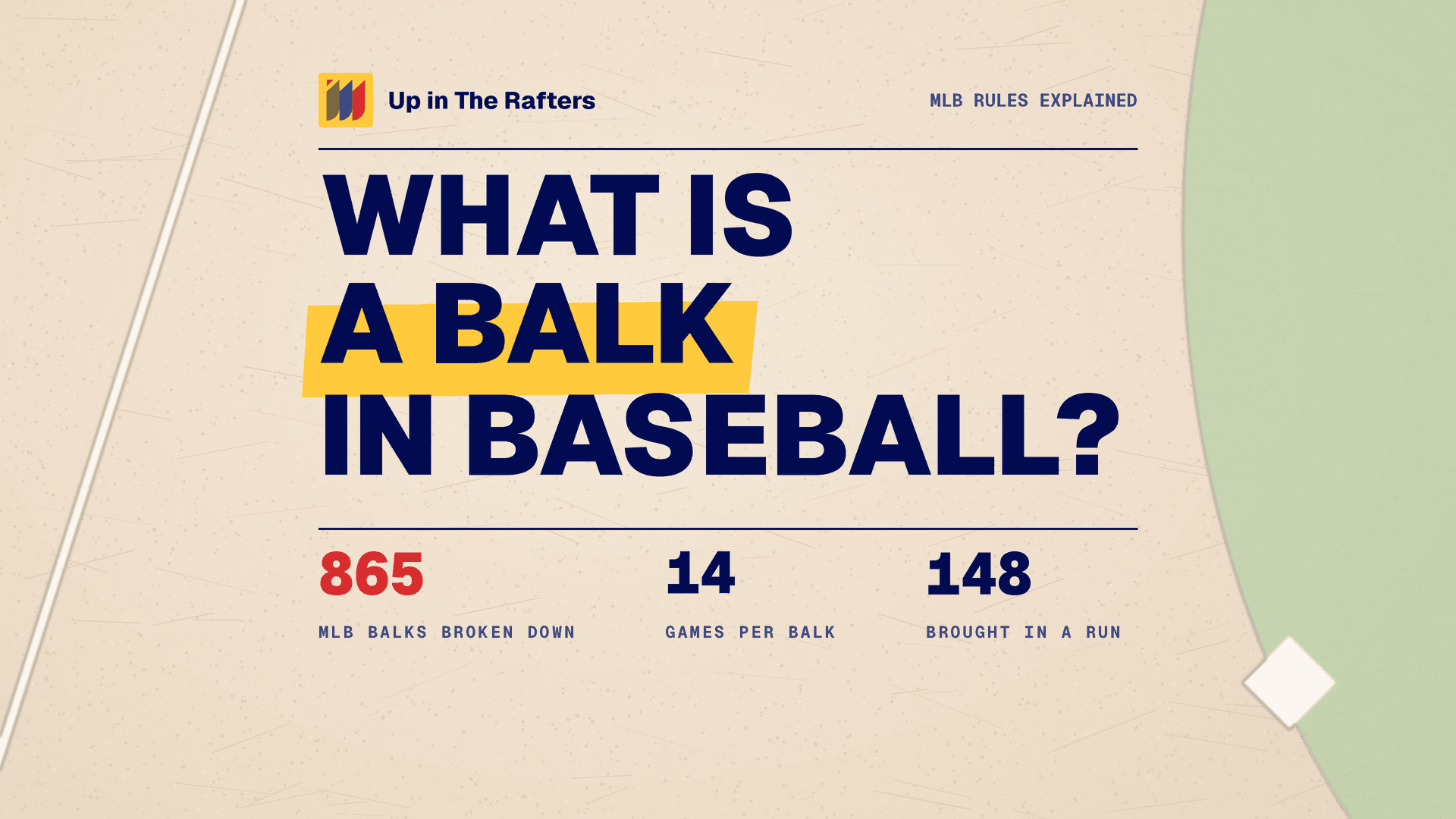
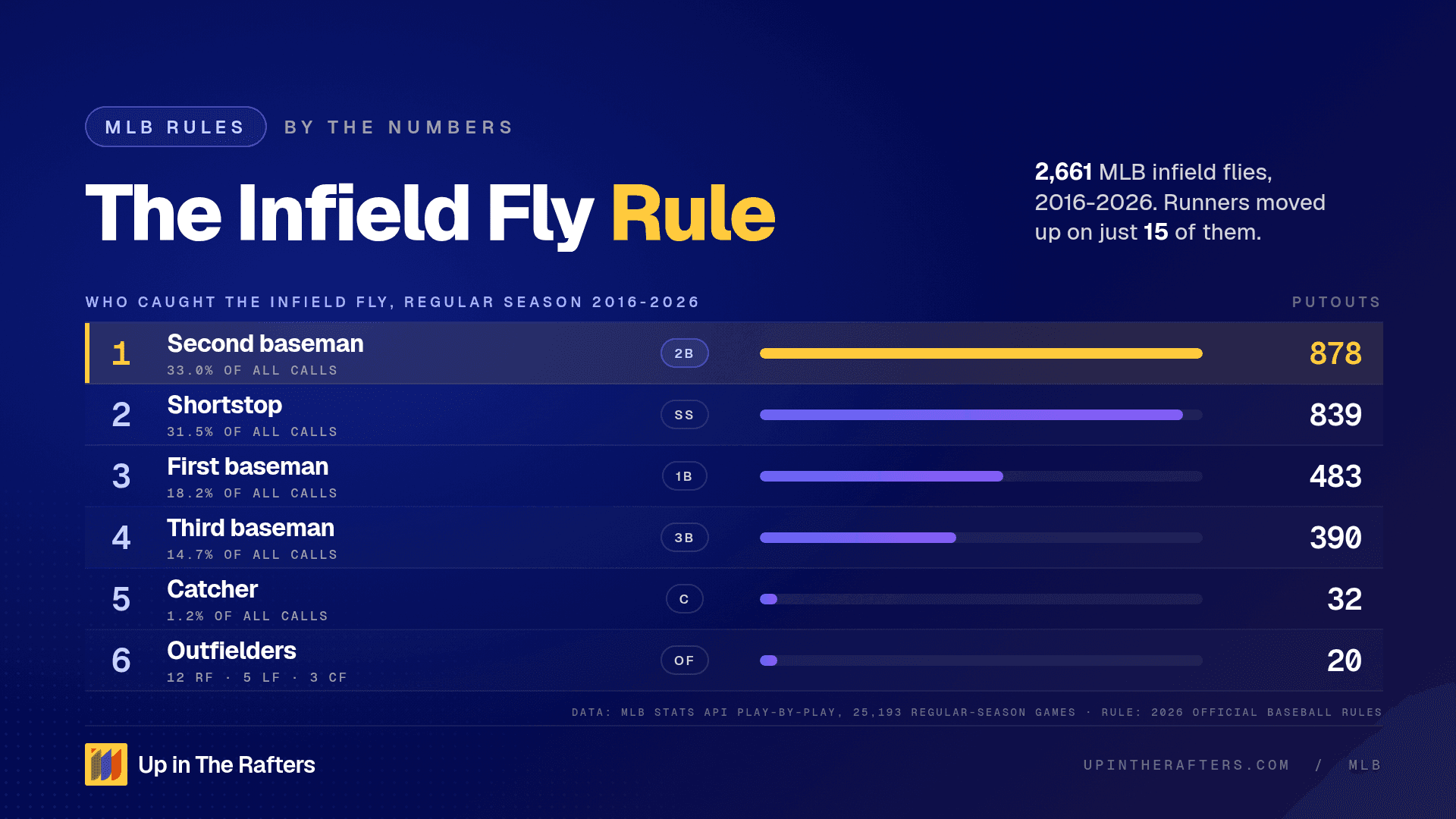
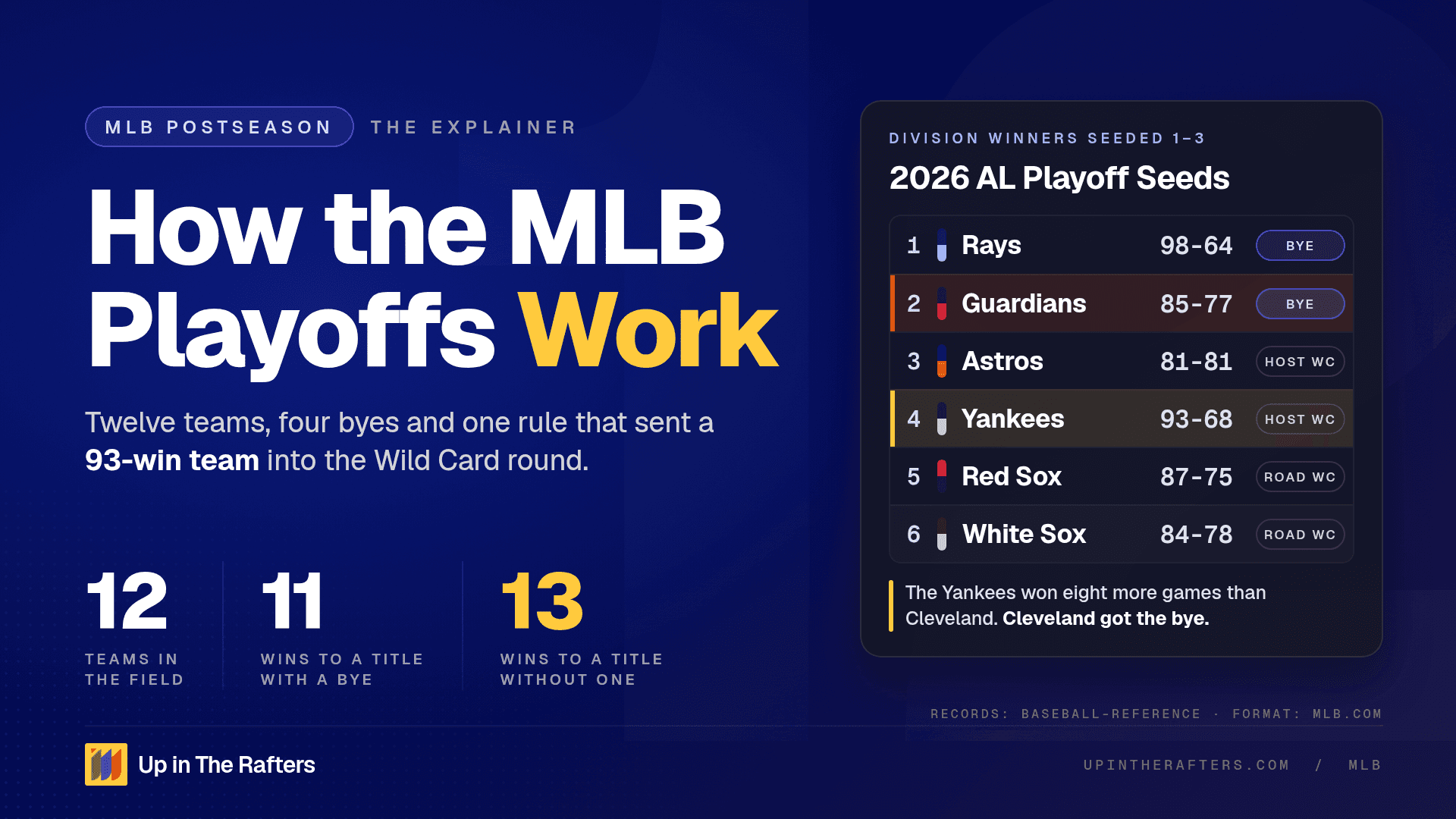
If you want more baseball rules with numbers behind them, I counted every balk and every infield fly. There's also how many innings are in a baseball game, how long a baseball game lasts, how the MLB playoffs work and the 2023 baseball rule changes. And for another play that ends with one team celebrating, here's the pick six in football.
Sources: