Up in The Rafters
How Do the MLB Playoffs Work? The 12-Team Format, Explained
Twelve teams make the MLB playoffs, but not every great team gets treated the same. Here's how the seeding, the byes and every round actually work, using the real 2026 bracket, plus the one rule I'd change.
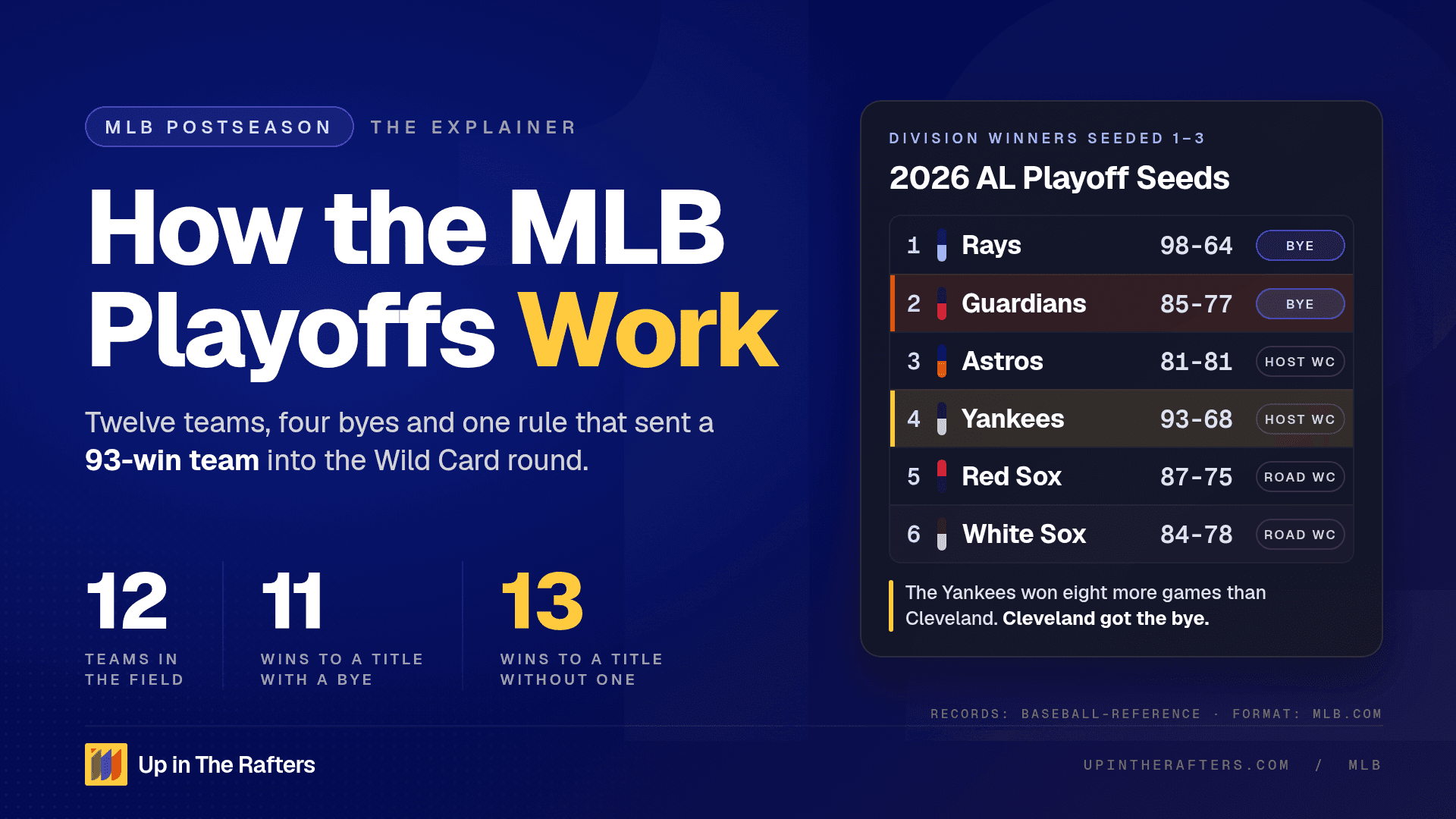
The Houston Astros went 81-81 this season and hosted a playoff series. The New York Yankees won 93 games and had to play an extra round to get where Cleveland walked in for free. That one sentence explains most of how the MLB playoffs work, and most of what I'd change about them.
Here's the short version. Twelve teams make the postseason, six from each league: the three division winners and three Wild Cards. The two best division winners in each league skip the first round. Everyone else plays a best-of-three Wild Card Series. From there it's a fixed bracket: a best-of-five Division Series, a best-of-seven League Championship Series, and a best-of-seven World Series. No reseeding, no Game 163, no runner on second in extra innings.
I'm going to walk through every round using the actual 2026 bracket, because this format makes a lot more sense when you can see exactly who it helped and who it burned.
How Many Teams Make the MLB Playoffs?
Twelve of the 30. MLB introduced this format in 2022, up from 10 teams under the old system, according to MLB.com's postseason format explainer. Each league gets three division winners (East, Central, West) and three Wild Card teams, which are simply the three best records among the clubs that didn't win their division.
The seeding is where it gets interesting. Division winners take the top three seeds, ordered by record. Wild Cards take seeds four through six. And if a Wild Card team has a better record than a division winner? MLB.com's answer is blunt: "It doesn't matter. The division winner takes precedence with regard to seeding."
Keep that rule in mind. It's the whole story of the 2026 American League.
The 2026 MLB Playoff Seeds
Here's how the field shook out this year. Records are final regular-season marks from Baseball-Reference.
Seed | American League | National League | What the seed gets you |
1 | Tampa Bay Rays (98-64) | Milwaukee Brewers (103-59) | Bye to the Division Series |
2 | Cleveland Guardians (85-77) | Los Angeles Dodgers (100-62) | Bye to the Division Series |
3 | Houston Astros (81-81) | Atlanta Braves (94-68) | Hosts all of the Wild Card Series vs. No. 6 |
4 | New York Yankees (93-68) | San Diego Padres (91-71) | Hosts all of the Wild Card Series vs. No. 5 |
5 | Boston Red Sox (87-75) | Chicago Cubs (89-73) | Plays every Wild Card game on the road |
6 | Chicago White Sox (84-78) | Philadelphia Phillies (88-74) | Plays every Wild Card game on the road |
Look at the AL column. The Yankees won eight more games than the Guardians and 12 more than the Astros, and both of those teams were seeded ahead of them. Cleveland won the Central, so Cleveland got the bye. New York finished second in the East behind a 98-win Rays team, so New York got a Wild Card Series and then a date with the best team in the league.
The National League mostly behaved itself. The top three records belonged to the three division winners, and the Padres, the best Wild Card at 91-71, got to host.
Round 1: The Wild Card Series
The Wild Card Series is a best-of-three. The No. 3 seed plays the No. 6 seed, and the No. 4 seed plays the No. 5 seed. Every game is played at the higher seed's ballpark, and the whole round is crammed into three straight days so the bye teams aren't sitting around for a week.
This replaced the single-elimination Wild Card Game that MLB used from 2012 to 2019 and again in 2021. I'll say it plainly: the best-of-three is better. One game decides almost nothing in baseball. Three games still isn't much, but at least one bad start doesn't end a 90-win season on its own.
Here's how the 2026 round played out:
Yankees over Red Sox, 2-0: 9-0 and 9-2 at Yankee Stadium.
White Sox over Astros, 2-0: 6-3 and 7-3, both in Houston.
Padres over Cubs, 2-0: 8-0 and 4-1 in San Diego.
Braves over Phillies, 2-1: Atlanta won Game 1 5-3, lost Game 2 4-3 in 10 innings, then took Game 3 6-2.
The Astros series is the one I keep coming back to. Houston got all three potential games at home as a .500 team, against a White Sox club with a better record, and still got swept. Home field in a best-of-three is a real advantage. It just isn't enough to cover for being an 81-win team.
Round 2: The Division Series
The Division Series is a best-of-five in a 2-2-1 format. The higher seed hosts Games 1, 2 and 5. The lower seed hosts Games 3 and 4.
There's no reseeding after the Wild Card round. The No. 1 seed always gets the winner of the 4-vs-5 series, and the No. 2 seed always gets the winner of 3-vs-6. MLB built it that way on purpose. Per MLB.com, it "ensures that the No. 1 seed won't face another division winner in the Division Series round." In practice, the No. 1 seed's reward this year was the 93-win Yankees. Some reward.
Through Monday night, October 5:
Series | Game 1 | Game 2 | Status |
ALDS: (1) Rays vs. (4) Yankees | Rays 1, Yankees 0 | Rays 5, Yankees 2 | Rays lead 2-0 |
ALDS: (2) Guardians vs. (6) White Sox | White Sox 3, Guardians 0 | White Sox 4, Guardians 3 | White Sox lead 2-0 |
NLDS: (1) Brewers vs. (4) Padres | Brewers 3, Padres 2 | Brewers 4, Padres 3 | Brewers lead 2-0 |
NLDS: (2) Dodgers vs. (3) Braves | Dodgers 5, Braves 3 | Braves 3, Dodgers 2 | Tied 1-1 |
The White Sox are the best argument for this format's chaos. They're the No. 6 seed. According to MLB.com's Game 2 recap, they've won their first four games of this postseason, all on the road, and after losing at least 100 games in three straight seasons, they're one win away from their first ALCS since 2005. Sean Burke gave them 5 1/3 innings of one-hit, one-run ball on Monday. Whatever you think of the bracket, that's a fun team.
Round 3: The League Championship Series
The ALCS and NLCS are best-of-seven, played in a 2-3-2 format, per FOX Sports. The higher remaining seed hosts Games 1, 2, 6 and 7. The lower seed hosts Games 3, 4 and 5. Win four and you're in the World Series.
According to MLB's 2026 postseason schedule, the NLCS starts Sunday, October 11 and the ALCS starts Monday, October 12.
Round 4: The World Series
Same deal: best-of-seven, 2-3-2. The one wrinkle is home-field advantage. It doesn't go to the higher seed, because an AL seed and an NL seed can't really be compared. It goes to the pennant winner with the better regular-season record, regardless of seeding, per MLB.com.
The 2026 World Series opens Friday, October 23. If it goes the distance, Game 7 is Saturday, October 31, per ESPN's full postseason schedule. Halloween baseball. I'm in.
The Full Format at a Glance
Round | Length | Home-field format | 2026 dates |
Wild Card Series | Best of 3 | All games at higher seed | Sept. 29 to Oct. 1 |
Division Series | Best of 5 | 2-2-1 | Oct. 3 to Oct. 10 |
League Championship Series | Best of 7 | 2-3-2 | Oct. 11 to Oct. 20 |
World Series | Best of 7 | 2-3-2 (better record hosts) | Oct. 23 to Oct. 31 |
Do the math on that and you get a useful way to think about the bye. A team that skips the Wild Card round needs 11 postseason wins to take the title (3 + 4 + 4). A team that plays the Wild Card round needs 13 (2 + 3 + 4 + 4). The maximum number of games is 19 with a bye and 22 without one.
Does the Bye Actually Hurt Teams?
Every October somebody brings up the "bye curse," the idea that five days off kills a team's timing while the Wild Card winners stay hot. I think it's mostly a 2023 story that refuses to die.
MLB.com's Mike Petriello ran the numbers on October 2. There have been 16 Division Series under this format, and the bye teams won nine of them.
Year | Bye teams' Division Series record |
2022 | 2-2 |
2023 | 1-3 |
2024 | 3-1 |
2025 | 3-1 |
Total | 9-7 |
The part that killed the theory for me: based on their projected win probabilities, the 16 bye teams should have won at a .576 clip. They actually won at .563. That's almost exactly what you'd expect from slightly better teams playing short series. No rust tax showing up anywhere.
And as that same piece points out, no team with a first-round bye has ever lost in the first round. Ask the Red Sox, Astros, Cubs and Phillies whether they'd trade "rhythm" for that.
So far in 2026, the bye teams are 5-3 in Division Series games. Small sample. That's the whole point.
Tiebreakers and Postseason Rule Changes
A few rules work differently from what you might remember, or from the regular season:
No more Game 163. Ties for a division or a playoff spot are settled mathematically, with head-to-head record as the first tiebreaker, per MLB.com.
No automatic runner in extra innings. The runner-on-second rule from the regular season doesn't apply in October. Extra innings are played the old-fashioned way. If you need a refresher on how innings work in baseball, we've covered that.
Two replay challenges per game. Managers start each postseason game with two, instead of one in the regular season.
ABS challenges carry over. The Automated Ball-Strike Challenge System, which debuted in MLB in 2026, works the same as in the regular season: two challenges per team per game, and you keep the ones you win.
That last one is new this year, and I'm watching it closely. Every challenged pitch in a 3-2 game in October is going to get more attention than the umpires working these games probably want.
What I'd Change
I like this format more than I expected to when it launched. Twelve teams is the right number. The best-of-three beats a one-game coin flip. Byes are a real reward for a great season, and the numbers say they don't backfire.
My problem is who gets the byes. Right now the reward goes to the two best division winners. I'd give it to the two best records, period. Keep the guaranteed playoff spot for every division winner, because division races should matter. Just stop handing an 85-win team a week off while a 93-win team plays an elimination series because it shares a division with a juggernaut. And an 81-81 team should never host a playoff game against a team with a better record.
I'm honest about the limits of this argument. No format fixes the randomness of short-series baseball, and MLB's own numbers show that. The White Sox are up 2-0 on the team the format favored. But "the bracket might not matter anyway" isn't a reason to set it up wrong.
Final Thoughts
The MLB playoffs come down to this: 12 teams, a best-of-three Wild Card round for eight of them, then five-game and seven-game series to the end. Division winners get protected seeding, and the top two in each league get a bye. It's a good format with one flaw in how it hands out its biggest reward.
If you're settling in for the rest of October, knowing how to read a box score helps. Here's what OPS and WHIP actually tell you. And if you're a Yankees fan staring at an 0-2 hole, I've had my own complaints about the Yankees' defense before. You're welcome to read that one when you're ready.
Sources: