Up in The Rafters
How Are NFL Draft Picks Determined?
NFL draft picks are determined by reverse order of finish, playoff performance, tiebreakers, compensatory picks, and trades. Full breakdown here.
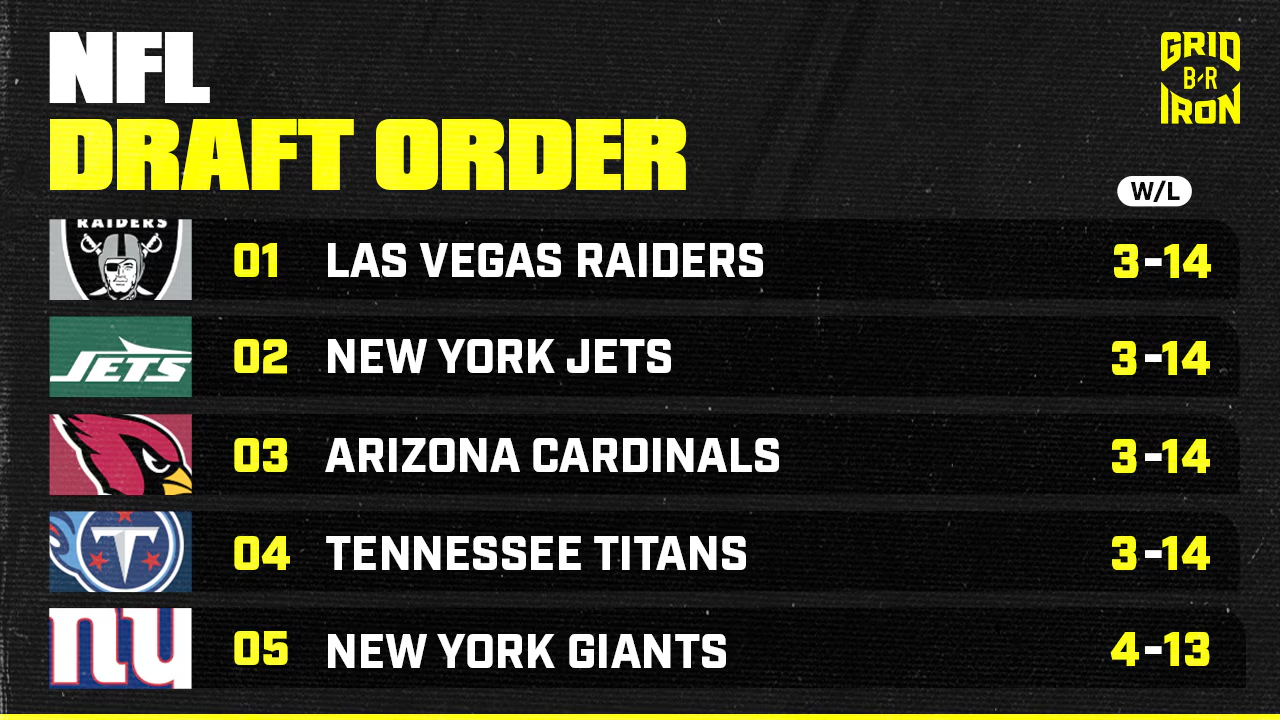
NFL draft picks are determined primarily by the reverse order of finish from the previous season. The team with the worst record picks first, and the Super Bowl champion picks last. From there, playoff performance, strength of schedule tiebreakers, compensatory free agent losses, and trades all shape the final order across all seven rounds.
That is the short answer. But the full system is a lot more layered than that single rule suggests, and understanding it makes watching the draft a completely different experience.
The Basic Framework: Worst to Best
Every year, all 32 teams receive one pick in each of the seven rounds of the NFL Draft. The order of selection is determined by the reverse order of finish in the previous season. Each round starts with the team that finished with the worst record and ends with the Super Bowl champion.
The league splits the 32 picks into two broad buckets: non-playoff teams and playoff teams.
Teams that did not qualify for the playoffs are assigned draft slots 1 through 20. The club with the worst record picks first, and the one with the best record among non-playoff teams picks 20th.
From there, the playoff teams slot in based on how far they went before being eliminated.
This tiered structure rewards teams for losing early in the playoffs with earlier picks, which is the competitive balance logic at the core of the entire system.
NFL Draft Pick Order by Team Status
Draft Slots | Team Status | Order Within Group |
1 to 18 | Missed playoffs | Worst record picks first |
19 to 24 | Wild card round losers | Worst record picks first |
25 to 28 | Divisional round losers | Worst record picks first |
29 to 30 | Conference championship losers | Worst record picks first |
31 | Super Bowl loser | Fixed slot |
32 | Super Bowl champion | Fixed slot (picks last) |
How Tiebreakers Work
When two or more teams finish the season with identical records, the NFL does not simply flip a coin anymore. Ties between teams with identical records are determined by strength of schedule, which is the combined win-loss record of all 17 of a team's opponents in the previous season. The team with the lower strength of schedule, meaning their opponents compiled fewer wins, is granted the earlier pick in round one.
The idea is that a team that won the same number of games against harder competition deserves a bit more credit, so they get pushed back slightly in the draft order.
If strength of schedule does not break the tie either, the NFL works through a series of additional tiebreakers including head-to-head results, win percentage in common games, and strength of victory. Prior to the 2020 NFL Draft, interconference ties were only broken by a coin flip. The league has clearly moved away from leaving anything to chance.
For teams that are still tied across multiple rounds, the NFL uses a cycling system. Clubs involved in two-club ties will alternate positions from round to round. In ties involving three or more clubs, the club at the top of a tied segment in a given round moves to the bottom for the next round, while all other clubs in the segment move up one position.
Compensatory Picks: Rewarding Teams That Lose Free Agents
Beyond the standard 32 picks per round, the league adds an extra layer through compensatory selections. Under the terms of the NFL collective bargaining agreement, the league can assign as many as 32 additional compensatory free agent picks, which allow clubs that have lost free agents to another team to use the draft to try to fill the void. The awarded picks take place at the end of the third through seventh rounds.
The formula used to calculate which teams receive compensatory picks is proprietary, but the general mechanics are known. The placement of selections is determined by a formula based on the player's average annual salary, playing time, and postseason honors with his new team, with salary being the primary factor. So, for example, a team that lost a linebacker who signed for $2.5 million per year in free agency might get a sixth-round compensatory pick, while a team that lost a wide receiver who signed for $5 million per year might receive a fourth-round pick.
Compensatory picks were not always tradeable. That changed starting with the 2017 NFL Draft, which opened up a new layer of strategy for front offices to work with.
The Role of Trades
Trading draft picks is one of the defining features of how modern NFL rosters are built. Teams move picks forward or backward in the current draft, swap future picks across multiple years, and bundle picks together to move up for a franchise quarterback or other premium target.
There are rules governing how far into the future picks can be traded. At any given point before a draft, teams can only trade picks up to two years out. Once a draft begins, picks from three years out become eligible to trade.
Trades can dramatically reshape what a team's draft board looks like. A squad that enters the first round with three picks in the top 15 might trade them all away for a proven veteran, while another team builds an entire rebuild around stockpiling future selections. Both are legitimate strategies, and the draft order system accommodates them fully.
Picks Forfeited for Rule Violations
Not every team arrives at the draft with all their picks intact. The NFL has the authority to strip draft selections as punishment for salary cap violations or tampering with players before free agency opens. In the 2025 Draft, both the San Francisco 49ers and the Atlanta Falcons lost their fifth-round picks, the 49ers for a payroll accounting error that violated the salary cap in 2022, and the Falcons for contacting free agents before the signing period opened.
These forfeited picks simply disappear from the order rather than being transferred to another team. They serve as a deterrent, and losing a draft pick, even in a late round, is a meaningful penalty given how much value front offices place on depth selections.
The Minority Hiring Compensatory Picks
One relatively newer wrinkle in the draft order involves picks tied to diversity hiring practices. Resolution JC-2A, enacted by the NFL in November 2020, rewards teams for developing minority candidates for head coach and general manager positions. It rewards teams whose minority candidates are hired away for one of those positions by awarding compensatory draft picks. These picks are placed at the end of the third round, after standard compensatory picks.
This means a team could theoretically gain an extra third-round pick simply because a coordinator or executive they developed was hired as a head coach or general manager elsewhere. It is a meaningful incentive with real draft value attached to it.
Why This System Matters for Fans
Understanding how draft order is determined changes how you watch an entire NFL season. Every late-season game between two bad teams carries weight because the loser gains draft positioning. Teams that are clearly out of playoff contention by November have a financial and roster-building incentive to lose, which creates what fans call tanking, a topic that generates real debate every year.
On the other end, Super Bowl contenders pick at the back of every round. This is one of the structural reasons it is so hard to sustain dominance in the NFL. The teams winning championships consistently pick 32nd, which means they must develop talent at a higher rate than everyone else or find steals in the later rounds. Legends like Tom Brady, who was selected in the sixth round, and Terrell Davis, also a sixth-round pick, are proof that late-round selections can build dynasties just as surely as first-round studs.
For more NFL coverage and sharp takes on the league, check out our breakdown of who Shedeur Sanders plays like after his surprising fall on draft day, and our look at what it takes to host a Super Bowl if you want to understand how much infrastructure goes into the league's biggest event. You can also read the official breakdown of draft rules directly from NFL Football Operations.
More in NFL
View all