How Does the ATP Finals Work? The Format, Tiebreakers and Money, Explained
Eight players, two groups, three round-robin matches each. Here's how the ATP Finals works, from qualifying and tiebreakers to the $5.17 million top prize.
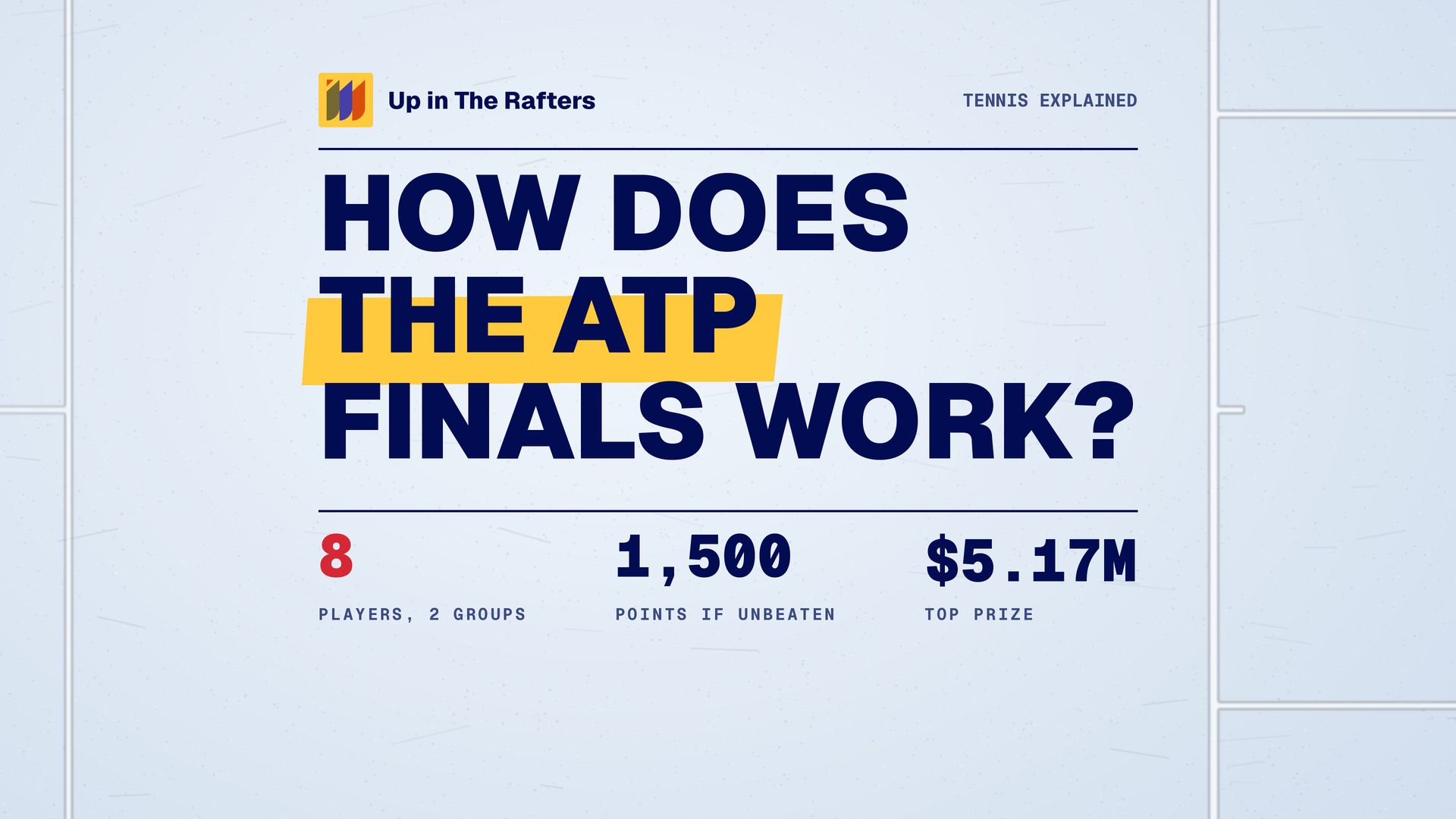
The ATP Finals is men's tennis's season-ending championship, and it doesn't work like any other tournament on the calendar. The eight best singles players of the season are split into two groups of four. Everyone plays everyone in his group, the top two in each group reach the semifinals, and from there it's straight knockout. Every match, including the final, is best of three tiebreak sets (ATP Rulebook).
That's the short answer. The part that confuses people is the middle: you can lose a match and still win the title, and a group can come down to the percentage of games a player won. This year's event runs Nov. 15-22, 2026, at the Inalpi Arena in Turin, Italy, and on Nov. 18 Carlos Alcaraz beat Daniil Medvedev 6-2, 6-4 to move to 2-0 in his group (ATP Tour). So I went through the rulebook, the qualifying rules and the prize money table to lay out how the whole thing works.
How does the ATP Finals work? The top eight players in the season-long Race to Turin qualify. They're split into two groups of four and play a round robin, three matches each. The top two in each group advance to the semifinals, and the semifinal winners play for the title. Group places are decided by wins first, then by tiebreakers that can go all the way down to percentage of games won. An undefeated champion earns 1,500 ranking points and $5,171,000.
The ATP Finals at a glance
| Detail | This year's event |
|---|---|
| Official name | Nitto ATP Finals |
| Dates | Nov. 15-22, 2026 |
| Venue | Inalpi Arena, Turin, Italy (indoor hard court) |
| Singles field | 8 players, two groups of four |
| Doubles field | 8 teams, two groups of four |
| Match format (singles) | Best of three tiebreak sets, final included |
| Semifinals | Saturday, Nov. 21 |
| Final | Sunday, Nov. 22 |
| Total prize money | $15,750,000 |
| Undefeated champion | 1,500 points and $5,171,000 |
Sources: ATP Tour, Nitto ATP Finals, Tennis Majors.
How players qualify for the ATP Finals
There's no invitation and no wild card. Players qualify through the PIF ATP Race to Turin, a season-long ranking that starts over every year. That's different from the regular ATP rankings, which roll over 52 weeks.
The rulebook builds the field in this order (ATP Rulebook):
The top seven players in the Race after the Paris Masters.
Up to two players who won a Grand Slam that year and sit between eighth and 20th in the Race.
Everyone else from eighth place down, in order.
The top eight on that list are in. If one of them withdraws before the pre-tournament press conference, the next player on the list takes his place. The next player after that becomes the alternate, who has to be on site and ready to step in if someone pulls out during the round robin.
The rule change for this year: the Race now ends after the Paris Masters. Until 2025, the week after Paris still counted, which led to late scrambles for the last spots. Starting in 2026, results from the week after Paris count toward next year's Race instead (ATP). If you've seen "ATP Finals rule change" pop up in search, that's the change.
Injuries shape the field, too. Jannik Sinner, the champion in 2024 and 2025, ended his season on Oct. 6 because of a knee injury (ATP Tour). That opened a spot, and Rafael Jodar clinched it on Nov. 6, when Alcaraz beat Taylor Fritz in the Paris quarterfinals (ATP Tour). A year ago, Jodar was playing college tennis at Virginia. Alex de Minaur and Fritz are the alternates (Tennis Majors).
How the groups are drawn
The draw isn't fully random. The No. 1 seed goes into one group and the No. 2 seed goes into the other. Then seeds 3 and 4 are drawn as a pair, with the first name drawn going to the No. 1 seed's group. Seeds 5 and 6 and seeds 7 and 8 are drawn the same way. Every group ends up with one player from each pair.
The groups are named after former champions. This year it's the John McEnroe Group and the Ivan Lendl Group (Nitto ATP Finals). Here's where they stood before the night session on Nov. 18:
| John McEnroe Group | Record | Sets |
|---|---|---|
| (1) Alexander Zverev | 2-0 (qualified) | 4-0 |
| (3) Ben Shelton | 1-1 | 2-3 |
| (6) Arthur Fils | 1-1 | 3-3 |
| (8) Rafael Jodar | 0-2 | 1-4 |
| Ivan Lendl Group | Record | Sets |
|---|---|---|
| (2) Carlos Alcaraz | 2-0 | 4-0 |
| (4) Daniil Medvedev | 1-1 | 2-2 |
| (5) Flavio Cobolli | 0-1 | 0-2 |
| (7) Frances Tiafoe | 0-1 | 0-2 |
Records and sets are my count from the official results: Zverev d. Jodar 6-4, 6-4 and Shelton d. Fils 6-2, 3-6, 6-3 on Nov. 15 (Nitto ATP Finals); Alcaraz d. Tiafoe 6-2, 6-2 and Medvedev d. Cobolli 7-6(4), 6-3 on Nov. 16 (ATP Tour); Zverev d. Shelton 6-2, 7-6(4) and Fils d. Jodar 4-6, 6-2, 6-2 on Nov. 17 (ATP Tour); and Alcaraz d. Medvedev 6-2, 6-4 on Nov. 18.
How the ATP Finals tiebreakers work
This is the part worth knowing. With only three matches each, ties happen a lot. The rulebook ranks each group using the first rule that applies (Nitto ATP Finals):
| Order | Tiebreaker |
|---|---|
| 1 | Most wins |
| 2 | Most matches played |
| 3 | Head-to-head, if only two players are tied |
| 4 | If three are tied: highest percentage of sets won |
| 5 | Then highest percentage of games won |
| 6 | Then the PIF ATP Rankings |
Rule No. 2 looks strange until you remember players sometimes withdraw mid-week. If an alternate comes in, a 2-1 record beats 2-0, and 1-2 beats 1-0. Finishing all three matches counts for something.
Rule No. 4 is where it gets fun. If three players end up tied, it isn't a coin flip or a head-to-head loop. It's math. And if the sets or games tiebreaker separates one player from the other two, the remaining pair goes back to head-to-head.
There's one more detail I like. If a player retires mid-match, it counts as a straight-sets result, but the games from that match don't count toward the games percentage. The rulebook says this exists so a player who only needs one set can't win it and then quit (ATP Rulebook).
A real example: Jodar's path in the McEnroe Group
Jodar is 0-2, and he can still reach the semifinals. Thursday, Nov. 19, he plays Shelton, and Zverev plays Fils. The ATP says Jodar's only clean path is to beat Shelton in straight sets and have Zverev beat Fils in straight sets (ATP Tour). Here's why, with my own math. Zverev would be 3-0, and the other three would all be 1-2, so it goes to percentage of sets won:
| If Jodar and Zverev both win in straight sets | Sets won-lost | Sets won % |
|---|---|---|
| Rafael Jodar | 3-4 | 42.9% |
| Arthur Fils | 3-5 | 37.5% |
| Ben Shelton | 2-5 | 28.6% |
Jodar would finish second in the group and go through. But if Jodar needs three sets to beat Shelton, all three players finish 3-5 in sets, 37.5% each, and the spot comes down to percentage of games won. An 0-2 player getting through on a set percentage sounds odd, but that's the format.
How the semifinals and final work
The two group winners go into opposite halves. Each group winner plays the runner-up from the other group in the semifinals on Saturday, Nov. 21. The winners meet in the final on Sunday, Nov. 22. There's no third-place match (ATP Rulebook).
That's how you can lose and still win the tournament. Go 2-1 in your group, finish second, and win your semifinal and final, and you're the champion. You just get fewer points and less money than an undefeated champion.
ATP Finals points and prize money
Points and money are paid per win, not per round reached (Nitto ATP Finals):
| Result | Ranking points | Prize money (singles) |
|---|---|---|
| Participation (all three group matches) | 0 | $338,000 |
| Each round-robin win | 200 | $405,000 |
| Semifinal win | 400 | $1,206,000 |
| Final win | 500 | $2,412,000 |
| Undefeated champion (5-0) | 1,500 | $5,171,000 |
The participation fee is pro-rated: $169,000 for one match, $253,000 for two and $338,000 for three. An alternate who never plays gets $156,000. A champion who went 2-1 in the group would earn 1,300 points and $4,766,000, which is my math from the official table and matches Tennis Majors' calculation (Tennis Majors).
For perspective, 1,500 points is more than a Masters 1000 title (1,000) and less than a Grand Slam (2,000), per the ATP rankings FAQ.
How doubles works at the ATP Finals
Doubles uses the same structure: eight teams, two groups, round robin, then semifinals and a final. The difference is scoring. Doubles matches are two no-ad sets, with a 10-point match tiebreak if they split sets. This year's doubles groups are the Todd Woodbridge Group and the Mark Woodforde Group, and Harri Heliovaara and Henry Patten are the defending champions (Nitto ATP Finals). An undefeated doubles team splits $959,300.
A short history of the ATP Finals
The first one was played in Tokyo in December 1970, and Stan Smith won it. Since then it has moved around a lot. Its longest homes were New York's Madison Square Garden (1977-1989) and London's O2 Arena (2009-2020), with stops in Germany, Shanghai and elsewhere in between, and it has been in Turin since 2021 (Nitto ATP Finals). Turin is confirmed through 2027, and the event stays in Italy through 2030 (ATP Tour).
| Fact | Answer |
|---|---|
| First edition | Tokyo, 1970 (Stan Smith) |
| Most singles titles | Novak Djokovic, 7 |
| Last two champions | Jannik Sinner (2024, 2025) |
| Last American champion | Pete Sampras, 1999 |
| Hosted in Turin | Since 2021, confirmed through 2027 |
Shelton and Tiafoe are both trying to become the first American to win it since Sampras, and Shelton would be the first left-handed champion since John McEnroe in 1984 (ATP Tour).
What I think of the format
I like it, and the reason is the same reason the group stage works in the NBA's in-season tournament: one bad night doesn't end your week. If you want the basketball version, I broke down how the NBA Cup works, including its point-differential tiebreaker. The ATP version uses sets and games instead, which rewards the same thing, winning cleanly.
My one gripe is that the last day of group play can be confusing to watch if you don't have the math in front of you. A player can win his match and still be eliminated, or lose and still go through, depending on a set in a different match. That's not a reason to change it. It's a reason to know the tiebreakers before Thursday.
If you like knowing how the brackets work before the big games, I've done the same for the College Football Playoff and the NFL playoffs.
Frequently Asked Questions
How many players are in the ATP Finals?
Eight in singles and eight teams in doubles. The singles players are split into two groups of four, and each player plays the other three in his group.
How do you qualify for the ATP Finals?
Finish in the top seven of the Race to Turin after the Paris Masters, or win a Grand Slam that year and finish between eighth and 20th. The rest of the eight-man field is filled in Race order. Starting in 2026, the week after Paris no longer counts.
Can you lose a match and still win the ATP Finals?
Yes. The top two in each group reach the semifinals, so a player can go 2-1, finish second and still win the title. He'd earn 1,300 points instead of 1,500.
What happens if players are tied in their ATP Finals group?
Wins come first, then matches played. Two tied players are separated by head-to-head. Three tied players are separated by percentage of sets won, then percentage of games won, then the ATP rankings.
How much does the ATP Finals winner get?
An undefeated singles champion earns $5,171,000 and 1,500 ranking points in 2026. A champion who lost one group match earns $4,766,000 and 1,300 points.
Why isn't Jannik Sinner playing the ATP Finals?
Sinner ended his 2026 season on Oct. 6 to treat a knee injury. He won the event in 2024 and 2025, and Rafael Jodar took the open spot in the field.
Sources
Matt's first sports memories are Kobe dropping 81, LaDainian Tomlinson making defenders look silly, and Derek Jeter somehow always coming through in October. He's been hooked ever since.
Think a number is off? Tell us, or check the Corrections page.