Up in The Rafters
How Many Innings in Baseball?
A standard MLB game has 9 innings. Learn how extra innings work, when games become official, and how innings vary by level of baseball.
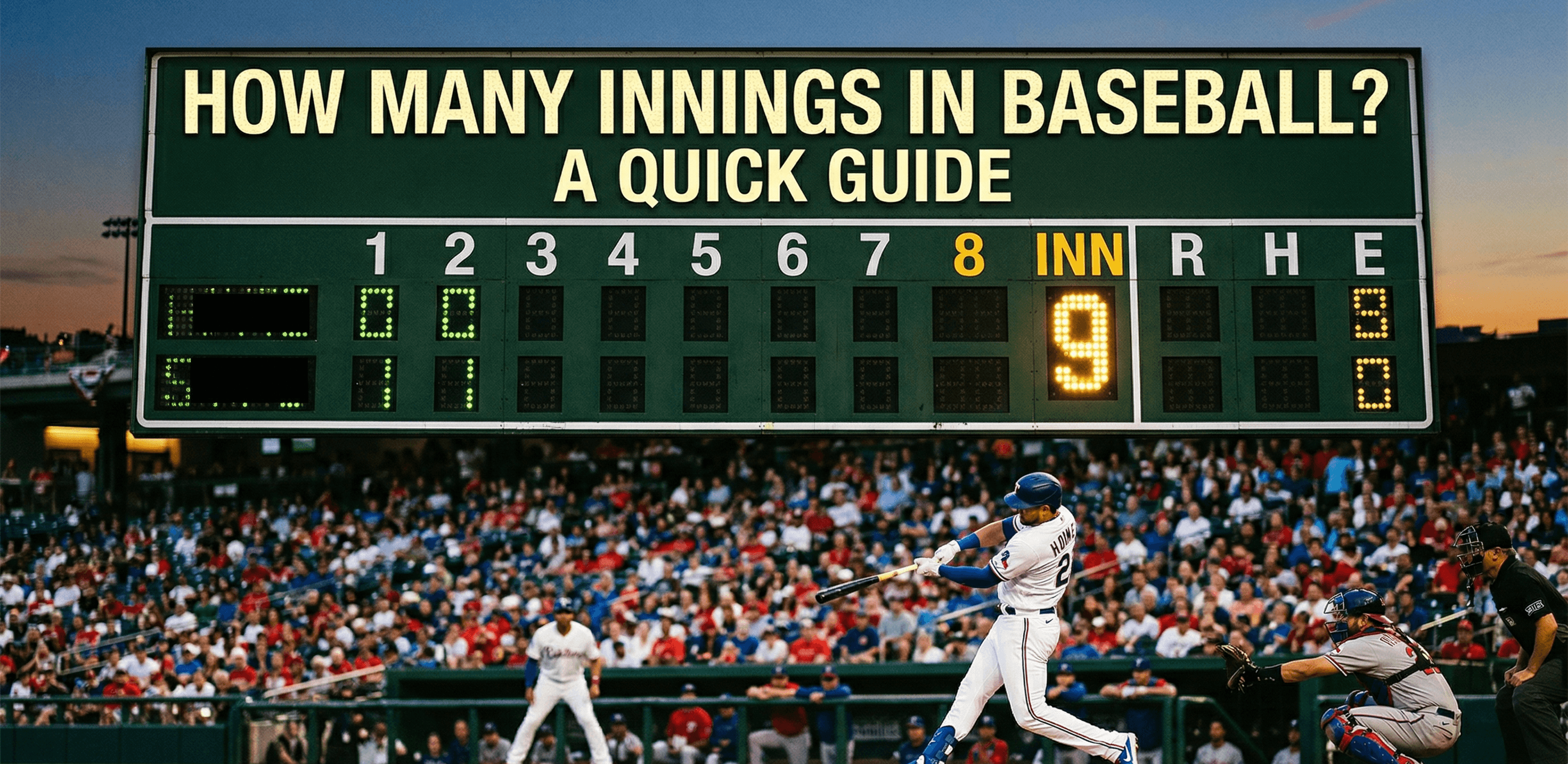
A standard MLB game has 9 innings. That is the short answer, and it has been the standard since the National League formalized it in 1876. But there is a lot more happening inside those 9 innings, and there are plenty of situations where a game goes shorter or longer than that. Here is everything you need to know.
What Is an Inning?
An inning in baseball is made up of two segments: the top half and the bottom half. Each half allows one team to bat while the other plays defense. The visiting team always bats in the top half, and the home team bats in the bottom half. Each team bats until they record 3 outs, then the halves flip.
So in a full 9-inning game, each team gets 9 turns at bat and records 27 outs on defense. That is the backbone of baseball's structure.
How Many Innings in an MLB Game?
A regulation MLB game consists of nine innings. If the score is tied after nine innings, the game goes to extra innings. If the home team is leading after the top of the ninth inning, the bottom half is not played.
That last part matters more than people realize. A lot of games end after 8.5 innings because the home team already has the lead locked up heading into the final frame.
When Does a Game Become Official?
You do not always need all 9 innings for a game to count. A game is considered a regulation game once the visiting team has made 15 outs (five innings) and the home team is leading, or once the home team has made 15 outs regardless of score.
This matters during rain delays. If a storm rolls in and the umpires have to call the game early, the result still counts as long as the official game threshold has been crossed.
Extra Innings: When 9 Is Not Enough
If the game is tied after both teams have made 27 outs each, the game will go to extra innings. It will continue until the home team takes the lead at any point, or the visiting team takes the lead and the home team subsequently makes three outs without tying the game or going ahead.
Starting in 2020, MLB changed how extra innings work to speed things up. Each half-inning in extra innings now starts with a runner on second base. The rule was made permanent beginning with the 2023 season. This "ghost runner" rule is often called the Manfred Man, a nod to commissioner Rob Manfred who implemented it.
One important note for playoff fans: extra runners are not used in MLB postseason games. Postseason games that last beyond nine innings begin all extra innings without any runner being placed on base.
How Many Innings by Level of Baseball
Not every level of the game uses 9 innings. Here is how it breaks down:
Professional baseball games as well as college baseball games are scheduled for nine innings. Softball games and high school baseball games are scheduled for seven innings, as are some minor league baseball doubleheaders. Little League games are scheduled for six innings and may be shortened further if a team has an overwhelming scoring lead.
For youth baseball specifically, Tee-ball games usually have three innings, Little League games have six innings, and Junior and Senior league games often have seven innings. Shorter games in youth baseball aim to reduce player fatigue.
Here is a quick reference:
Level | Standard Innings |
MLB / Minor League | 9 |
College Baseball | 9 |
High School Baseball | 7 |
Little League | 6 |
Tee-Ball | 3 |
Softball | 7 |
What About Doubleheaders?
In doubleheaders, particularly in minor leagues or special events, games may be shortened to 7 innings each. MLB temporarily went to 7-inning doubleheader games during the COVID-19 shortened 2020 and 2021 seasons, but returned to the full 9 innings for doubleheaders in 2022.
How Long Does a Baseball Game Take?
Since the introduction of the pitch clock in 2023, the average MLB game runs approximately 2 hours and 36 minutes. Before the pitch clock, average game times had crept above 3 hours. The pitch clock brought average game length down by roughly 30 minutes.
On a per-inning basis, each inning averages roughly 17-20 minutes at the current pace of play. High-scoring innings with lots of pitching changes can push that much higher.
The Longest Games in Baseball History
Most games end cleanly at 9 innings. A few become legends.
The record for the most innings played in a single professional game is 33, which occurred in 1981 in a Minor League Baseball game between the Pawtucket Red Sox and the Rochester Red Wings. Each team had a future Hall of Famer on its roster: Wade Boggs for Pawtucket and Cal Ripken Jr. for Rochester.
In the majors, the longest MLB game in terms of time occurred in 1984 between the Chicago White Sox and the Milwaukee Brewers, lasting 8 hours and 6 minutes and spanning 25 innings.
For postseason records, the longest postseason game by innings in MLB history is 18 innings, which has occurred in five games, all decided by a solo home run.
Why 9 Innings? A Brief History
Originally, 19th-century baseball had no set innings, varying by local rules or team agreements. Later, as baseball turned professional, standardizing innings became important. The National League, started in 1876, set the nine-inning standard to make games more exciting.
The structure has held ever since, making 9 innings one of the most enduring rules in all of American professional sports.
Quick-Answer Summary
MLB games: 9 innings
A game is official after: 5 innings (4.5 if home team leads)
Tied after 9? Extra innings, with a ghost runner on second (regular season)
Postseason extra innings: No ghost runner
Longest MLB game: 25 innings (1984, White Sox vs. Brewers)
Longest pro game ever: 33 innings (1981 minor league)
For more on how MLB rules work, check out the official breakdown at MLB.com's glossary on regulation games. If you want to dig deeper into baseball history and how the sport's rules have evolved, Baseball Reference is the most thorough database out there.
If you are getting into the game and want to understand all the pieces, check out our breakdowns on MLB umpire salaries and Mariano Rivera's cutter for more context on the sport's inner workings.
Subscribe to Up in the Rafters at upintherafters.com/subscribe for sharp takes delivered straight to your inbox.