Up in The Rafters
Are NFL Refs Held Accountable? Yes, in Secret, and That's the Problem
Are NFL refs held accountable? Yes, through weekly grades, benching, suspensions and firings, but almost none of it is public. After Alex Moore's crew was pulled from prime time, here's the penalty data and why transparency beats punishment.

On Oct. 29, 2026, the NFL quietly pulled referee Alex Moore's crew off its Week 8 Sunday Night Football assignment, Eagles-Commanders on Nov. 1, and moved it to Patriots-Dolphins in the 4:25 p.m. ET window. Shawn Hochuli's crew worked the prime-time game instead. Moore's crew had worked the Lions' 20-17 win over the Packers on Oct. 25, the game Tom Brady picked apart on the FOX broadcast. An officiating source told Football Zebras the swap was about optics, not discipline.
On Oct. 30, 2026, Rob Gronkowski told OutKick the league should punish referees "just like any coach or any NFL player can be punished."
Here's my take: Gronk is half right. NFL refs are already held accountable, with more tools than the league has had before. They're graded every week, they can be benched and fired, and two of them were suspended in October 2026. What's missing is the part fans can see. The league keeps the grades, the explanations and even the reasons for crew swaps to itself, and that secrecy is why every bad call turns into a conspiracy theory.
Are NFL refs held accountable for bad calls? Yes, privately. Every official is graded each week on accuracy and mechanics, and those grades decide playoff assignments. Low performers can be benched, sent for extra training or fired. The league almost never makes any of that public, so fans rarely see the consequences.
What Happened in Detroit
The calls that started all this came in the second half at Ford Field. I went through the NFL play-by-play for the game (via nflverse) and lined up the disputed flags with the postgame reporting.
Time | Flag | What it set up |
3rd qtr, 7:46 | Unnecessary roughness on GB DT Devonte Wyatt | Lions first down at the Green Bay 11; Goff hit Jameson Williams for a TD two plays later to go up 17-14 |
3rd qtr, 4:09 | Roughing the passer on Green Bay | Wiped out a Goff incompletion; 15 yards and an automatic first down |
4th qtr, 15:00 | Intentional grounding on Packers QB Jordan Love | Loss of down and 11 yards |
4th qtr, 10:02 | Unnecessary roughness on DET LB Derrick Barnes | Wiped out a Love incompletion; 15 yards for Green Bay |
4th qtr, 2:45 | Roughing the passer on Green Bay | 15 yards added to an 18-yard Lions completion |
The Wyatt flag is the one Green Bay can't let go. Amon-Ra St. Brown went down, popped back up and kept moving, and Wyatt tackled him again. Packers coach Matt LaFleur said no whistle blew. In the postgame pool report, Moore said, "We ruled that the play was over. I can't honestly hear if there was a whistle or not," according to Heavy and Sporting News.
Here's the detail I didn't expect. By my count, that game had 13 accepted penalties, eight on Green Bay and five on Detroit. That's below the league average of 14.7 through Week 7 of 2026. Detroit wasn't a flag avalanche. People were angry about which flags got thrown and how little anyone could explain them.
The Flags Are Up Again
The backdrop is a 2026 season with a lot of yellow on the field. I counted every accepted penalty in nflverse's play-by-play for Weeks 1-7 of each regular season since 2015, so 2026 is compared with the same stretch of past ones.
Season | Games (Weeks 1-7) | Accepted penalties per game |
2015 | 105 | 14.7 |
2016 | 107 | 13.9 |
2017 | 106 | 13.8 |
2018 | 107 | 13.4 |
2019 | 106 | 14.6 |
2020 | 105 | 11.4 |
2021 | 107 | 12.5 |
2022 | 108 | 12.1 |
2023 | 106 | 12.5 |
2024 | 107 | 13.0 |
2025 | 108 | 14.2 |
2026 | 107 | 14.7 |
Through Week 7, the 2026 rate (14.67) was essentially tied with 2015 (14.74) for the highest in this span, and was 2.6 more flags a game than the same weeks in 2022. My numbers match the NFL Officiating Observatory, which builds its counts from the same play-by-play. Offensive holding is the biggest driver at 3.25 a game, up from 2.80 through the same weeks of 2025.
Are NFL penalties up? Yes. Through Week 7 of 2026, games averaged 14.7 accepted penalties, essentially tied with 2015 for the highest over the same weeks since 2015 and up from 14.2 in 2025, based on nflverse play-by-play data.
One fair caveat: accepted penalties aren't a pure measure of the refs. Teams decide whether to accept a flag, and some delay-of-game penalties on fourth down are on purpose, a point league sources made to Yahoo Sports. Still, more flags are more flags, whoever's choosing to accept them.
Which Crew You Get Changes the Flag Count
This is the number that makes fans suspicious. Through Week 7, plus the Oct. 29, 2026, Panthers-Packers game, games worked by Scott Novak's crew averaged 19.0 accepted penalties. Games worked by Clay Martin's crew averaged 11.6. Same rulebook, same season, a 7.4-flag gap.
Crew chief | Games | Accepted penalties | Per game |
Scott Novak | 8 | 152 | 19.0 |
Craig Wrolstad | 6 | 108 | 18.0 |
Adrian Hill | 5 | 89 | 17.8 |
Alex Moore | 6 | 106 | 17.7 |
Shawn Hochuli | 6 | 86 | 14.3 |
Brad Rogers | 7 | 85 | 12.1 |
Clay Martin | 7 | 81 | 11.6 |
Source: NFL Officiating Observatory crew chief table, accessed Oct. 30, 2026. Moore's 17.7 also matches WhyNFL's figure, which ranked his crew fourth in the league.
Small samples, sure. Five to eight games per crew is nothing. But this is exactly the kind of gap the league's own evaluators can explain, because they've graded every one of those flags. They just don't show their work.
Which NFL referee crew calls the most penalties? Through Week 7 of 2026, Scott Novak's crew led at 19.0 accepted penalties per game and Clay Martin's crew had the fewest at 11.6, according to the NFL Officiating Observatory.
The NFL Already Punishes Refs, Just Quietly
Gronk said refs should be accountable the way players are, because "players can be cut the very next day." Here's what's already in place:
Weekly grades. Each official is graded on the accuracy and consistency of calls, plus positioning, mechanics and communication. The grades drive playoff assignments (Yahoo Sports, NBC News).
A bench. The seven-year deal with the NFL Referees Association, which runs through the 2032 season (NFL.com), lets the league sit an underperforming official and bring in a backup. Dean Blandino described it to NBC News as a "No. 2" who comes in and works for them.
More competition. ESPN's breakdown of the deal, summarized by Pro Football Rumors, says the league can now hire 12 swing officials instead of two, uses four performance tiers instead of three, and can fire low-performing officials on probation without showing cause.
Suspensions. After the Week 4 games on Oct. 4, 2026, the league suspended line judge Jeff Seeman two games for cursing at Cardinals tight end Trey McBride and referee Adrian Hill one game over his reaction toward Vikings linebacker Eric Wilson. Yahoo Sports reported the last known officiating suspension before that was in 2018.
Firings. In October 2018, the NFL fired down judge Hugo Cruz for performance reasons, according to NFL.com. Football Zebras called it the first midseason firing of an official in the Super Bowl era.
That Cruz story stings a little for me. I'm a Chargers fan, and the call Cruz became known for was a missed false start by Russell Okung in the Chargers' 38-14 win at Cleveland on Oct. 14, 2018. Philip Rivers threw a 29-yard touchdown to Tyrell Williams on the play. (If you want more Rivers, I wrote about his career here.) NFL Network reported that no single call got Cruz fired; the league said he hadn't met the standard over a sustained period. Either way, nobody can say the NFL never acts.
And for context on the other side of the whistle: in October 2026 the NFL fined Mike Vrabel, Aaron Glenn and Nick Sirianni $250,000 each for their conduct toward officials, then put the fines on hold as long as they behave for the rest of the season (Los Angeles Times, Yahoo Sports). So the league isn't shy about discipline. It's shy about explaining it.
The Problem Is Nobody Gets to See It
The Moore swap is the perfect example. The league didn't announce it. It surfaced as an update to Football Zebras' Week 8 assignments post, two days after that post went up, with an unnamed source saying it was optics. The same report noted the crew "did not receive many downgrades" for the Detroit game, and that crews get paid the same no matter which window they work. So was anyone held accountable? Nobody outside the league office can say.
My dad Steve is a Rams fan, and the Rams got the worst version of this. On Sept. 27, 2026, at Denver, Rams cornerback Josh Wallace intercepted a Bo Nix pass at the Rams' 8 with 1:15 left. The interception was wiped out by a pass interference flag on Wallace. The Broncos kept the drive alive, scored and won 30-26. Afterward, officials told Sean McVay they agreed Wallace hadn't committed pass interference. The league's response, per Yahoo Sports, was a memo reminding teams that officiating review conversations are supposed to stay confidential.
That's backwards. The admission was the useful part.
Now look at the NBA. The league publishes a Last Two Minute Report for games within three points in the final two minutes, grading every whistle and notable non-call. The report for the Hawks' 114-111 win over the Cavaliers on Oct. 29, 2026, was posted on Oct. 30. As a Lakers fan, I can look up the last two minutes of the Lakers' 136-129 loss to Portland on Oct. 27 the same way. The NBA hasn't stopped people from yelling at refs. It has given them something real to yell about.
Here's what I'd ask the NFL to do, and none of it needs a new punishment:
Publish a two-minute report for one-score games. League sources told Yahoo Sports this idea is already on the table.
Say why a crew gets moved. If it's optics, say so. If it's grades, say that.
Explain every disputed call on game day. The pool report already exists. Moore's explanation of the Wyatt flag only came out because a pool reporter asked.
The Best Case Against Me
The strongest pushback came from inside the league. A high-ranking NFC executive told Yahoo Sports that publishing officials' grades would be like showing fans every grade of every player each week, and said, "I don't think it's productive." The referees' union called the October 2026 suspensions "excessive and inconsistent with past precedent." And it's fair to worry that public grades would put a target on specific officials when tempers are already running hot.
I take that seriously. But players do get graded in public, every week, by everybody. Officials don't need to be fined for every miss. They need the league to say "we got that wrong" when it got that wrong, out loud, the way it already did privately to McVay. The NBA's reports are proof you can admit mistakes without the sky falling.
Why This Hits Home for Me
Flag counts aren't abstract in my family. Through Week 7 of 2026, my Chargers had 54 accepted penalties in six games, 9.0 a game, among the most in the NFL by my count. My dad's Rams had 53 in seven games, 7.6 a game. I'd like to know how many of those flags the league's own graders agreed with. There's no public way to find out.
Can NFL refs get fired for bad calls? Yes. Officials can be fired for poor performance, and probationary officials with low grades can be let go without cause under the current deal. It's usually about a pattern over a season, not a single call. The NFL fired down judge Hugo Cruz midseason in 2018.
Do NFL refs get fined? Not the way players and coaches do. The public discipline for officials is suspensions, like the two-game ban for Jeff Seeman and one game for Adrian Hill in October 2026. Most consequences come through grades, lost playoff assignments and benching.
Why was Alex Moore's crew taken off Sunday Night Football? The league moved the crew from Eagles-Commanders to Patriots-Dolphins on Oct. 29, 2026, after its disputed Packers-Lions game. An officiating source told Football Zebras it was about optics, not discipline.
Final Thoughts
In 2026, the NFL added more ways to hold officials accountable than it had ever had: a bench, more swing officials, a fourth tier, real suspensions. Then it hides almost all of it. Gronk's instinct is right that fans want consequences. The fix isn't harsher punishment. It's letting fans see the grades, the mistakes and the reasons. Until that happens, every crew swap will look like a cover-up, even when it isn't.
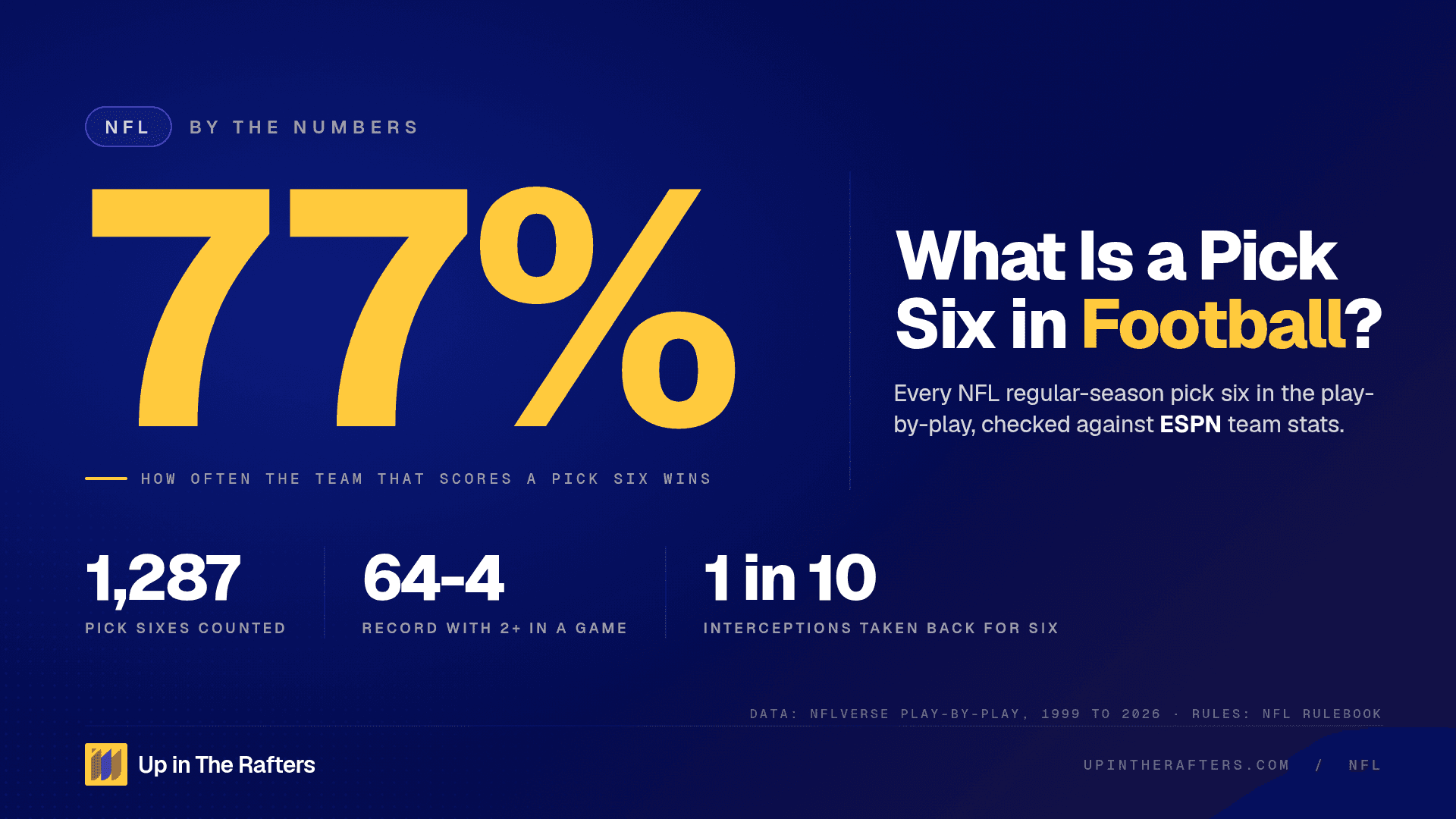
If you want the money side of the job, here's how much NFL refs make, and for baseball's version, how much MLB umpires make. And if a flag erasing a turnover is what set you off, here's what a pick-six is.
How I got the numbers: Penalty counts are accepted penalties in regular-season games from nflverse play-by-play data, Weeks 1-7 of each season from 2015 through 2026 (declined and offsetting flags don't count). Game dates and scores come from nflverse's schedule file. Crew chief averages are from the NFL Officiating Observatory, accessed Oct. 30, 2026; I couldn't rebuild every 2026 crew assignment myself, so those figures are theirs.
Sources:
NBC Sports (PFT): NFL flexes referee Alex Moore's crew out of prime time
The Comeback: Rob Gronkowski calls for NFL to punish referees
Sporting News: Referee's explanation for controversial Packers-Lions call
Yahoo Sports: Shocking suspensions, f-bombs and a flurry of flags
NBC News: One month into the NFL season, referees are the biggest story
NFL.com: NFL fires official Cruz for performance-based reasons
Los Angeles Times: NFL fines 3 coaches $250K for berating officials