Up in The Rafters
What Is a Touchback in Football? I Tracked 28,981 NFL Kickoffs
A touchback is when the ball dies in a team's own end zone after the other team sent it there. No points, just a fresh possession, usually at the 20 and at the 35 on most NFL kickoffs. Here's where the ball goes in every situation, why the spot keeps moving, and what 28,981 NFL kickoffs show.

A touchback is when the ball ends up dead in a team's own end zone and the other team is the one that sent it there. Nobody scores. The team defending that end zone just gets the ball and starts a new possession, usually at its own 20-yard line. In the NFL, most kickoff touchbacks now come out to the 35.
That "usually" is the part people get wrong, because the spot has moved a lot. I went through the NFL's play-by-play for every regular-season kickoff from the 2015 season through the 2025 season, 28,981 of them (not counting onside kicks), and the touchback spot on kickoffs changed three times in that span: the 20, then the 25, then the 30, then the 35.
Here's how the rule works, where the ball goes in every situation, and what happened when the NFL made kneeling in the end zone worth more than it had ever been.
The Touchback Rule in Plain English
The 2026 NFL rulebook defines it in Rule 3, Section 37: it's a touchback "if the ball is dead on or behind the goal line a team is defending, provided that the impetus comes from an opponent, and that it is not a touchdown or an incomplete pass."
Impetus is the key word. It means which team provided the force that sent the ball into the end zone: a kick, a pass, a fumble or a runner carrying it there.
If the other team put the ball in your end zone and it dies there, it's a touchback. Your ball.
If your team put it there and it dies there, it's a safety. Two points for the other team.
Same end zone, same dead ball, completely different result. That's why a kick returner can take a knee in his own end zone and nothing bad happens, but a running back tackled in the same spot gives up 2 points.
The most common touchbacks:
A kickoff that's downed in the end zone or goes out the back of it.
A punt that touches the ground in the end zone before anyone on the receiving team touches it past the line of scrimmage. The ball is dead right away (Rule 9-4-1).
An interception in the end zone where the defender gives himself up or is tackled there. The offense threw it, so the offense provided the impetus.
A fumble that goes forward into the opponent's end zone and out of bounds. The defense gets a touchback, even though no defender ever touched the ball (Rule 8-7-3, Item 4).
A kickoff or punt that hits the receiving team's goal post or crossbar (Rule 11-6-2). Missed field goals have their own rule, covered below.
Where the Ball Goes After a Touchback
This is the question people are actually asking. Under the 2026 NFL rules, the answer depends on what kind of play it was.
Situation | Where the ball goes |
Kickoff that lands in the end zone on the fly and is downed there, or goes out of bounds behind the goal line without touching the landing zone | Receiving team's own 35 (Rule 6-1-5) |
Kickoff that hits the receiving team's goal post or crossbar before touching the landing zone | Its own 35 (Rule 6-1-5) |
Kickoff that first lands in the landing zone (between the 20 and the goal line), then rolls into the end zone and is downed or goes out the back | Its own 20 (Rule 6-1-5) |
Kickoff from the 50-yard line (after a penalty) that ends in a touchback | Its own 20 (Rule 6-1-5) |
Punt that ends in a touchback | Receiving team's own 20 (Rule 11-6-3) |
Interception or fumble recovery downed in your own end zone | Your own 20 (Rule 11-6-3) |
Offense fumbles forward into the end zone and out of bounds | The defense gets it at its own 20 (Rule 8-7-3, Item 4) |
Two things that aren't touchbacks, even though they look like one:
A kickoff that lands short of the landing zone. That's a penalty on the kicking team. The receiving team can take the ball 25 yards from the spot of the kick (Rule 6-2-4), which is its own 40 on a normal kickoff from the 35.
A missed field goal that goes into the end zone. If the kick was from beyond the 20, the other team gets the ball at the spot of the kick. If it was from inside the 20, they get it at the 20 (Rule 11-4-2).
One more wrinkle: on an NFL kickoff that lands in the end zone and stays in bounds, the ball is live. The returner has to either bring it out or down it (Rule 6-1-5). It doesn't die on its own the way a punt does.
The Touchback Spot Keeps Moving
Every number in this table comes from the play-by-play. I checked where the receiving team actually snapped the ball after each kickoff touchback, and the most common spot each season lines up with the rule changes the league announced.
Season | Kickoffs | Kickoff touchbacks | Touchback rate | Where touchbacks came out |
2015 | 2,565 | 1,473 | 57.4% | 20 |
2016 | 2,577 | 1,517 | 58.9% | 25 |
2017 | 2,502 | 1,445 | 57.8% | 25 |
2018 | 2,592 | 1,605 | 61.9% | 25 |
2019 | 2,544 | 1,585 | 62.3% | 25 |
2020 | 2,689 | 1,687 | 62.7% | 25 |
2021 | 2,722 | 1,598 | 58.7% | 25 |
2022 | 2,647 | 1,613 | 60.9% | 25 |
2023 | 2,657 | 1,970 | 74.1% | 25 |
2024 | 2,753 | 1,803 | 65.5% | 30 (20 if it hit the landing zone first) |
2025 | 2,733 | 576 | 21.1% | 35 (20 if it hit the landing zone first) |
Kickoffs here are regular-season kickoffs without onside kicks. Touchback rate is touchbacks divided by those kickoffs.
What happened in each change:
2016: the 20 became the 25. NFL owners passed it as a one-year trial, and it only applied to kickoffs. Punts and turnovers stayed at the 20, according to CBS Sports, and Commissioner Roger Goodell said the change had a "safety element" to it. In the data, kickoff touchbacks kept coming out at the 25 every season through 2023.
2023: the fair catch rule. Owners approved a one-year rule that put the ball at the 25 after a fair catch of a kickoff anywhere behind the 25, per NFL.com. I counted 91 kickoff fair catches in the 2023 regular season, compared with three or fewer in every other season in my data. The touchback rate jumped to 74.1%, the highest in the table.
2024: the dynamic kickoff. The league rebuilt the whole play on a one-year trial and moved the touchback to the 30. It got the return rate up from 21.8% to 32.8%, according to NFL.com, but two out of three kickoffs were still touchbacks.
2025: the 35. Owners made the dynamic kickoff permanent and moved the touchback on kicks that reach the end zone to the 35, per the NFL's approved 2025 rules summary.
2026: a fix for kickoffs from the 50. When a penalty pushes a kickoff up to midfield, a touchback now comes out to the 20, per NFL.com. The Rams' team site explains why: under the 2025 rule, a team kicking from the 50 could boot it out of bounds on purpose and pin the other team at its own 25, which was better than giving up the 35.
What Moving It to the 35 Actually Did
The touchback rate fell off a cliff. It went from 65.5% in the 2024 season to 21.1% in 2025. That was the whole point. The NFL said 74.5% of kickoffs were returned in 2025, up from 32.8% in 2024, according to Pro Football Talk.
Kickers didn't get worse. Giving the other team the 35 for free is a bad deal, so teams started trying to drop the ball into the landing zone and cover it. Sports Info Solutions saw it in their tracking a month into the 2025 season: 28% of kickoffs (not counting squibs or onside kicks) were outside the normal 3.3- to 3.8-second hang time, compared with 7% in 2024. Kickers were cutting hang time and changing the spin on purpose. Of the 576 kickoff touchbacks in 2025, 495 came out to the 35 and 81 came out to the 20 because the ball landed in the landing zone first and then rolled into the end zone.
Here's the part I didn't expect. Field position barely moved.
Season | Average starting spot after a kickoff | Kickoff touchback spot |
2015 | Own 21.4 | 20 |
2016-2023 | Own 24.6 to 25.2 every season | 25 |
2024 | Own 29.5 | 30 |
2025 | Own 30.2 | 35 |
This is my own measure: the yard line of the receiving team's first snap after the kickoff. I left out onside kicks, return touchdowns and kickoffs where the kicking team got the ball back.
The touchback moved 5 yards from 2024 to 2025, and the average start moved less than 1. Most of those returns don't get to the 35. In 2025, the median return left the offense starting at its own 29, and 82% of returns left it starting short of the 35. So the league got a lot more returns without handing offenses a lot more field.
Should the Returner Just Take the Knee?
If a kickoff lands in the end zone on the fly, the returner has a choice: kneel and take the 35, or bring it out.
In the 2025 regular season, returners fielded 263 kickoffs at or behind their own goal line and brought them out. On the 257 of those I could match to the next snap, the median drive start was the 26. Only 8.6% made it to the 35 or better, and one went all the way for a touchdown. Through the first 94 games of the 2026 season (through October 22, 2026), it's about the same: 81 returns out of the end zone, a median start at the 26, and 8.6% reaching the 35.
So on average, kneeling wins by about 9 yards. One caveat: the play-by-play tells me where the ball was fielded, not whether it bounced first. A kick that hit the landing zone and then rolled into the end zone would only be worth the 20 if the returner downed it, so some of these returns weren't really a choice between the 35 and a return. I can't tell how many, so treat the 9 yards as a rough gap, not an exact one.
As someone who played some football growing up, I get the urge to bring it out. But the 2025 numbers say the knee is the better bet most of the time.
Who Takes the Most Touchbacks
Kicking teams handle this differently. Here are the extremes from the 2025 regular season.
Kicking team | Kickoffs | Touchbacks | Touchback rate |
Los Angeles Rams | 103 | 59 | 57.3% |
Jacksonville Jaguars | 93 | 35 | 37.6% |
New Orleans Saints | 74 | 25 | 33.8% |
Atlanta Falcons | 83 | 23 | 27.7% |
New England Patriots | 95 | 25 | 26.3% |
Los Angeles Chargers | 90 | 16 | 17.8% |
Baltimore Ravens | 92 | 10 | 10.9% |
Pittsburgh Steelers | 85 | 7 | 8.2% |
Indianapolis Colts | 97 | 6 | 6.2% |
That excludes onside kicks and kickoffs from anywhere other than the kicking team's 35.
The Rams were in a league of their own. More than half of their kickoffs ended in touchbacks, while every other team was under 38%. PFF found the same thing: only 42.9% of Rams kickoffs were returned in 2025. Steve is a Rams fan, so this is his team taking the most conservative approach in the league. My Chargers were 19th of 32 at 17.8%, right around the league median of 18.3%.
The Colts went the other way. Only 6 touchbacks on 97 kickoffs.
Touchbacks Beyond Kickoffs
Kickoffs get the attention, but they aren't the only touchbacks. In the 2025 regular season I counted:
149 punt touchbacks, on 7.7% of the 1,924 punts that weren't blocked. That rate has stayed between 5.2% and 7.7% every season from 2015 through 2025. Those always come out to the 20.
35 interceptions that ended as touchbacks after the defender was downed in his own end zone (not counting plays wiped out by a penalty or reversed on review).
4 fumbles that ended as touchbacks, including a ball that went out of bounds in the end zone and one recovered by the defense in its end zone.
The fumble one is the harshest rule in football, in my opinion. A receiver who fumbles at the 1 and watches the ball roll out the side of the end zone doesn't just lose the touchdown. His team loses the ball, and the other team gets it at its own 20. Fumble the same ball out of bounds at the 2 and his team keeps it.
Touchbacks in College Football
The idea is the same in college, but a couple of details are different, per the 2026 NCAA football rules book.
Rule | NFL (2026) | NCAA (2026) |
Kickoff touchback | 35 if the kick reaches the end zone on the fly, 20 if it hits the landing zone first | 25 (Rule 6-1-7 and 8-6-2) |
Other touchbacks (punts, turnovers) | 20 | 20 (Rule 8-6-2) |
Kickoff that touches the ground in the end zone untouched | Live ball. Has to be returned or downed | Dead right away. Touchback (Rule 6-1-7) |
The college kickoff rule is simpler. If the kick hits the ground in the end zone before anyone touches it, the play is over and it's a touchback at the 25. College also puts the ball at the 25 after a fair catch of a kickoff behind the 25 (Rule 6-5-1).
Quick Answers
What is a touchback in football? A touchback is when the ball becomes dead on or behind a team's own goal line after the other team sent it there, like with a kickoff, punt, interception or fumble. No points are scored. The team defending that end zone gets the ball.
Where is the ball placed after a touchback? At the 20-yard line for punts, turnovers and most other plays. On NFL kickoffs that reach the end zone in the air, it's the 35. On NFL kickoffs that land in the landing zone before going into the end zone, it's the 20. In college, kickoff touchbacks come out to the 25.
Is a touchback worth any points? No. A touchback isn't a score. A safety is the play worth 2 points, and the difference is which team sent the ball into the end zone.
Why did the NFL move kickoff touchbacks to the 35? To get more kickoffs returned. With the touchback at the 30 in the 2024 season, about two-thirds of kickoffs were still touchbacks. After the move to the 35 in 2025, the touchback rate fell to 21.1% and the NFL said 74.5% of kickoffs were returned.
Is it a touchback if a punt goes into the end zone? Yes, if it touches the ground in the end zone or goes out of bounds there before anyone on the receiving team touches it beyond the line of scrimmage. The receiving team gets the ball at its 20.
Final Thoughts
A touchback is football's reset button. The other team sent the ball into your end zone, it died there, and you start fresh. The only real question is where you start, and in the NFL that answer has changed three times since the 2015 season, plus a 2026 tweak for kickoffs from the 50. Moving the kickoff touchback to the 35 in 2025 cut touchbacks by about two-thirds, and the average starting spot after a kickoff still only moved from the 29.5 to the 30.2.
How I got the numbers: I used the public nflverse play-by-play data for every regular-season game from the 2015 season through October 22, 2026. Then I checked the kickoff and punt touchback totals against ESPN's team kicking and punting stats. Kickoff touchbacks matched ESPN exactly for every season from 2019 through 2026 except 2022, which was off by one, and every season from 2015 through 2018 was within four. The touchback spots come from where the next snap actually happened, not from the rule descriptions.
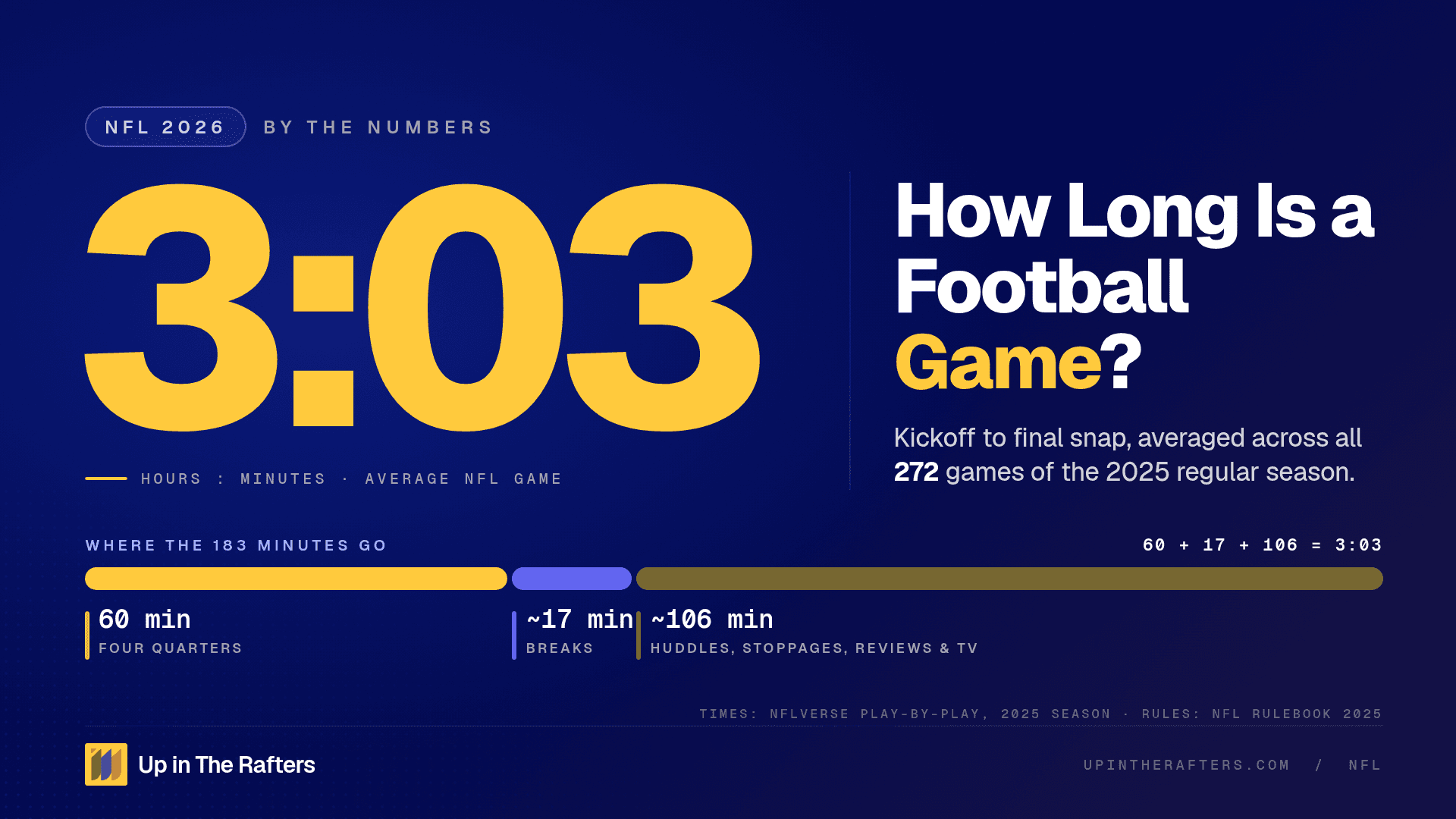
If you like rules explainers with data, I did the same thing for what a safety is in football, which is the touchback's evil twin, and for icing in hockey and the infield fly rule. And if all these returns have you wondering about game length, here's how long a football game actually lasts.
Sources:
NFL: 2026 Official Playing Rules of the National Football League
NFL.com: NFL owners vote to adjust ball spot on touchbacks to 35-yard line on dynamic kickoffs
NFL.com: NFL announces new playing rules, bylaws, resolutions for 2026
NFL.com: NFL owners pass rule to place ball at 25-yard line following fair catches on kickoffs
CBS Sports: NFL implements huge new touchback rule, admits it could backfire
Pro Football Talk: NFL had 74.5 percent of kickoffs returned in 2025
Sports Info Solutions: The impact of the NFL's kickoff rule changes