Up in The Rafters
What Is a Safety in Football? I Broke Down All 151 NFL Safeties Since 2016
A safety is when the offense gets stopped with the ball in its own end zone. The defense gets 2 points, then receives a free kick from the other team's 20. Here's how NFL Rule 11 works, what happens after a safety, why teams take one on purpose, and what all 151 NFL safeties from 2016 through 2025 show.

A safety is when the offense gets stopped with the ball in its own end zone. The defense gets 2 points, and then the team that gave up the safety has to kick the ball to them from its own 20-yard line. So the defense gets the points and the ball.
It also happens a lot less than you'd think. I went through the NFL's play-by-play for every regular-season game from 2016 through 2025, all 2,639 of them, and found 151 safeties. That's one every 17 or 18 games, or fewer than one per week of the season.
Here's how the rule works, what happens after a safety, how those 151 actually happened, and why some teams take one on purpose.
The Safety Rule in Plain English
Rule 11, Section 5 of the 2026 NFL rulebook gives two ways to get one:
The ball is dead in the offense's own end zone, and the offense put it there. A quarterback sacked in the end zone, a running back tackled in the end zone, or a fumble that rolls out the back or side of the end zone.
The offense commits a foul in its own end zone, and the defense accepts the penalty. Holding in the end zone is the classic one.
The key word in the rulebook is impetus, meaning which team sent the ball into the end zone. If the offense did it (with a run, a snap, a fumble or a backward pass), a play that dies there is a safety. If the other team did it, like a kickoff or punt into the end zone, the same play is a touchback. That's why a kick returner can take a knee in the end zone without giving up 2 points.
A few more ways a safety happens that catch people off guard:
Intentional grounding from the end zone. If the passer's entire body and the ball are in his end zone when he throws it, the penalty is a safety (Rule 8-2-1).
A punt that hits your own goal post. If a scrimmage kick touches the kicking team's goal post, uprights or crossbar, it's a safety (Rule 9-4-3).
A fumble out of bounds from your own end zone. If a team fumbles in its own end zone and the ball goes forward into the field of play and out of bounds, it's still a safety, as long as that team put the ball in the end zone in the first place (Rule 8-7-3).
And two situations that look like a safety but aren't:
An incomplete pass in the end zone. It's just an incomplete pass.
Momentum. If a defender intercepts a pass or catches a punt in the field of play and his momentum carries him into his own end zone, where he's downed, his team gets the ball at the spot where he made the catch. If he made the catch in the end zone, it's a touchback.
What Happens After a Safety
The 2 points are only half of it. The team that gave up the safety also has to give the ball away.
After a safety... | What the 2026 NFL rulebook says |
Points | 2 for the team that scored the safety (Rule 11-1-2) |
Who kicks | The team that gave up the safety, with a free kick from its own 20-yard line (Rule 11-5-2) |
Type of kick | A punt, drop kick or place kick, and a tee is allowed (Rule 6-1-1) |
Setup | Same as the kickoff: the other 10 players on the kicking team line up at the receiving team's 40, and at least nine receivers set up between their own 35 and 30 (Rule 6-1-2 and 6-1-3) |
Kick out of bounds or short of the landing zone | The receiving team can take the ball 30 yards from the spot of the kick, instead of the usual 25 on a kickoff (Rule 6-2-4). From the 20, that's midfield |
Onside kick | Allowed. The kicking team can declare one at any time in 2026, kicked from its 20 (Rule 6-1-6) |
Overtime | If the team that kicked off scores a safety on the other team's first possession, the game is over (Rule 16-1-3 and 16-1-4) |
That free kick matters more than people think. On the 129 regular safety kicks from 2016 through 2025 that I could match to the next drive (I left out onside tries), the team that scored the safety started its next drive around its own 37-yard line on average. That's 2 points plus decent field position. Score a touchdown and kick the extra point on that drive, and the safety turned into 9 points.
How the 151 Safeties Actually Happened
I sorted every regular-season safety from 2016 through 2025 by how it happened, using each play's official description.
How it happened | Safeties, 2016-2025 |
Quarterback sacked in the end zone (including strip-sacks) | 54 |
Ball carrier tackled in the end zone | 31 |
Fumble or bad snap out of (or recovered in) the end zone | 16 |
Penalty on the offense in its own end zone | 16 |
Intentional grounding in the end zone | 14 |
Punter runs out of or is tackled in the end zone | 6 |
Blocked punt out of the end zone | 6 |
Punt returner downed in his own end zone | 5 |
Other (laterals, a catch tackled in the end zone) | 3 |
Total | 151 |
Sacks account for about 36% of all safeties. That makes sense to me. A quarterback backed up on his own 2 is dropping back into the end zone, and an edge rusher only needs one clean step. Holding was 11 of the 16 safeties by penalty. When a lineman is getting beat on the goal line, grabbing feels like the safe move, but in the end zone, it isn't.
The fourth quarter had the most, with 57 (38%). The first quarter had 30, the second 37 and the third 27. Part of that fourth-quarter bump is the intentional safety, which I'll get to below.
The team that scored the safety went on to win 97 of the 151 games, or 64%.
Safeties by Season
Season | Regular-season games | Safeties | Games per safety |
2016 | 256 | 20 | 12.8 |
2017 | 256 | 15 | 17.1 |
2018 | 256 | 10 | 25.6 |
2019 | 256 | 17 | 15.1 |
2020 | 256 | 24 | 10.7 |
2021 | 272 | 8 | 34.0 |
2022 | 271 | 13 | 20.8 |
2023 | 272 | 17 | 16.0 |
2024 | 272 | 15 | 18.1 |
2025 | 272 | 12 | 22.7 |
2016-2025 | 2,639 | 151 | 17.5 |
The 2022 season has 271 games because the Bills-Bengals game in Week 17 was never finished. Going back further, the play-by-play data from 1999 through 2025 shows 427 safeties in 6,964 regular-season games, about one every 16 games. In that 27-season stretch, 2020 had the most (24) and 2021 had the fewest (8).
In the 2026 season's first 92 games, played through October 18, 2026, there's been exactly one: a holding call on Chargers tackle Joe Alt in the end zone against the Raiders on September 20, 2026.
The NFL record for career safeties is four, shared by Ted Hendricks, Doug English, Jared Allen and Justin Houston. Houston tied it in December 2020 and, according to Pro Football Talk, thinks he should have five. In 2016 he forced a Trevor Siemian fumble in the end zone that a Broncos lineman fell on, and that one went down as a team safety. I found that play in the data. He has a point.
The Intentional Safety
This is my favorite play in football, and it's the reason a team that scores a safety doesn't always win.
The idea: you're winning by more than 2 points, there are only a few seconds left, and you're stuck punting from deep in your own territory. A punt can get blocked or returned for a touchdown. So instead, the punter takes the snap, runs around in the end zone until the clock is nearly out, and then steps out of bounds or gets tackled. You give up 2 points, and either the game ends or you get a free kick from the 20.
From 2016 through 2025, a punter ran out of his own end zone or got tackled there from punt formation six times. Five of those came with 15 seconds or less left in the game, by a team protecting a lead, and that team won all five.
The most recent one: on September 28, 2025, the Eagles led the Buccaneers 31-23 with 6 seconds left. After a delay-of-game penalty pushed them back to their own 34, punter Braden Mann took the snap and ran backward into the end zone, where he was tackled for a 34-yard loss. The clock hit zero. Final: 31-25.
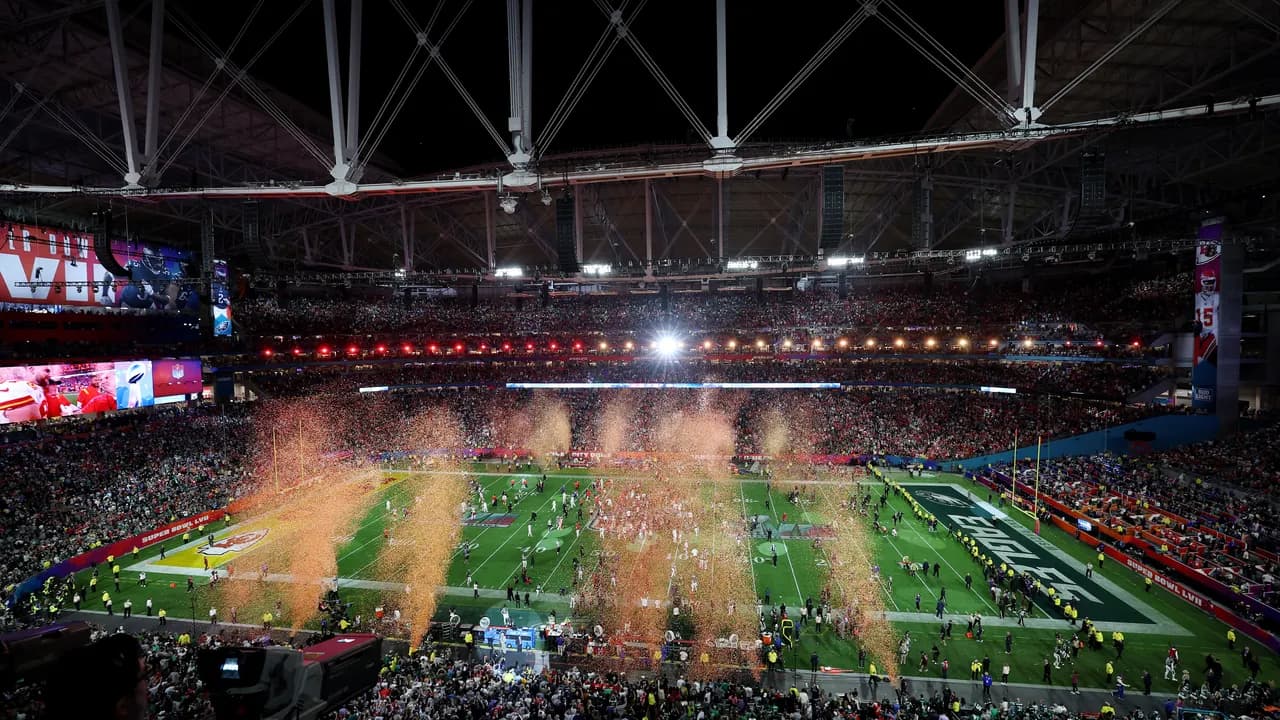
The Ravens are the masters of this. In Super Bowl XLVII on February 3, 2013, they led the 49ers 34-29 with 12 seconds left when punter Sam Koch ran around his own end zone and stepped out. That left 4 seconds, and the free kick return ended the game with Baltimore winning 34-31.
Then, on November 27, 2016, the Ravens did it again against the Bengals, with a twist. Up 19-12 with 11 seconds left, they had their punt protectors hold every Bengals rusher while Koch drifted in the end zone. He stepped out as time expired, and the Ravens won 19-14. A hold in the end zone only costs you a safety, which they were giving up anyway, and there's no untimed down after an offensive penalty. The flags didn't cost them anything.
The league closed that loophole. In March 2017 the competition committee proposed a rule aimed at what the Ravens and 49ers had done, and it's now Rule 12-3-3: a team can't commit multiple fouls on the same down to manipulate the game clock. The penalty is 15 yards, and the clock goes back to where it was at the snap. Teams can still take an intentional safety. They just can't hold all 11 guys to do it.
The One-Point Safety
Yes, a safety can be worth 1 point. It can only happen on a try after a touchdown. NFL Rule 11-3-2 says that if a try results in what would normally be a safety against either team, the other team gets 1 point. The easiest way: the defense intercepts a two-point conversion near the goal line and gets tackled in its own end zone on the return.
It has never happened in the NFL. According to CBS Sports, it wasn't even possible until 2015, when the NFL started letting the defense score on a try. As of CBS Sports' June 2026 explainer, there still hadn't been one. I didn't find one in the play-by-play from 2015 through October 18, 2026, either.
College football has had two at the FBS level, according to CBS: Texas vs. Texas A&M in 2004, and Oregon vs. Kansas State in the Fiesta Bowl in January 2013. I want to see the NFL's first one, if only to watch the broadcast booth try to explain it in real time.
Safety Rules in College vs. the NFL
The basics are the same in college, but the 2026 NCAA football rules book has a few differences.
Rule | NFL | NCAA |
Points | 2 | 2 (Rule 8-1-1) |
Kick after a safety | Free kick from the 20: punt, drop kick or place kick | Free kick from the 20: punt, drop kick or place kick (Rule 8-5-2) |
Momentum exception | Applies to a catch or recovery anywhere in the field of play | Only applies if the player gains possession between his own 5-yard line and the goal line (Rule 8-5-1) |
Close call | No "when in question" line in Rule 11-5 | "When in question, it is a touchback, not a safety" (Rule 8-5-1) |
Safety on a try | 1 point to the other team (Rule 11-3-2) | 1 point to the other team (Rule 8-1-1) |
The momentum rule is the one I'd watch. A college defensive back who picks off a pass at his own 10 and gets carried into the end zone can be tackled there for a safety. In the NFL, his team would get the ball at the 10.
Safety the Score vs. Safety the Position
Same word, two different things. A safety on the scoreboard is the 2-point play. A safety on the depth chart is a defensive back who lines up deepest in the secondary, as a free safety or strong safety.
And sometimes the safety scores the safety. On December 21, 2025, Steelers safety Kyle Dugger sacked Jared Goff in the Lions' end zone in the third quarter of Pittsburgh's 29-24 win.
Quick Answers
What is a safety in football? A safety is a 2-point score for the defense. It happens when the offense is tackled with the ball in its own end zone, when the ball goes out of bounds behind the offense's own goal line after the offense put it there, or when the offense commits a foul in its own end zone and the defense accepts the penalty.
How many points is a safety in football? Two. The team that gave up the safety then has to free kick the ball to the team that scored it from its own 20-yard line. On a try after a touchdown, a safety is worth 1 point.
What happens after a safety in football? The team that gave up the safety kicks the ball away from its own 20-yard line. It can punt, drop kick or place kick, and in the NFL it can use a tee or try an onside kick. If the kick goes out of bounds, the receiving team can take the ball 30 yards from the spot of the kick.
Has there ever been a one-point safety in the NFL? No. The rule that allows it has been in the NFL rulebook since 2015, but it hasn't happened in an NFL game. College football has had two at the FBS level, most recently in the Fiesta Bowl in January 2013.
How often do safeties happen in the NFL? About once every 17 or 18 games. There were 151 safeties in 2,639 NFL regular-season games from 2016 through 2025, and 12 in the 272 games of the 2025 season.
Final Thoughts
A safety is simple at its core: stop the offense in its own end zone, and you get 2 points and the ball. It mostly comes from sacks and tackles in the end zone, sometimes from a hold or a grounding call, and every so often from a punter running out the clock on purpose. In the 2025 season it happened 12 times in 272 games.
How I got the numbers: I used the public nflverse play-by-play data and counted every play flagged as a safety in the regular season. Then I checked every season from 2016 through October 18, 2026 against the scoring plays in ESPN's game summaries. The counts matched week by week in all 11 seasons. The "how it happened" table comes from reading each play's official description.
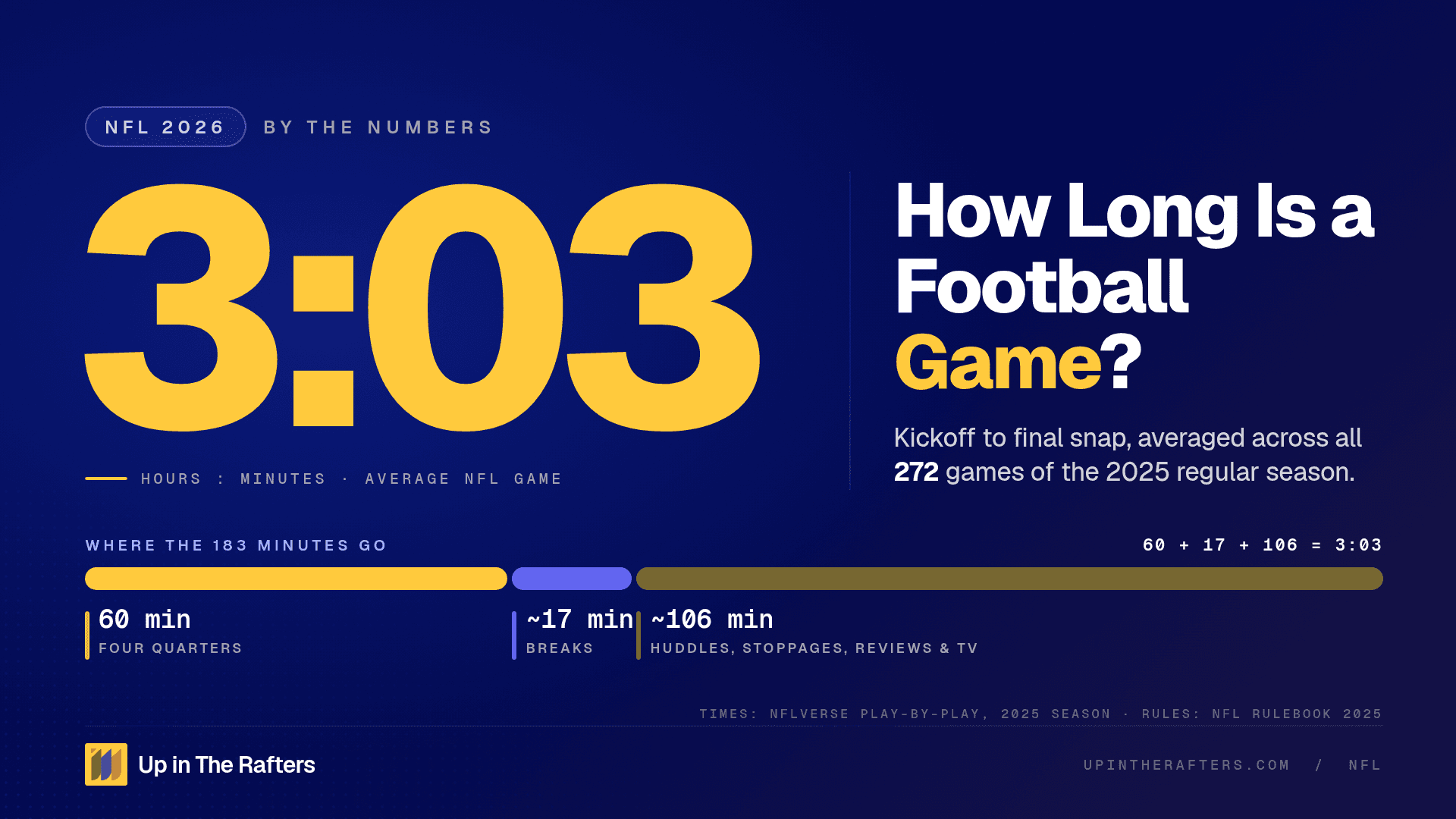
If you want more on the clock side of this, I broke down how long a football game actually lasts, including the overtime rules. For the people throwing the flags on those end-zone holds, here's how much NFL refs make. And for the other end-of-game chaos play, there's the history of the Hail Mary. If you like rules explainers with data, I did the same thing for icing in hockey.
Sources:
NFL: 2026 Official Playing Rules of the National Football League
Baltimore Ravens: Intentional safety was even better than Super Bowl trick, in execution
ESPN: NFL competition committee proposes rule change to prevent intentional penalties
CBS Sports: NFL one-point safety, why football's rarest score never happened
Pro Football Talk: Justin Houston ties the all-time record for safeties