Up in The Rafters
What Is WHIP in Baseball?
WHIP in baseball means Walks plus Hits per Inning Pitched. Learn the formula, what a good WHIP looks like, and the all-time single-season and career leaders.

WHIP stands for Walks plus Hits per Inning Pitched. It measures how many baserunners a pitcher allows per inning. The formula is simple: add the total walks and hits a pitcher has allowed, then divide by innings pitched. A lower WHIP is always better.
WHIP = (Walks + Hits) / Innings Pitched
WHIP reflects a pitcher's propensity for allowing batters to reach base, therefore a lower WHIP indicates better performance. While ERA measures the earned runs a pitcher gives up, WHIP more directly measures a pitcher's effectiveness against batters.
If a pitcher has a WHIP of 1.00, they are allowing exactly one baserunner per inning on average. If they sit at 1.30, they are giving up 1.3 baserunners per inning. Elite pitchers push that number below 1.00. Replacement-level pitchers creep well above 1.50.
The History of WHIP: Who Invented It?
The stat was invented in 1979 by writer Daniel Okrent, who called the metric "innings pitched ratio" at the time. Okrent excluded hit batsmen from the numerator of baserunners allowed since Sunday newspapers did not include hit batsmen in their agate box scores.
That quirk from 1979 explains why hit batters are still excluded from the modern WHIP calculation. The stat stuck to its original formula even as other metrics evolved.
WHIP is one of the OG sabermetric statistics in Major League Baseball. It still has a ton of value in today's game, and not just from a fantasy perspective. WHIP is part of a pitcher's standard stat line now, alongside metrics like strikeout rate and ERA.
How to Calculate WHIP: Step by Step
The formula requires three numbers:
Walks (BB):
The number of times the pitcher issued a free pass
Hits (H):
Any single, double, triple, or home run allowed
Innings Pitched (IP):
Total innings, with partial innings counted in thirds
WHIP = (H + BB) / IP
Example Calculation
Say a starting pitcher has thrown 180 innings, allowed 160 hits, and issued 50 walks:
(160 + 50) / 180 = 1.17 WHIP
That is a solid above-average number for a starting pitcher.
A Note on Partial Innings
When calculating WHIP, keep in mind that any time you see a .1 IP in a box score, it is actually, mathematically, .3333 IP. Similarly, .2 IP is actually .6667 IP. Box scores display innings in thirds of an inning, not decimals, so 6.2 innings pitched is actually 6.667 innings for calculation purposes.
What Is a Good WHIP in Baseball?
Here is the full breakdown by quality tier used across MLB analysis:
WHIP | Rating |
Below 1.00 | Elite / Cy Young caliber |
1.00 to 1.10 | Excellent |
1.10 to 1.25 | Above Average |
1.25 to 1.35 | Average |
1.35 to 1.50 | Below Average |
Above 1.50 | Poor |
A low WHIP below 1.10 is considered excellent in Major League Baseball, while anything above 1.30 suggests a pitcher's performance is struggling.
A WHIP near 1.000 or lower over the course of a season will often rank among the league leaders in Major League Baseball.
The league average tends to sit in the 1.30 range during most seasons, which means a pitcher at 1.10 is already meaningfully better than the typical MLB arm.
Breaking Down What WHIP Measures
Walks
Walks are fully within the pitcher's control and represent the most direct signal of command problems. Walks are detrimental to a pitcher's performance as they provide the opposing team with scoring opportunities and increase the chances of runs being scored. A pitcher with a high walk rate will have a higher WHIP, indicating difficulty in maintaining control over their pitches.
A pitcher who walks batters is doing two harmful things at once: giving away free bases and extending innings, which means more pitches and more opportunities for the opponent to score.
Hits
A hit can be anything from a bloop single to a line drive home run. WHIP counts them all the same, which is one of the stat's known limitations (more on that below). Still, a pitcher who consistently limits hits is keeping hitters off balance and getting weak contact.
What WHIP Does NOT Count
WHIP does not include every way a batter can reach base. It specifically excludes:
Excluded Event | Why It Is Not Counted |
Hit by Pitch (HBP) | Excluded from Okrent's original 1979 formula |
Fielding Errors | Considered the fielder's fault, not the pitcher's |
Fielder's Choice | Baserunner reaches but not directly by the pitcher |
Dropped Third Strike | Catcher error, not a pitcher event |
WHIP does not include hit batters. The reason for this is simple: when Okrent conceived WHIP, hit-by-pitch numbers were not listed in the Sunday newspaper box scores.
WHIP vs. ERA: What Is the Difference?
ERA (Earned Run Average) measures how many earned runs a pitcher allows per nine innings. WHIP measures how many baserunners a pitcher allows per inning. They are related but measure different things.
Stat | What It Measures | What It Misses |
ERA | Runs allowed per 9 innings | Strand rate, defense, ballpark |
WHIP | Baserunners allowed per inning | Type of hit, hit by pitch |
WHIP is a better isolation of pitcher performance in many cases than ERA because it is based on individual events rather than a sequence of events. In other words, it is easier for one bad play on defense to tank your ERA than your WHIP.
A pitcher could have a great WHIP but a bad ERA if his defense consistently fails to convert outs behind him. Conversely, a pitcher with a slightly elevated WHIP but excellent strand rates might post a surprisingly low ERA. Using both together gives a far more complete picture than either stat alone.
The Limitations of WHIP
WHIP is useful and widely understood, but it has real weaknesses.
1. All hits are treated equally.
WHIP does not consider the different types of hits. A home run counts the same as a single, even though the homer is clearly worse to give up. A pitcher who surrenders lots of home runs can still post a respectable WHIP, masking the true damage done.
2. It does not account for hit batters.
Hit batters reach base just like a walk and represent a failure of command, but they are invisible in the WHIP calculation because of how the stat was originally designed.
3. It does not adjust for era or ballpark.
A WHIP of 1.20 in 2000 and a WHIP of 1.20 in 1968 (the Year of the Pitcher) are very different performances relative to league average. Raw WHIP does not tell you that.
4. It uses innings pitched as the denominator.
OBP against is a better choice than WHIP because batters faced is a better denominator than innings. WHIP is more of a quick reference statistic rather than something you want to use for full-fledged analysis.
Despite these flaws, WHIP remains one of the most widely trusted and broadcast-friendly pitching stats in the game.
All-Time Career WHIP Leaders
Addie Joss is the all-time leader with a career WHIP of 0.9678. Jacob deGrom (0.9934) and Ed Walsh (0.9996) are the only other players with a career WHIP under 1.0000.
The career WHIP leaders among qualified pitchers are Addie Joss (0.9678), Jacob deGrom (0.9868), Ed Walsh (0.9996), Mariano Rivera (1.0003), and Clayton Kershaw (1.0177).
Rank | Pitcher | Career WHIP | Era |
1 | Addie Joss | 0.9678 | 1902-1910 |
2 | Jacob deGrom | 0.9868 | 2014-present |
3 | Ed Walsh | 0.9996 | 1904-1917 |
4 | Mariano Rivera | 1.0003 | 1995-2013 |
5 | Clayton Kershaw | 1.0177 | 2008-present |
6 | Chris Sale | 1.0429 | 2010-present |
7 | John Ward | 1.0435 | 1878-1894 |
8 | Pedro Martinez | 1.0544 | 1992-2009 |
The fact that deGrom sits second all-time in career WHIP among qualified pitchers, ahead of dead-ball era legends, is a testament to how historically dominant he has been during his healthy seasons.
Single-Season WHIP Records
The lowest single-season WHIP in MLB history through 2025 is held by Pedro Martinez of the 2000 Boston Red Sox, with a WHIP of 0.7373, which broke the previous record of 0.7803 held by Walter Johnson of the 1913 Washington Senators.
Season | Pitcher | WHIP |
2000 | Pedro Martinez | 0.7373 |
2020 | Kenta Maeda | 0.7500 |
1882 | Guy Hecker | 0.7692 |
1913 | Walter Johnson | 0.7803 |
Pedro Martinez's 2000 season is widely considered one of the most dominant pitching performances in baseball history. He struck out 284 batters, posted a 1.74 ERA, and allowed fewer than three quarters of a baserunner per inning over a full 217-inning season.
WHIP in the Postseason: Mariano Rivera
If regular-season WHIP records are impressive, postseason WHIP is in a different universe. Postseason Mariano Rivera was a WHIP God, allowing 86 hits and 21 walks in 141 innings pitched for an outrageous 0.759 WHIP.
Rivera did that across 96 postseason appearances, in the highest-pressure situations the sport produces. His postseason WHIP is the lowest in MLB history for any pitcher with at least 50 playoff innings.
WHIP and Fantasy Baseball
WHIP is one of the most commonly used statistics in fantasy baseball, and is standard in fantasy leagues that employ 4x4, 5x5, and 6x6 formats.
In a standard 5x5 fantasy league, the five pitching categories are typically wins, strikeouts, saves, ERA, and WHIP. That means WHIP is worth 20% of your pitching score in the most popular fantasy format. Prioritizing starters with low WHIPs is one of the most reliable strategies for winning that category across a full season.
Relief pitchers often have lower WHIPs than starters due to smaller sample sizes and selective usage. High-strikeout pitchers tend to have better WHIPs as strikeouts avoid balls in play.
WHIP vs. Other Advanced Pitching Metrics
WHIP is a great starting point, but it sits alongside a deeper toolkit of pitching metrics in modern analysis.
Metric | What It Measures | Advantage Over WHIP |
WHIP | Baserunners (H + BB) per inning | Simple, widely available |
ERA | Earned runs per 9 innings | Measures actual damage |
FIP | ERA using only K, BB, HR | Removes defense from equation |
xFIP | FIP normalized for HR rate | Stabilizes faster, more predictive |
OBP Against | On-base percentage vs. pitcher | Better denominator (batters faced) |
wOBA Against | Weighted value of each offensive event | Weights hits by actual run value |
If you have access to OBP against or wOBA against, you should use those instead of WHIP, as they are a bit more mathematically consistent with the concepts we want to measure. WHIP is no longer at the forefront of stat-head analysis, but it correlates relatively well with more accurate statistics.
For casual analysis, WHIP is fast and reliable. For deeper scouting or roster decisions, pairing it with FIP and strikeout rate gives a much fuller picture.
Quick Reference Summary
Question | Answer |
What does WHIP stand for? | Walks plus Hits per Inning Pitched |
What is the WHIP formula? | (Walks + Hits) / Innings Pitched |
Who invented WHIP? | Daniel Okrent in 1979 |
What is a good WHIP? | Below 1.10 is excellent, below 1.00 is elite |
What is the MLB average WHIP? | Around 1.30 |
All-time career WHIP leader? | Addie Joss at 0.9678 |
Single-season WHIP record? | Pedro Martinez in 2000 at 0.7373 |
Does WHIP count hit batters? | No |
Does WHIP count errors? | No |
WHIP is one of the cleanest, most accessible ways to evaluate whether a pitcher is doing his fundamental job: keeping hitters off the bases. It is not perfect, and analysts have more powerful tools available today, but for a fast read on a pitcher's effectiveness it remains indispensable. Any starter posting a WHIP below 1.10 is having a very good year. Anyone below 1.00 is operating in elite territory.
For official WHIP leaderboards and career data, visit MLB's official WHIP glossary and the career leaders at Baseball Reference.
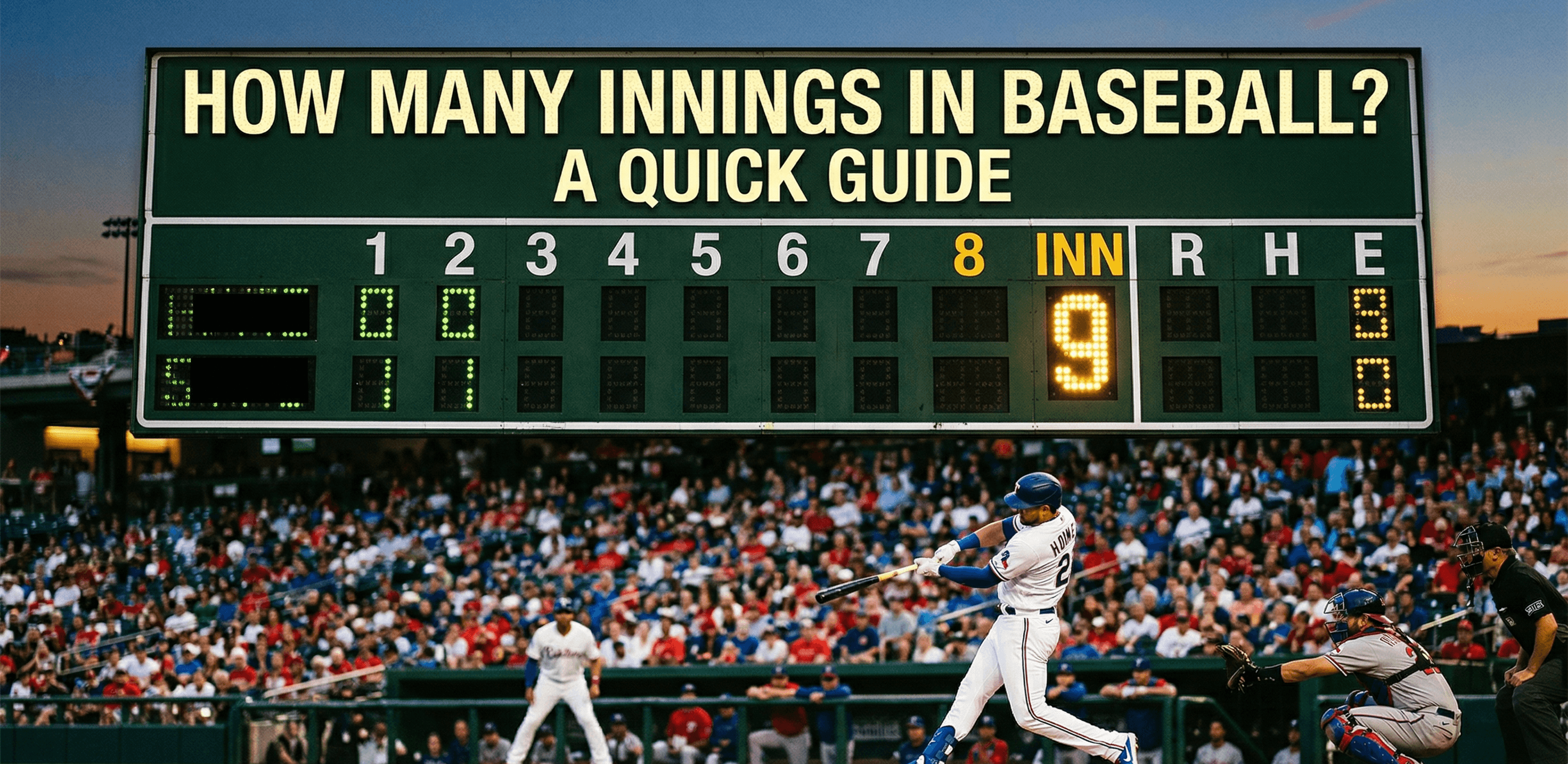
Want more baseball stat breakdowns? Check out our in-depth guide to what OPS is in baseball and our piece on how many innings are in a baseball game for more on how the sport is scored and measured.
Subscribe to Up in The Rafters at upintherafters.com/subscribe for sharp, data-driven sports takes straight to your inbox.