Up in The Rafters
What Is Icing in Hockey? I Counted All 10,949 NHL Icings From 2025-26
Icing is when a team shoots the puck from its own half past the other team's goal line and nobody touches it. Here's how NHL Rule 81 and hybrid icing work, when icing gets waved off, how college and youth hockey differ, and what all 10,949 icings from the 2025-26 NHL season show.

Icing is when a team shoots the puck from its own side of the center red line all the way past the other team's goal line, and nobody touches it. The linesperson blows the whistle, and the faceoff goes back into the end of the team that iced it. The tired players who iced it have to stay on the ice for that faceoff, too.
That's the short version. The rule has more exceptions than most fans realize, and it gets called a lot more than you'd think. I went through the NHL's play-by-play for all 1,312 games of the 2025-26 regular season and counted every icing. There were 10,949 of them, about 8.35 per game.
Here's how the rule works, when it gets waved off, how the NHL's version differs from college and youth hockey, and which teams iced the puck the most.
The Icing Rule in Plain English
Rule 81 of the NHL's 2026-27 rulebook uses the center red line to split the rink in half. If a team that's at even strength or on the power play shoots, bats or deflects the puck from its own half beyond the opponent's goal line, play stops.
Three details decide most close calls:
Where the puck was last touched. The linesperson goes by the spot where the team in possession last touched the puck, not where the shooter was standing.
"Gaining the line." To get out of an icing, the puck has to touch the center red line while it's on the player's stick. On his skate doesn't count.
Who wins the race. This is hybrid icing. Once the linesperson decides the puck will cross the goal line, he judges which player would touch it first. He has to decide by the time the first player reaches the end-zone faceoff dots, and a player's skate is what counts. If the defender is winning, it's icing. If the attacker is winning, play goes on. If it's too close to call, the rule says icing.
Watch the back linesperson. Rule 29.19 has him raise an arm straight up to signal a possible icing, and keep it up until his partner either blows the whistle or the icing is washed out. If it's icing, he points to the faceoff spot, skates to it and crosses his arms over his chest. That raised arm is your tell.
What Happens After an Icing
The real penalty for icing isn't the faceoff location. It's that the players who iced it are stuck out there.
After an icing... | What the NHL rulebook says |
Faceoff location | In the offending team's end. The attacking team picks which of the two end-zone dots (Rule 81.2) |
Line change | The team that iced it can't change players before the faceoff (Rule 81.4). Exceptions: replacing an injured player, putting the goalie back in after he was pulled, or a penalty that changes on-ice strength |
Team timeout | The team that iced it can't call one (Rule 87.1) |
TV timeout | Not allowed after an icing, unless a penalty changes the on-ice strength (Rule 87.1) |
Faceoff violation | The first violation on an icing faceoff doesn't get the center thrown out. He gets a warning, and a second violation by that team is a bench minor (Rule 76.4) |
None of that happened all at once. The NHL stopped letting the team that iced it change lines in 2005. Coaches could still buy their players a rest with a timeout, so the league banned that for 2017-18. Then for 2019-20, the NHL let the attacking team pick the faceoff dot, so the team that's about to attack gets to set up on whichever side it likes.
I like all three changes. The point is to make icing cost you something. A defenseman at the end of a long shift who flips it the length of the ice now has to stay out for a defensive-zone draw against whatever fresh line the other coach wants. That's the punishment.
When Icing Gets Waved Off
This is where most of the confusion comes from. Here's every situation in Rule 81 where a puck shot from your own half past the goal line is not icing.
Situation | Icing? | Why |
The team that shot it is shorthanded | No | Rule 81.6. A penalty-killing team can ice it all it wants |
A defender could have played the puck before the goal line and didn't | No | Rule 81.5. The linesperson waves it off. That includes a team letting the puck go by during a line change to avoid a too-many-men call |
The puck touches an opponent, including the goalie, before or after the goal line | No | Rule 81.5 |
The goalie skates toward the puck, tries to play it, or fakes playing it | No | Rule 81.3 |
The attacking player wins the race to the faceoff dots | No | Rule 81.1, hybrid icing |
The puck goes the length of the ice straight off a faceoff | No | Rule 81.5 |
The puck hits an official | Still icing | Rule 81.1. Hitting an official doesn't cancel it on its own |
The penalty expires while the puck is in the air | No | Rule 81.6. If the puck left the stick before the penalty ended, no icing |
A shot at an empty net misses | Yes | It's still a puck shot from your own half past the goal line |
The empty-net one catches people. When a team pulls its goalie, the team protecting the lead isn't shorthanded. It's five skaters and a goalie against six skaters, six players apiece. So if you try for the empty-netter from your own end and miss, that's icing, and now you've got a defensive-zone faceoff with no line change and the other team's extra attacker on the ice. It's not rare, either. In 2025-26, 551 icings came with the other team's goalie pulled.
I've never loved the shorthanded exception. I get why it exists, since killing a penalty is hard enough. But you broke a rule, and then you get to ignore a different rule because you broke the first one? That's a strange reward.
What 10,949 Icings Look Like
The NHL logs every stoppage in its play-by-play feed, and each icing is tagged with a reason. I pulled all 1,312 regular-season games from 2025-26 and counted them. Then I checked 19 games against the NHL's official HTML play-by-play sheets, and the counts matched in all 19.
10,949 icings, or 8.35 per game. The median game had 8.
445 games (about one in three) had 10 or more icings.
The most: 20, which happened twice. Dallas at Utah on January 15, 2026 (Utah iced it 15 times), and Chicago at Winnipeg on March 3, 2026. Chicago iced it 16 times that night, the most by one team in any game all season.
The fewest: zero. Philadelphia at Minnesota on March 12, 2026 went 65 minutes, plus a shootout the Flyers won 3-2, without a single icing. That's the only game all season without one.
Then I looked at when they happen.
When | Icings | Note |
1st period | 3,431 | |
2nd period | 3,457 | The long change barely moves it |
3rd period | 4,041 | 551 of these came with the other team's goalie pulled |
Overtime | 20 | 3-on-3, across 326 games that went past regulation |
Total | 10,949 | 2025-26 regular season |
You'd expect the second period to lead. Teams have the long change in the second, so their bench is at the far end and a tired line is more tempted to just get the puck out. It barely registered: 3,457 icings in the second against 3,431 in the first. The third-period bump is almost all empty-net hockey. Take out those 551 icings with the other team's goalie pulled, and the third period drops to 3,490, right in line with the other two.
By strength, about 93% of icings (10,211) came at 5-on-5. Teams on the power play iced it 97 times. That gets called like any other icing, since only the shorthanded team gets the exception.
Which NHL Teams Iced the Puck the Most
The play-by-play feed doesn't say which team iced it, but the rulebook does: the faceoff after an icing goes in the offending team's end. So I credited each icing to the team whose end the next faceoff was in. For the same 19 games, the faceoff zones in the feed matched the official play-by-play sheets on all 177 icings. Ten icings across the season were followed by a neutral-zone or center-ice faceoff (the rulebook moves the draw out after a scrum, and to center ice if the linesperson called icing by mistake), so I left those out. Another 14 had a penalty called before the faceoff, which can move the draw, so treat any team's total as accurate to within a handful.
Team | Icings in 2025-26 | Per game |
San Jose Sharks | 422 | 5.15 |
Nashville Predators | 411 | 5.01 |
Detroit Red Wings | 405 | 4.94 |
Boston Bruins | 384 | 4.68 |
Minnesota Wild | 376 | 4.59 |
... | ... | ... |
Calgary Flames | 308 | 3.76 |
Edmonton Oilers | 302 | 3.68 |
Tampa Bay Lightning | 298 | 3.63 |
Florida Panthers | 298 | 3.63 |
Winnipeg Jets | 269 | 3.28 |
Winnipeg iced the puck 153 fewer times than San Jose over 82 games. That's almost two fewer defensive-zone faceoffs with a tired group every night.
On the other side, Carolina drew the most icings. Opponents iced it against the Hurricanes 441 times, or 5.38 a game. Calgary (405) and Vegas (403) were next. My Canucks were dead even: they iced it 369 times and had it iced against them 366 times.
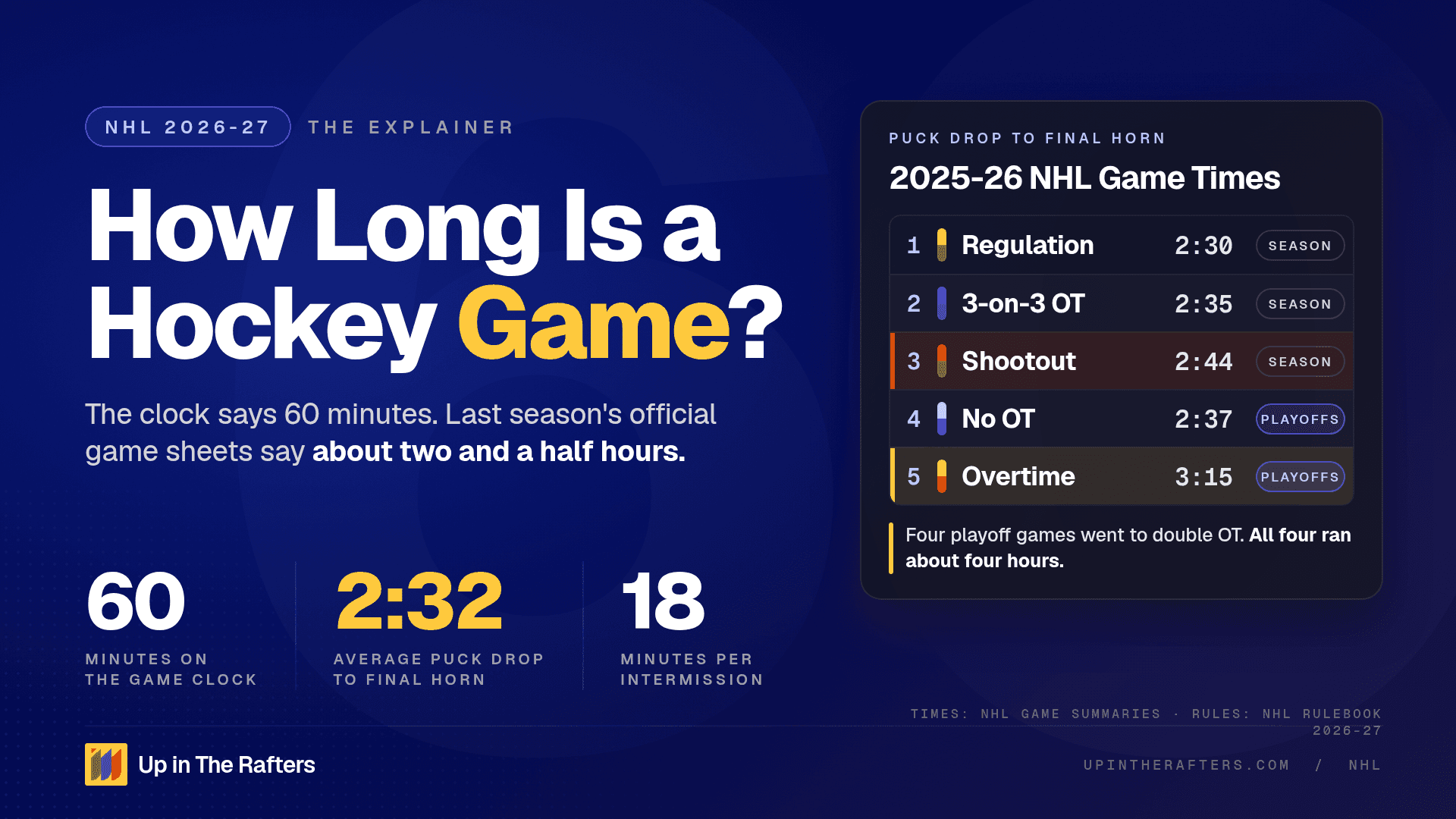
One more thing on counting: icing, like offside and the goalie freezing the puck, is one of the whistles that adds real time to a game. I broke down where all that time goes in how long a hockey game actually lasts.
Icing in College and Youth Hockey
The NHL isn't the only version of the rule, and if you watch your kid play on Saturday morning, you've seen a different one.
Level | Type of icing | Shorthanded team can ice it? |
NHL | Hybrid: race to the end-zone faceoff dots | Yes |
NCAA | Hybrid: it's icing unless an onside attacker is clearly going to get there first, decided by the time the first player reaches the end-zone dots | Yes (Rule 85.6). And unlike the NHL, the team that iced it can use its timeout to get a line change (Rule 85.4) |
USA Hockey | No-touch: icing is complete the instant the puck crosses the goal line | Only at Youth 15-Only and older, Girls 16U and older, high school and adult levels. Younger age groups get icing called on the penalty kill too |
The NCAA's version, in Rule 85 of its 2024-25 and 2025-26 rules book, is close to the NHL's, but it leans toward calling icing. The race only matters if an attacker is onside at the blue line, has nobody between him and the goal line, and is clearly going to touch the puck first. A 2023 memo from the NCAA rules committee also reminded officials that a race too close to call is icing.
USA Hockey's Rule 624 is simpler. No race at all. The puck crosses the goal line, and it's icing. The younger age groups also lose the shorthanded exception, which makes sense to me. Kids should learn to move the puck on the penalty kill, not fire it down the ice.
Why Icing Exists, and Why the NHL Went Hybrid
Icing exists because teams used to stall. On December 8, 1931, the New York Americans beat the Bruins 3-2 at Boston Garden and, according to Bruins president Charles Adams, iced the puck 61 times to protect the lead. The rematch at Madison Square Garden on January 3, 1932 ended 0-0, and the Bruins reportedly iced it 87 times to make a point. That history is laid out in The New York Times, and both results are on Hockey-Reference. The NHL's own history of rule changes lists icing as new for the 1937-38 season.
Before 2013-14, the NHL used touch icing. The defender had to skate all the way to the puck and touch it, so the play turned into a full-speed race into the end boards. That race hurt people. The same Times piece was written the day after Carolina defenseman Joni Pitkanen broke his heel in an icing race in April 2013, and it lists a history of icing-race injuries going back decades.
The NHL and the players' union announced hybrid icing on September 30, 2013, after testing it in the preseason, and it's been the rule ever since. The NHLPA called it "a middle ground between the old rule and no-touch icing." You still get a race, so the forward can beat a lazy defenseman and keep the puck alive. It just gets decided at the dots, not on a collision course with the boards.
Quick Answers
What is icing in hockey? Icing is when a team at even strength or on the power play shoots, bats or deflects the puck from its own half of the ice, past the center red line, beyond the opposing team's goal line without anyone touching it. Play stops and the faceoff goes to the offending team's end (NHL Rule 81).
Can a shorthanded team ice the puck? Yes, in the NHL and NCAA. A team killing a penalty can ice the puck without a stoppage. In USA Hockey, that exception only applies at Youth 15-Only and older, Girls 16U and older, high school and adult levels, so younger age groups get icing called on the penalty kill.
What is hybrid icing? Hybrid icing is a race to the end-zone faceoff dots. The linesperson judges which player would touch the puck first by the time the first player reaches the dots. If the defender is winning, it's icing. If the attacker is winning, play continues. A race too close to call is icing. The NHL adopted it for the 2013-14 season.
Can a team change lines after icing? Not in the NHL. The team that iced the puck can't change players before the next faceoff, except to replace an injured player, put a pulled goalie back in, or when a penalty changes the on-ice strength. It can't call a timeout either. In NCAA hockey, the team that iced it can use its timeout to get a change.
How many icings are there in an NHL game? About eight. Across all 1,312 games of the 2025-26 NHL regular season there were 10,949 icings, or 8.35 per game. The most in one game was 20, and one game, Philadelphia at Minnesota on March 12, 2026, had none.
Final Thoughts
Icing is simple at its core: shoot it from your own half past the other goal line, nobody touches it, and you're taking a faceoff in your own end with the same tired players. The exceptions are where the arguments start. A shorthanded team can do it. A defender who could have played the puck can wave it off. A missed empty-netter counts. And whoever is winning the race to the dots decides the close ones.
In 2025-26 it happened 10,949 times, about eight a night. Through the first 134 games of the 2026-27 season, all games played through October 17, 2026, the rate is 8.57 per game, right in line with last season.
How I got the numbers: the NHL's public play-by-play feed tags every stoppage with a reason, like this one for Dallas at Utah on January 15, 2026. I counted every stoppage tagged "icing" in all 1,312 regular-season games and spot-checked 19 games against the official HTML play-by-play sheets. Team totals come from where the next faceoff was taken.
If you want more on the rulebook, I've broken down how overtime works in hockey and how the NHL draft lottery works. And if you want to see how hockey's clock compares with soccer's, here's how long a soccer game really is.
Sources:
NHL official play-by-play report: Dallas at Utah, January 15, 2026
Scouting the Refs: NHL adopts rule changes for 2017-18 season
NCAA: 2024-25 and 2025-26 men's and women's ice hockey rules book (PDF hosted by the ACHA)
NCAA: 2023 men's and women's ice hockey early season guidance
The New York Times: Pitkanen's injury renews debate about icing rule
Hockey-Reference: 1931-32 Boston Bruins schedule and results