What Is Offsides in Hockey? I Counted 5,942 NHL Offside Calls
Offsides in hockey is the blue line rule: no attacker can enter the zone before the puck. Here's how Rule 83, delayed offside and the coach's challenge work, plus what 5,942 NHL offside calls show.
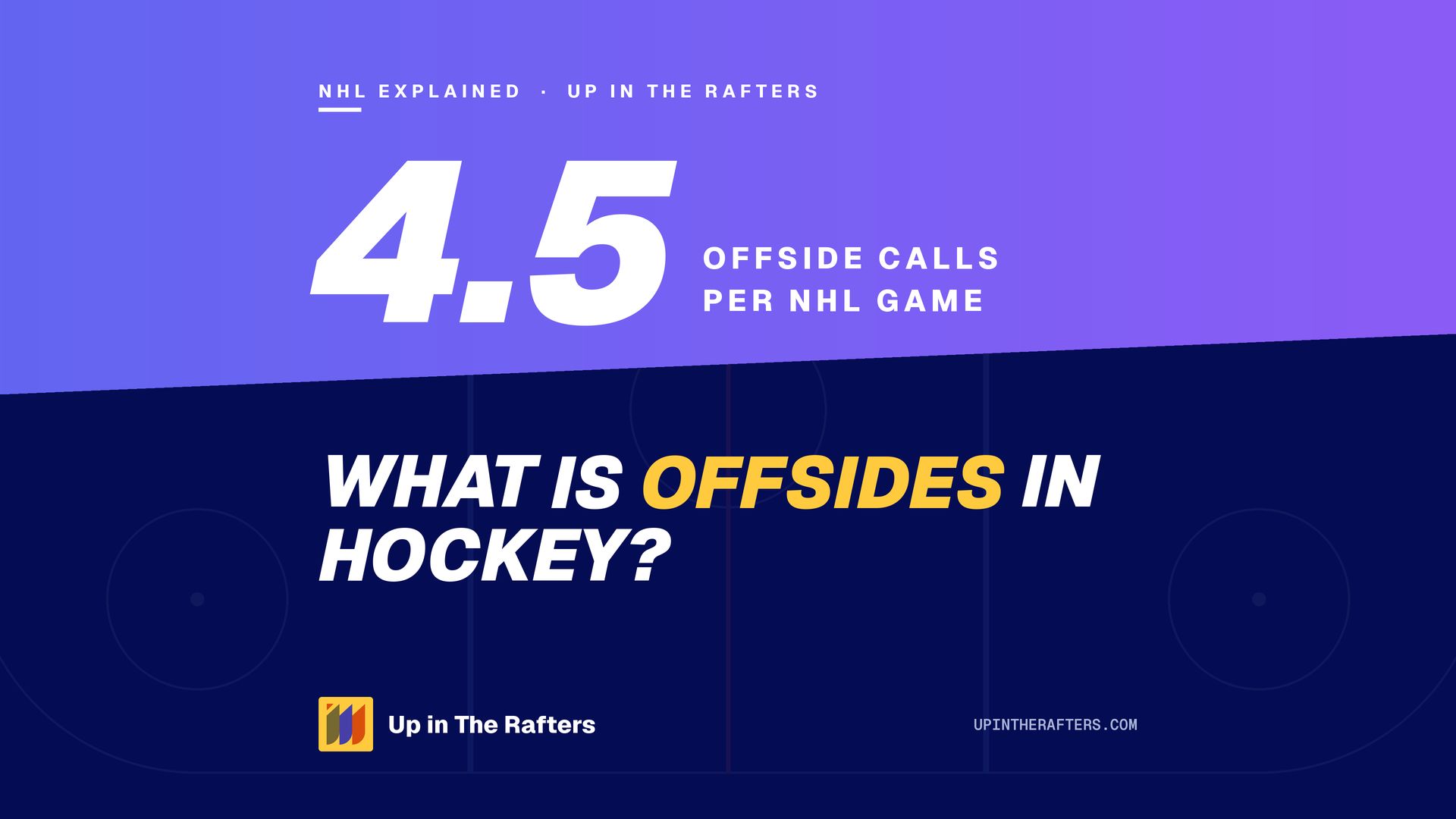
Offsides in hockey means an attacking player got into the offensive zone before the puck did. The blue line is the gate. The puck has to cross it completely before any attacker's skates are fully over it. If a player beats the puck in, the linesperson either blows the whistle or raises an arm for a delayed offside, and play restarts with a faceoff outside the zone.
That's the whole idea. The rest is details, and the details are where fans get lost: skates in the air, players carrying the puck, delayed calls, and goals that come off the board after a coach's challenge. So I went through Rule 83 of the NHL's 2026-27 rulebook and the NHL's play-by-play data for every game of the 2025-26 regular season. There were 5,942 offside whistles in 1,312 games, about 4.5 a game.
I grew up playing basketball and baseball. My dad, Steve, is the one who played hockey, as a goalie growing up, and the two of us both root for the Buffalo Sabres. So this is me working through the rulebook and the numbers, not passing along tips from my own playing days.
What is offsides in hockey? A player is offside when both of his skates are completely over the attacking blue line before the puck has completely crossed it. Where his stick is doesn't matter. Only the skates count. If one skate is still touching the line or hasn't broken the plane of the line, he's onside. When offside is called, play stops and the faceoff goes outside the zone, usually at a neutral-zone dot.
Offsides in hockey at a glance
| Question | Answer |
|---|---|
| Rule | NHL Rule 83, Off-side |
| The line that matters | The attacking blue line (12 inches wide, 64 feet from the goal line) |
| What decides it | Skates only, not the stick |
| Onside if | Either skate touches the blue line or hasn't broken its plane when the puck fully crosses |
| Who calls it | The linespersons |
| Restart (puck carried in) | Faceoff at the neutral-zone dot nearest the zone |
| Restart (puck passed or shot in) | Faceoff at the dot closest to where the pass or shot started |
| Penalty? | No, just a stoppage (unless a failed coach's challenge, which costs a minor) |
Sources: NHL Official Rules 2026-27, Rules 1.5, 38 and 83.
How the blue line decides offsides
The NHL rink is split into three zones by two blue lines. Rule 1.5 says the lines are 12 inches wide and sit 64 feet out from each goal line. For the attacking team, the area past the far blue line is the attacking zone, and Rule 83.1 says attackers "must not precede the puck" into it.
Here's how the call is actually made:
The puck has to completely cross the leading edge of the blue line. Touching the line isn't enough.
The skates decide it, not the stick. A player can have his stick deep in the zone and still be onside.
A player is offside only when both skates are completely over the line. One skate on the line or behind it keeps him onside.
A skate in the air still counts if it hasn't broken the plane. The rulebook treats the line as a wall going straight up from its leading edge.
That last part is newer than people think. Before the 2020-21 season, a skate had to be touching the ice on the line or behind it. The NHL changed Rule 83.1 so a raised skate that hasn't crossed the plane is onside (NHL.com). General managers pushed for it after a run of goals got wiped out by toes hovering an inch off the ice. NHL.com reported in March 2020 that 18 coach's challenges through 1,015 games that season were for skate-in-the-air plays, and 14 of them took goals off the board (NHL.com).
Can you be offside if you have the puck?
No, as long as you keep control of it. Rule 83.1 says a player carrying the puck who crosses the line ahead of it isn't offside if he had possession and control with his stick before his trailing skate crossed the line, and he keeps that control right after the puck enters the zone.
That's the play you see on almost every clean zone entry. A forward's front skate goes over the line first, the puck is on his stick a foot behind, and nobody blinks. He's controlling the puck, so it's fine.
The other exception is going backwards. If a player legally carries, passes or plays the puck back into his own defending zone while an opponent is in that zone, the rulebook says the offside is ignored and play goes on.
What is a delayed offside?
A delayed offside is when an attacker is already in the zone ahead of the puck, but the defending team has the puck and can clear it without trouble. Instead of blowing the whistle right away, the linesperson raises his non-whistle arm straight up and lets play continue.
Under Rule 83.3, the linesperson drops his arm and wipes out the offside if either of these happens:
Every attacking player clears the zone at the same time, with skate contact on the blue line. That's the "tag-up."
The defending team passes or carries the puck out into the neutral zone.
He blows the whistle if an attacker touches the puck, goes after a loose puck, forces the puck carrier back into his zone, or is about to hit the puck carrier while the arm is up.
One rule here surprises people. If the puck is shot into the zone and creates a delayed offside, and that same shot ends up in the net, Rule 83.4 says the goal doesn't count, even if the attackers had tagged up by the time it went in. The only way to score on a delayed offside is if the defending team puts the puck in its own net without any action or contact from the attackers.
There's also an intentional offside. If the linesperson thinks a team went offside on purpose to get a stoppage, Rule 83.7 moves the faceoff all the way back to the offending team's end. And if a player deliberately touches the puck during a delayed offside to stop play, that's an intentional offside too.
What happens after offsides is called
Offside isn't a penalty. Nobody goes to the box. The penalty is losing the zone and the faceoff. Rule 83.6 sets the spot:
| How the offside happened | Where the faceoff goes |
|---|---|
| Puck carried over the blue line | Neutral-zone dot nearest the attacking zone |
| Puck passed or shot in | Dot closest to where the pass or shot started, giving the offending team the least territorial advantage |
| Defender pressured during a delayed offside | Same as a pass or shot: dot closest to where it started |
| Intentional offside | Offending team's defensive-zone dot |
Source: NHL Official Rules 2026-27, Rule 83.6.
In the data, 5,286 of the 5,942 offside whistles from 2025-26 (89%) were followed by a faceoff at one of the four neutral-zone dots. That lines up with Rule 83.6, since carried entries and passes from the neutral zone both restart at those dots.
How often offsides is called in the NHL
I pulled the NHL's play-by-play feed for all 1,312 regular-season games in 2025-26 and counted every stoppage the league logged as offside. To check it, I compared 22 games against the NHL's official play-by-play sheets, and the counts matched in all 22. The totals include about 100 offsides that were only called after a coach's challenge took a goal away.
| Stat | 2025-26 regular season | 2026-27 through Nov. 25, 2026 |
|---|---|---|
| Games | 1,312 | 399 |
| Offside whistles | 5,942 | 1,925 |
| Per game | 4.53 | 4.82 |
| Icing whistles (for comparison) | 10,949 (8.35 a game) | 3,370 (8.45 a game) |
| Most in one game | 12 (four games) | 15 (Utah at Ottawa, Nov. 7, 2026) |
| Games with no offsides | 18 | 3 |
Source: my count of the NHL's public play-by-play feed for every regular-season game, like this one for Utah at Ottawa on Nov. 7, 2026, checked against the official play-by-play sheets.
So icing gets called close to twice as often as offsides. If you want the other big line violation explained, I did the same kind of count in what icing is in hockey.
A few other things stood out:
The first period had the most offsides. In 2025-26 there were 2,223 in the first, 1,837 in the second and 1,847 in the third. That's 37% of all offsides in a third of the regulation time. I don't have a clean explanation for it, so I'm not going to make one up.
Most offsides happen at even strength. 5,232 of the 5,942 (88%) came with the same number of skaters on each side.
Overtime has offsides too. There were 35 in 2025-26 overtimes. The rule doesn't change at 3-on-3, which I covered in how overtime works in hockey.
Buffalo's games have had the most this season. Through Nov. 25, 2026, Sabres games averaged 5.96 offside whistles, both teams combined, the most of any team. I'd rather they led the league in something else.
Offsides and the coach's challenge
Offside is one of the few calls a coach can challenge. Under Rule 38, if a goal is scored and the defending team thinks the play should have been stopped for offside first, it can ask for a video review. The NHL Situation Room makes the final call. In the last minute of the third period and in overtime, the league starts the review itself.
The review only goes back so far. Rule 38.9 says a goal can only be reviewed for offside if the puck didn't come back out of the attacking zone between the offside and the goal. If the goal is overturned, the clock resets to the moment the offside happened.
Getting it wrong costs you. A failed challenge is a two-minute minor for delay of game, and a second failed challenge in the same game is a four-minute double minor.
Teams win most of these. In 2025-26, an offside review took the goal away almost nine times out of ten:
| Season | Offside reviews | Goals overturned | Goals stood |
|---|---|---|---|
| 2025-26 regular season | 114 | 101 (89%) | 13 |
| 2026-27 through Nov. 25, 2026 | 24 | 23 | 1 |
Sources: Scouting The Refs 2025-26 Coach's Challenge Tracker for 2025-26, which matched my play-by-play count of 114. The 2026-27 numbers are my own count from the play-by-play feed.
A Sabres example, since that's who we watch. On Oct. 13, 2025, Colorado's Martin Necas scored 7:26 into the third period in Buffalo. The Sabres challenged, and video review found Necas had entered the zone ahead of the puck. The goal came off the board and the clock went back to 7:13 of the period, when the offside happened (NHL.com). Colorado still won 3-1 (AP).
Is it offside or offsides?
Both get used. The NHL rulebook spells it "off-side," NHL.com stories usually write "offside," and most fans and broadcasters say "offsides." They all mean the same call. I used "offsides" in the title because that's what most people type into Google, and "offside" in the rule descriptions because that's closer to the rulebook.
How hockey offsides compares with soccer and football
Autocomplete keeps pairing "offsides in hockey" with soccer, and the rules are pretty different.
| Hockey (NHL) | Soccer (IFAB Law 11) | Football (NFL) | |
|---|---|---|---|
| What it's measured against | The attacking blue line | The ball and the second-last defender | The neutral zone at the line of scrimmage, or the free-kick line |
| When it's judged | When the puck crosses the blue line | When a teammate plays the ball | Before the ball is put in play |
| Is the position itself an offense? | Yes, unless a delayed offside is cleared | No, only if the player gets involved in play | Yes |
| Result | Stoppage and a faceoff | Indirect free kick | Five-yard penalty |
Sources: NHL Official Rules 2026-27, IFAB Law 11, NFL Football Operations.
The big difference with soccer is that hockey's line doesn't move. In soccer, the offside line moves with the second-last defender. In hockey, it's painted on the ice. That makes the call easier to explain, even if the replays still come down to an inch.
How the offside rule has changed
| Season | Change |
|---|---|
| 1996-97 | Tag-up offside removed |
| 2005-06 | Tag-up offside brought back, and the two-line pass (red line offside) eliminated |
| 2015-16 | Coach's challenge added for offside plays that lead to goals |
| 2020-21 | A skate in the air is onside if it hasn't broken the plane of the blue line |
Sources: Wikipedia: National Hockey League, NHL Records: Historical Rule Changes, NHL.com.
The 2005-06 change is the one that shaped how hockey looks now. Before it, a pass from your own zone couldn't be completed past the center red line. Taking that away made long stretch passes legal, and the blue line became the only offside line left. That's why you see so many breakouts that end with a forward timing his skates at the far blue line.
What I think of the offside rule
I like it, and I think the 2020-21 plane change was the right fix. The point of offsides is to stop attackers from parking in the zone and waiting for a long pass. A skate hovering half an inch off the ice doesn't give anybody that kind of edge, and goals were getting erased for it.
The part I'd change is the review. A coach's challenge can go back as long as the puck never left the zone, so in theory a goal can come off the board for an offside that happened long before the goal and had little to do with it. With 101 of 114 offside reviews overturned in 2025-26, the replays are clearly finding real offsides. I'd still put a time limit on how far back a challenge can reach.
If you're new to hockey rules, start with what a power play is and how long a hockey game really lasts. Offsides will make a lot more sense once you've watched a few zone entries with the blue line in mind.
Sources:
NHL official play-by-play report: Utah at Ottawa, Nov. 7, 2026
NHL.com: General managers recommend change to how offside rule is applied
AP: MacKinnon scores twice in the Avalanche's 3-1 victory over the Sabres
Frequently Asked Questions
What is offsides in hockey in simple terms?
An attacking player can't go into the offensive zone before the puck. If both of his skates are fully over the blue line before the puck completely crosses it, he's offside, and play stops for a faceoff outside the zone.
What's the difference between offsides and icing?
Offsides is about the attacking blue line: a player beat the puck into the zone. Icing is about the red lines: a team shot the puck from its own half all the way past the opponent's goal line. NHL officials called icing 10,949 times and offsides 5,942 times in the 2025-26 regular season.
What is a delayed offside in hockey?
It's when an attacker is in the zone ahead of the puck but the defending team has the puck. The linesperson raises an arm and lets play go on. The offside is wiped out if all the attackers clear the zone together or the defenders move the puck out. Play stops if an attacker touches the puck or pressures the puck carrier.
Can you be offside if you're carrying the puck?
No. A player who has control of the puck can cross the blue line ahead of it, as long as he had control before his trailing skate crossed and keeps it after the puck enters the zone.
Is there offsides in overtime hockey?
Yes. The offside rule doesn't change in overtime. NHL officials called 35 offsides in 2025-26 regular-season overtimes.
Can a coach challenge a goal for offsides?
Yes. A team can challenge a goal it thinks came off an offside play, as long as the puck stayed in the attacking zone between the offside and the goal. A failed challenge costs a two-minute minor penalty. In 2025-26, 101 of 114 offside reviews overturned the goal.
Sources
Matt's first sports memories are Kobe dropping 81, LaDainian Tomlinson making defenders look silly, and Derek Jeter somehow always coming through in October. He's been hooked ever since.
Think a number is off? Tell us, or check the Corrections page.
More in NHL
View all
Who Won the Dylan Larkin Trade? Montreal, Even if Detroit Did Well

What Is the Longest Point Streak in NHL History? Gretzky's 51 and McDavid's 23-Game Run
What Is a Hat Trick in Hockey? I Counted 485 NHL Hat Tricks