Up in The Rafters
What Is a Power Play in Hockey? What 7,555 NHL Power Plays From 2025-26 Show
A power play is when one team has more skaters on the ice because the other team is serving a penalty, usually 5-on-4 for two minutes. Here's how NHL power plays work, which penalties end on a goal, where the 1956 rule change came from, and what all 7,555 power plays from the 2025-26 season show.

A power play is when one team has more skaters on the ice because the other team has a player in the penalty box. Usually it's five skaters against four for two minutes. The team with the extra man is "on the power play." The team down a man is "shorthanded," and it's "killing the penalty."
That's the short version. The details decide a lot of games, so I pulled the numbers. The NHL had 7,555 power plays in the 2025-26 regular season, and teams scored 1,595 power-play goals. That's a 21.1% success rate, or roughly one goal for every five power plays. I also went through the NHL's play-by-play for all 1,312 games to see what kind of power plays produce goals, when in the two minutes those goals come, and what it's like from the goalie's side.
Here's how the rule works, when a power play ends early, and what the 2025-26 data says.
The Power Play in Plain English
Under Rule 16 of the NHL's 2026-27 rulebook, a minor penalty sends a player (anyone but the goalie) to the penalty box for two minutes, and his team can't replace him. That's where the power play comes from. The other team gets the advantage until the penalty runs out or it scores.
A few things to know:
A goal ends a minor penalty. If the power-play team scores, the penalized player comes right out (Rule 16.2). If two minors are running, only the one with the least time left ends.
The faceoff moves into the penalized team's end. When a penalty is called at a stoppage, the faceoff goes to one of the two dots in the offending team's zone, and the team on the power play picks the dot (Rule 76.2).
The delayed penalty. If the team that committed the foul doesn't have the puck, the referee raises his arm and waits. Play stops when the team to be penalized touches the puck (Rule 15.1). Since the whistle only comes when the penalized team touches the puck, the other team will often pull its goalie for an extra attacker until then.
No fewer than three skaters. A team can be down to three skaters, which makes it a 5-on-3. If a third player gets a penalty, his time doesn't start until one of the first two penalties ends (Rule 26.1).
Overtime is different. In regular-season overtime, which is played 3-on-3, a penalty makes it 4-on-3 (Rule 84.3).
The shorthanded team can ice the puck. The team on the power play can't (Rules 81.1 and 81.6). That's one of the biggest advantages of having the extra man, and I went through how that rule works in my post on icing in hockey.
Which Penalties Create a Power Play, and Which Ones End on a Goal
Not every penalty puts a team on the power play, and not every power play ends when the other team scores. This is where most of the confusion comes from.
Penalty | How long | Power play? | Does a power-play goal end it? |
Minor (Rule 16) | 2 minutes | Yes | Yes |
Bench minor (Rule 17) | 2 minutes, served by a player the coach picks | Yes | Yes |
Double minor (Rule 18) | 4 minutes | Yes | Partly. A goal in the first two minutes ends the first minor, and the second one starts over at that moment. A goal in the last two minutes ends it |
Major (Rule 20) | 5 minutes | Yes | No. The player serves all five minutes no matter how many goals go in (Rule 20.2) |
Match (Rule 21) | Player is gone for the game; a teammate serves 5 minutes | Yes | No. A substitute can come out only after five minutes of playing time (Rule 21.2) |
Misconduct (Rule 22) | 10 minutes | No | Doesn't apply. A misconduct alone doesn't make a team shorthanded (Rule 22.3) |
Coincidental minors (Rule 19) | 2 minutes each | No | Doesn't apply. One minor to each team at the same stoppage, with nothing else on the clock, means 4-on-4 |
Penalty shot | One shot | No | A goal on a penalty shot doesn't release anyone from the box (Rule 16.2) |
The major penalty one matters more than people think. A major (and, for two goals, a double minor) is the only way a team can score more than once on the same penalty. Most majors never turn into a power play, though. Of the 632 majors in the 2025-26 play-by-play, 611 were for fighting, and 610 of those had a matching fighting major to a player on the other team at the same moment, which cancels out.
The 1956 Rule Change That Made Power Plays End Early
Power plays didn't always end on a goal. Until 1956, a player served all two minutes of a minor penalty no matter what happened.
On November 5, 1955, Jean Béliveau of the Montreal Canadiens scored three power-play goals in 44 seconds against the Boston Bruins, all on the same penalty to Boston defenseman Hal Laycoe, according to NHL.com. Montreal won 4-2. At a Board of Governors meeting on June 6, 1956, five of the six NHL teams voted to release a minor-penalized player when the other team scored. Montreal was the one vote against.
Canadiens general manager Frank Selke didn't take it well. "Go get a power play of your own," he said, quoted in D'Arcy Jenish's book on the Canadiens and cited in that NHL.com story. The rule took effect for the 1956-57 season, and it's still Rule 16.2 today.
I think the change was right, and Bruins GM Lynn Patrick made the case in the same story: a player who takes a minor may have saved a goal with his foul, so once the other team scores that goal, "there's no reason why he shouldn't be allowed to return immediately." The penalty costs you a goal, not a pile of them.
What Kind of Power Plays Produce Goals
The NHL's play-by-play feed tags every goal with how many skaters each team had on the ice. Here's every power-play goal from the 2025-26 regular season, sorted by strength. My count of 1,595 matches the NHL's official total.
Strength when the goal was scored | Power-play goals, 2025-26 | Share |
5-on-4 | 1,444 | 90.5% |
5-on-3 | 87 | 5.5% |
4-on-3 | 34 | 2.1% |
6-on-4 (power-play team pulled its goalie for an extra attacker) | 22 | 1.4% |
Into an empty net while the shorthanded team had pulled its goalie | 8 | 0.5% |
Total | 1,595 | 100% |
Nine out of ten power-play goals are plain 5-on-4 goals. The 4-on-3 goals are mostly an overtime thing: 24 of the 34 came in overtime, where a penalty turns 3-on-3 into 4-on-3.
When Power-Play Goals Come
I wanted to know if teams score early in a power play, when the penalty-killers are fresh but the power play is set up off a faceoff, or late, when the killers are tired. So I looked at every 5-on-4 goal that came during a single two-minute minor, with no other penalty on the clock. That's 1,055 goals.
Time into the power play | Goals | Share |
0:00 to 0:29 | 259 | 24.5% |
0:30 to 0:59 | 289 | 27.4% |
1:00 to 1:29 | 259 | 24.5% |
1:30 to 2:00 | 248 | 23.5% |
It's pretty even. The median goal came 58 seconds in, and the second 30 seconds was the best stretch, but only by a little. There's no magic window. The fastest ones came two seconds in, right off the faceoff. Alex Ovechkin did it for Washington at Montreal on November 20, 2025, scoring two seconds after a Juraj Slafkovský high-sticking penalty, which is on the NHL's official play-by-play sheet. Andrei Svechnikov did it for Carolina against Vegas on October 28, 2025.
One thing to keep in mind with this table: a power play that's already ended can't produce a goal in the last 30 seconds. Some power plays end early because a goal goes in or the power-play team takes a penalty, so slightly fewer of them are still running late. The late goals are a little more impressive than the raw count makes them look.
The Goalie's Side of a Power Play
Steve played goalie growing up, and it's the goalie who has to deal with the extra man. You can see it in the save percentages. I took every shot on goal and every goal in 2025-26 with a goalie in net, left out penalty shots and empty-net goals, and grouped them by how many skaters were in front of the goalie.
Goalie's team vs. shooting team | Shots on goal faced | Goals allowed | Save percentage |
5-on-5 | 56,439 | 5,364 | .905 |
4-on-5 (killing a penalty) | 10,039 | 1,447 | .856 |
3-on-5 (killing a 5-on-3) | 361 | 87 | .759 |
5-on-4 (facing a shorthanded team) | 1,935 | 173 | .911 |
At 5-on-5, the league's goalies stopped 90.5% of shots. Kill a penalty and that drops to 85.6%. Kill a 5-on-3 and it's 75.9%, or about one goal every four shots. So the goalie on a penalty kill isn't just seeing more shots. Each shot is more likely to go in.
The last row is the flip side. When a shorthanded team got a shot on goal, the goalie at the other end stopped 91.1% of them, a bit better than at 5-on-5. Shorthanded goals happen (205 of them in 2025-26), but goalies win that matchup more often than usual.
Best and Worst Power Plays of 2025-26
These are the NHL's official numbers from its stats site, and they match Hockey-Reference.
Team | Power-play goals | Power plays | PP% | Points |
Edmonton Oilers | 68 | 222 | 30.6% | 93 |
Dallas Stars | 71 | 248 | 28.6% | 112 |
Minnesota Wild | 65 | 258 | 25.2% | 104 |
Carolina Hurricanes | 60 | 241 | 24.9% | 113 |
New York Rangers | 53 | 215 | 24.7% | 77 |
... | ... | ... | ... | ... |
Los Angeles Kings | 38 | 224 | 17.0% | 90 |
Chicago Blackhawks | 40 | 236 | 16.9% | 72 |
New York Islanders | 40 | 242 | 16.5% | 91 |
Calgary Flames | 37 | 229 | 16.2% | 77 |
Philadelphia Flyers | 37 | 235 | 15.7% | 98 |
Edmonton scored on almost one of every three power plays. The Rangers had the fifth-best power play and finished with 77 points.
The best team in the league didn't need its power play much. Colorado had the most points, 121, with a 17.1% power play that ranked 27th. But the Avalanche had the NHL's best penalty kill at 84.6%. Steve's and my Sabres were similar. Buffalo put up 109 points with the 21st-ranked power play (19.5%) and the fourth-best penalty kill (81.9%).
That got me curious, so I ran the correlation for all 32 teams. A team's power-play percentage and its point total had a correlation of 0.23 in 2025-26. Penalty-kill percentage and points: 0.40. It's one season and 32 teams, so I wouldn't stretch it far. But for 2025-26 at least, killing penalties lined up with winning more than scoring on the power play did.
There Are Fewer Power Plays Than There Used to Be
The NHL's stats site has power-play totals back to 1977-78. Here's a sample of seasons, with the 2026-27 season so far.
Season | Power plays per team per game | League PP% |
1980-81 | 4.25 | 22.5% |
1987-88 | 5.46 | 20.3% |
1997-98 | 4.64 | 15.1% |
2003-04 | 4.24 | 16.5% |
2005-06 | 5.85 | 17.7% |
2010-11 | 3.54 | 18.0% |
2016-17 | 2.99 | 19.1% |
2024-25 | 2.71 | 21.6% |
2025-26 | 2.88 | 21.1% |
2026-27 (151 games through October 20, 2026) | 3.25 | 20.9% |
Two things jump out.
First, 2005-06. That was the season after the lockout, when the league told referees to crack down on hooking, holding and interference. The Los Angeles Times described the crackdown at the time as "a philosophical change, not an amendment of rules." There were 14,390 power plays that season, still the most in the NHL's data. As a Sabres fan, I love this quote from Buffalo center Daniel Briere to NBC News in April 2006, as the playoffs were starting: "Throughout the season we were expecting the calls to go down, the referees to stop calling the new rules. They kept it going all year." The same story said his "speedy Sabres perhaps benefited more than any other team."
Second, the calls kept going down after that. In 2024-25 teams averaged 2.71 power plays a game, the fewest of any season in the data. At the same time, teams are converting more of them. The 21.6% league rate in 2024-25 was the highest since 1985-86, and 2025-26 (21.1%) wasn't far off. The low point was 1997-98 at 15.1%. Fewer chances, but teams make more of them.
Quick Answers
What is a power play in hockey? A power play is when one team has more skaters on the ice than the other because the other team is serving a penalty. Usually it's 5-on-4 for a two-minute minor penalty. The team with more players is on the power play, and the team with fewer is shorthanded.
How long is a power play in hockey? Two minutes for a minor penalty, four for a double minor and five for a major. A power-play goal ends a minor penalty early, but not a major.
Does a power play end when a team scores? For a minor penalty, yes. The penalized player returns as soon as the power-play team scores (NHL Rule 16.2). For a double minor, a goal ends only the first two minutes. For a major penalty, the player serves the full five minutes no matter how many goals are scored.
What is a good power-play percentage in the NHL? The league average was 21.1% in the 2025-26 regular season. Only three teams were above 25%: Edmonton led the NHL at 30.6%, followed by Dallas (28.6%) and Minnesota (25.2%). Philadelphia was last at 15.7%.
What is a 5-on-3 in hockey? A 5-on-3 is a two-man advantage, when the shorthanded team has two players in the penalty box at the same time. A team can't drop below three skaters. In 2025-26, NHL teams scored 87 goals at 5-on-3, and goalies stopped just 75.9% of the shots they faced while killing one.
Can a shorthanded team score? Yes. That's a shorthanded goal, and it doesn't end the penalty. NHL teams scored 205 shorthanded goals in 2025-26.
Final Thoughts
A power play is simple at its core: one team takes a penalty, the other gets an extra skater until the penalty ends or it scores. Most of what makes it interesting is in the exceptions. A major doesn't end on a goal. Coincidental minors don't create a power play at all. The shorthanded team gets to ice the puck. And ever since a 1955 Béliveau hat trick on one penalty, a power-play goal sends the penalized player back out.
In 2025-26, NHL teams converted 21.1% of their 7,555 power plays. Through the first 151 games of 2026-27, all games played through October 20, 2026, the rate is 20.9%, right in line with that.
How I got the numbers: team power-play totals come from the NHL's public stats API, which matches Hockey-Reference. For the goal strengths, timing and save percentages, I used the NHL's public play-by-play feed, which tags each shot and goal with the number of skaters on the ice for both teams, like this one for the 2025-26 opener between Chicago and Florida. Shootouts and penalty shots aren't included. For the timing table, I counted only 5-on-4 goals scored within two minutes of a single minor penalty, with no other penalty to either team in the previous five minutes. My strength split adds up to the NHL's official 1,595 power-play goals, but the timing and save-percentage tables are my own counts from that feed.
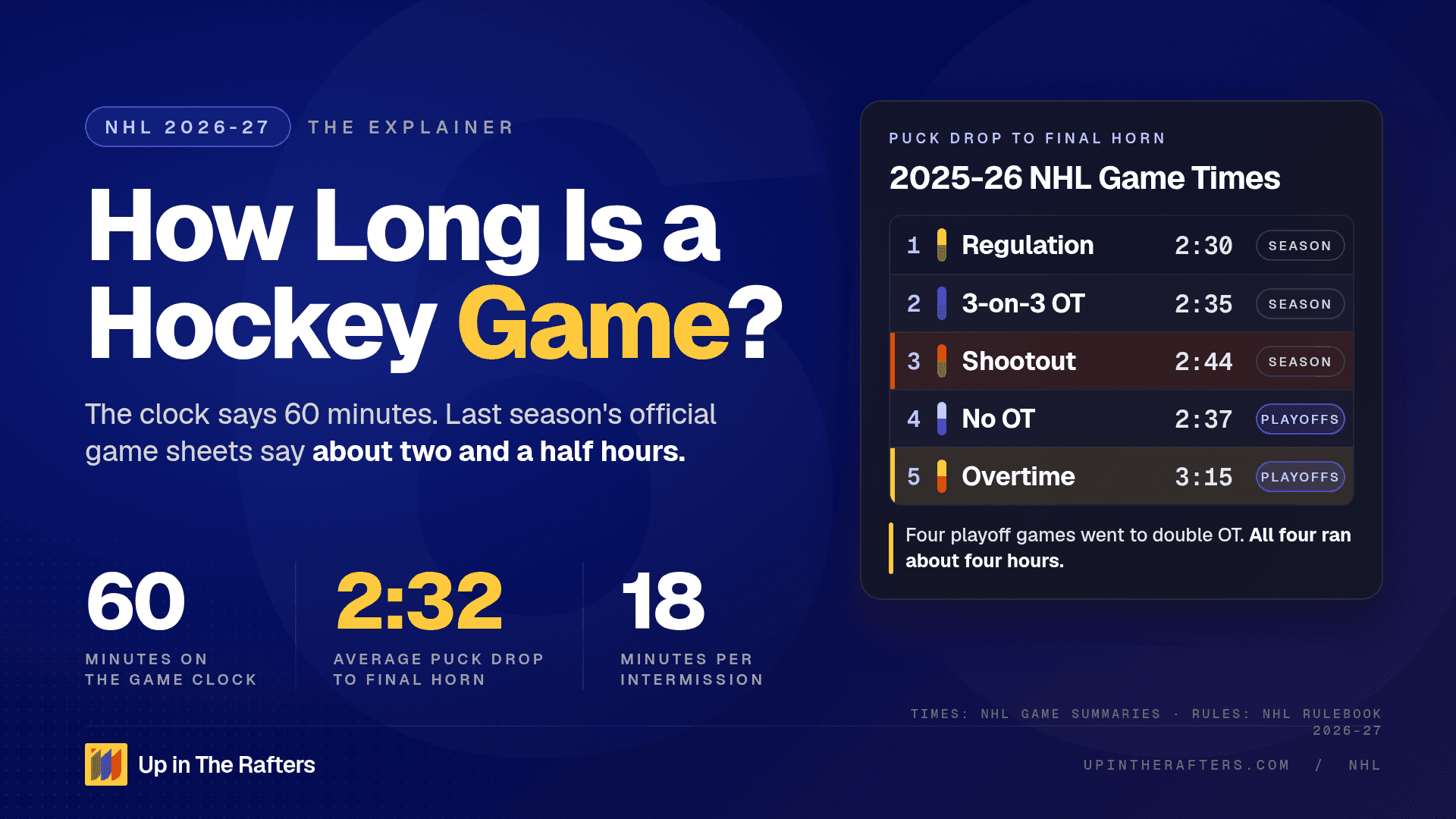
If you want more hockey rules, here's how overtime works in hockey and how long a hockey game lasts. And if you like rules explainers with data, I did the same for the infield fly rule and a safety in football.
Sources: